<?xml version="1.0" encoding="utf-8"?><feed xmlns="http://www.w3.org/2005/Atom" xml:lang="en-US"><generator uri="https://jekyllrb.com/" version="4.4.1">Jekyll</generator><link href="https://parsnipp.com/feed.xml" rel="self" type="application/atom+xml" /><link href="https://parsnipp.com/" rel="alternate" type="text/html" hreflang="en-US" /><updated>2026-09-29T20:13:17+00:00</updated><id>https://parsnipp.com/feed.xml</id><title type="html">Parsnipp</title><subtitle>Connect GEO / AEO, LLM Advertising, &amp; Agentic Commerce to build high-converting programs across ChatGPT, Gemini, Claude, and Perplexity.</subtitle><entry><title type="html">LLMs &amp;amp; Advertising: A Snapshot of Where Each Platform Stands (Q3 2026)</title><link href="https://parsnipp.com/blog/llms-advertising-a-snapshot-of-where-each-platform-stands-q3-2026/" rel="alternate" type="text/html" title="LLMs &amp;amp; Advertising: A Snapshot of Where Each Platform Stands (Q3 2026)" /><published>2026-09-17T17:31:03+00:00</published><updated>2026-09-17T21:16:02+00:00</updated><id>https://parsnipp.com/blog/llms-advertising-a-snapshot-of-where-each-platform-stands-q3-2026</id><content type="html" xml:base="https://parsnipp.com/blog/llms-advertising-a-snapshot-of-where-each-platform-stands-q3-2026/"><![CDATA[<p>Two quarters ago, ChatGPT Ads was a Criteo pilot. Last quarter, it crossed a billion-dollar run rate. This quarter, it went international — and everyone else’s position got a little sharper, too. Here’s where the five platforms we’re tracking stand as of mid-September.</p>

<h2 id="llm-advertising-geo--ai-search-is-still-not-only-about-content--organic-visibility">LLM Advertising: GEO / AI Search Is Still Not Only About Content &amp; Organic Visibility</h2>

<p>The 1.5x conversion gap we flagged back in Q1 hasn’t gone anywhere, and it’s getting harder to ignore: the surface where that traffic converts is now also the surface carrying paid placements, Google’s AI Overviews, and an increasingly crowded set of monetization experiments. The platforms aren’t converging on one model — if anything, Q3 pulled them further apart.</p>

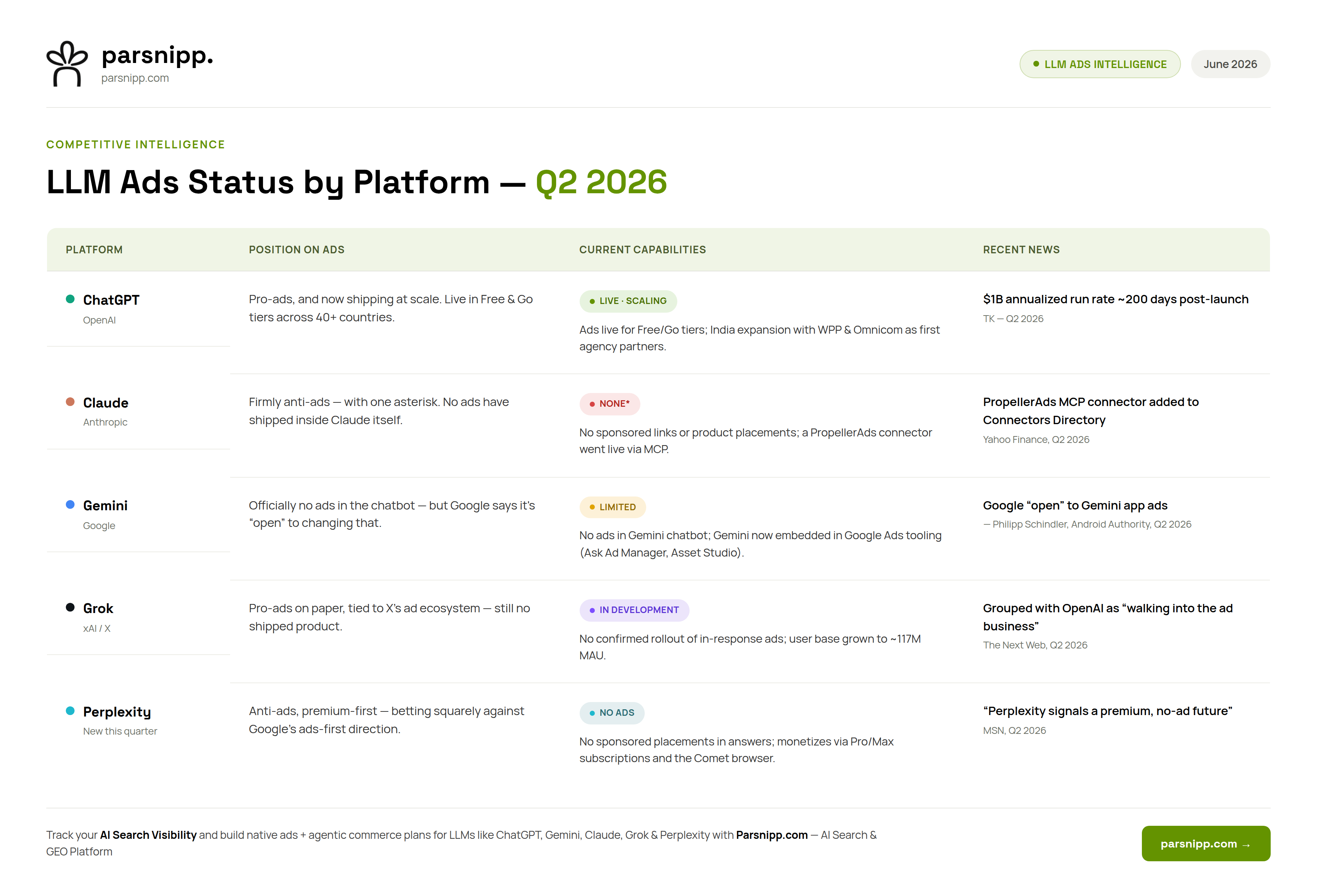
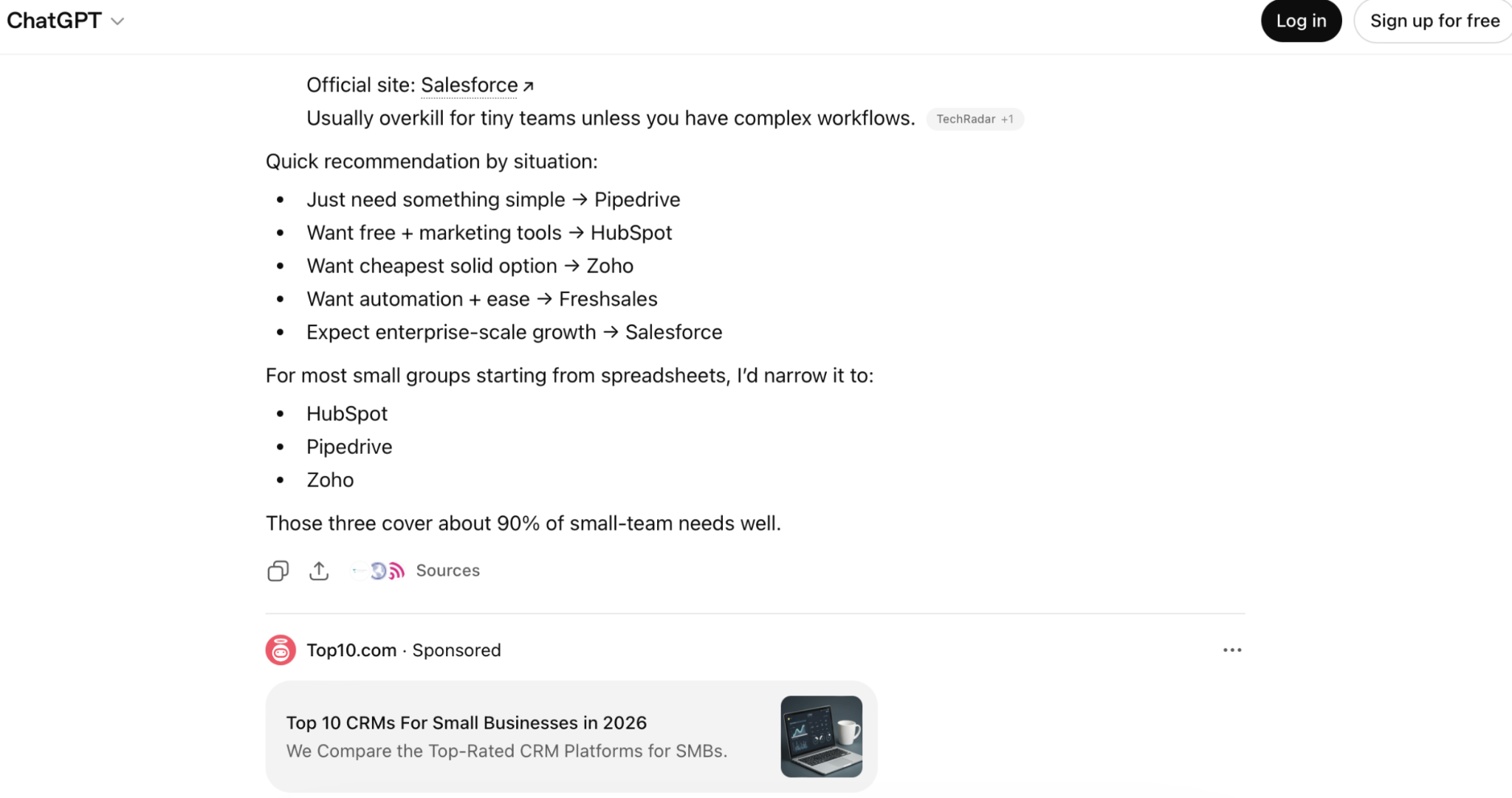
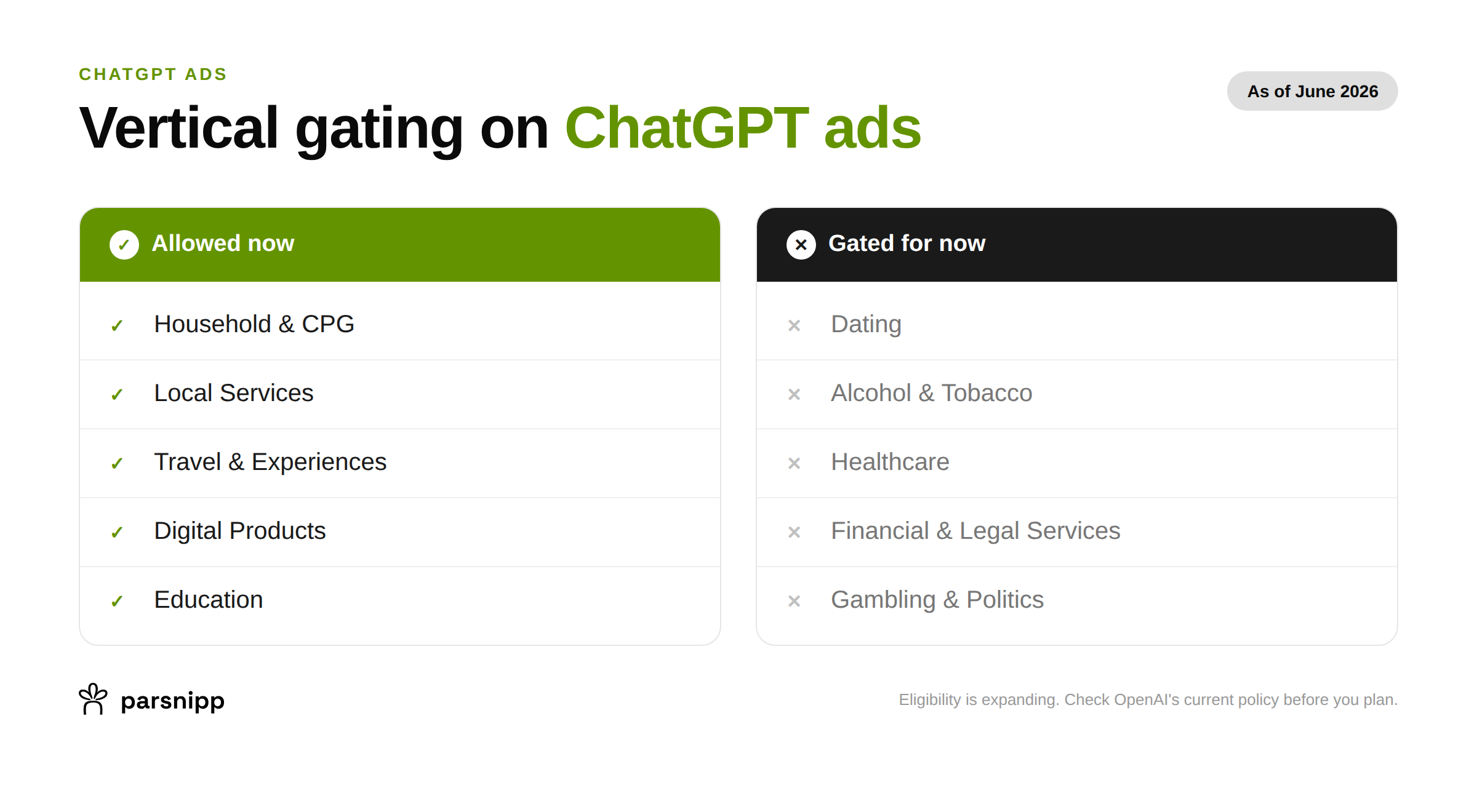
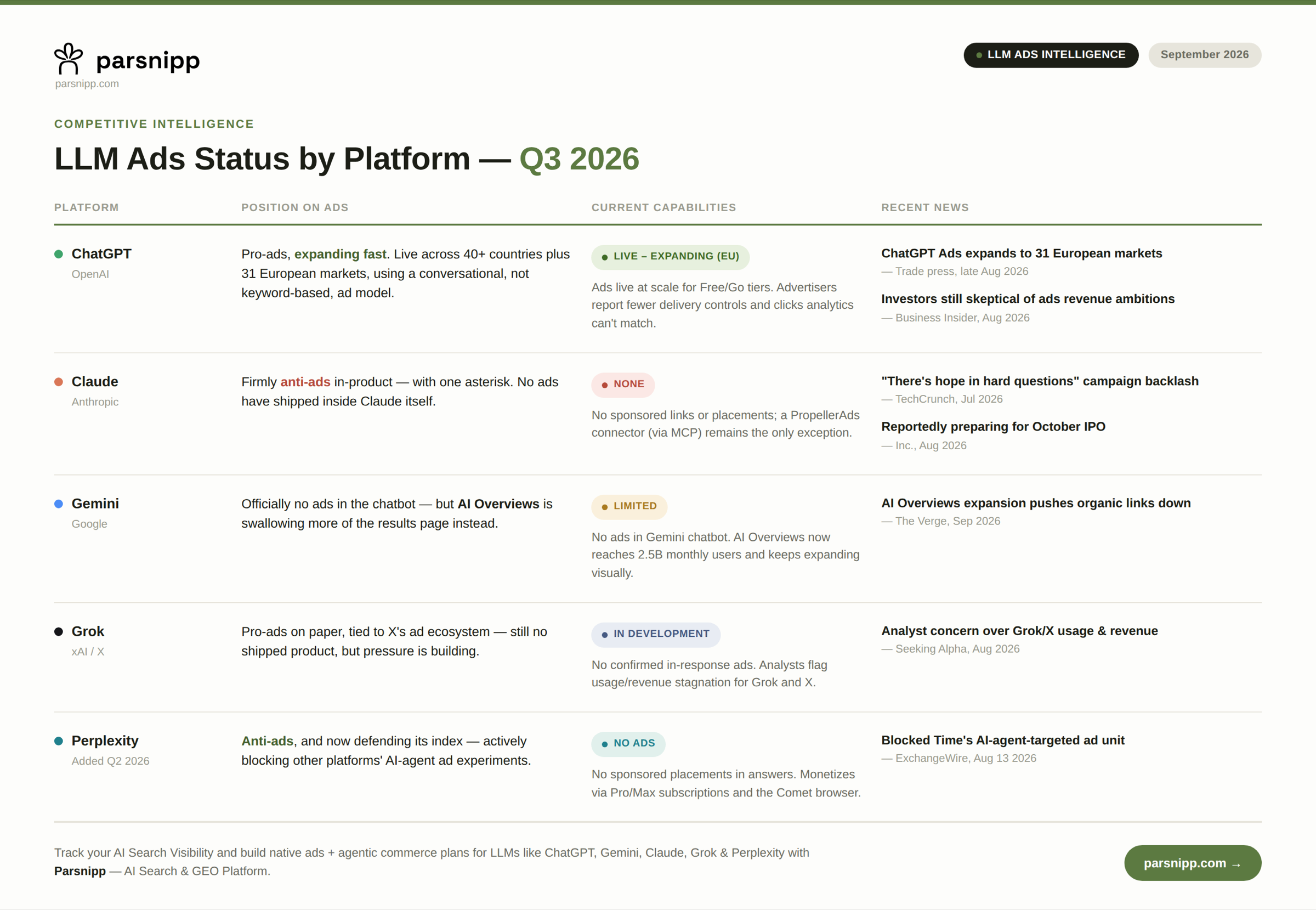
<p><strong>ChatGPT (OpenAI) — pro-ads and scaling into Europe.</strong> After the India expansion and agency partnerships we covered last quarter, OpenAI pushed ChatGPT Ads into 31 European markets in late August. The format is explicitly conversational rather than keyword-based — ads are matched to the context of the conversation, not a search query — and that’s producing real friction: advertisers have reported having fewer delivery controls than they’re used to, and some have flagged clicks “that analytics cannot find,” raising measurement questions. A specialist ecosystem is forming around this fast: agencies are now managing ChatGPT ad campaigns for verticals as specific as roofing and home services. Investors, meanwhile, are reportedly still skeptical that the ad business can hit OpenAI’s revenue ambitions — growth and doubt are showing up in the same headlines.</p>

<p><strong>Claude (Anthropic) — anti-ads in-product, aggressive on brand marketing.</strong> Nothing has shipped inside Claude that resembles a third-party ad unit; the PropellerAds MCP connector we noted last quarter is still a connector, not an ad placement, and remains the only asterisk on Anthropic’s stance. What did happen in Q3: Anthropic ran a self-promotional campaign, “There’s hope in hard questions,” that drew notable backlash in mid-July for imagery press coverage described as “unsettling” and “dark” — a reminder that “anti-ads” describes what appears inside Claude, not how aggressively Anthropic advertises Claude itself. Also worth watching heading into Q4: reports that Anthropic is preparing for an October IPO, working with Morgan Stanley, Goldman Sachs, and JPMorgan. A public listing tends to change how much patience a company has for foregone ad revenue — we’ll be watching whether the no-ads stance survives contact with public markets.</p>

<p><strong>Gemini (Google) — no ads in-app, but AI Overviews is swallowing more of the page.</strong> The Gemini chatbot itself is still ad-free, and Google hasn’t moved past “open to it” on that front since last quarter. But the more important shift for GEO is happening one level up: Sundar Pichai has said AI Overviews now reaches 2.5 billion monthly users, and Google has been visibly expanding how much space AI Overviews takes up on the results page — in some cases automatically, and at the cost of organic links getting pushed further down. Google also kept extending Gemini into ad infrastructure rather than the chat surface: a Gemini-powered “Business Agent” for lead qualification launched for Indian marketers in July. Net effect: Gemini-the-chatbot remains ad-free, but the search results page around it is being reshaped in ways that matter more for organic visibility than any Gemini ad unit would.</p>

<p><strong>Grok (xAI) — still pro-ads on paper, pressure building.</strong> No confirmed ad product has shipped inside Grok responses this quarter either, and we still don’t have specifics from xAI or Elon Musk on how in-chat ads would connect to X’s ad stack. What’s new is the pressure: some analysts have flagged usage and revenue stagnation concerns for Grok and X, the kind of headwind that tends to accelerate monetization roadmaps rather than slow them down. We’d treat Grok as the platform most likely to surprise with a fast ad launch if that pressure keeps building — worth a standing watch item for Q4.</p>

<p><strong>Perplexity — anti-ads, and now actively policing other platforms’ ad experiments.</strong> Perplexity’s own answers remain free of sponsored placements, consistent with the “premium, no-ad future” positioning we noted last quarter. The Q3 development is more pointed: Perplexity moved in mid-August to block an experimental Time ad unit built specifically to target AI agents from influencing its index and answers. That’s a meaningfully different posture than just “we don’t sell ads” — it’s Perplexity actively defending its answers from other companies’ AI-targeted advertising, which should reassure brands that Perplexity visibility still runs through earned, organic GEO rather than any paid workaround.</p>

<p><strong>LLM Ads Status by Platform as of September, 2026</strong></p>

<figure class="wp-block-table"><table class="has-fixed-layout">
<thead><tr>
<th><strong>Platform</strong></th>
<th><strong>Stated Position on Ads</strong></th>
<th><strong>Current Ad Capabilities</strong></th>
<th><strong>Recent News</strong></th>
</tr></thead>
<tbody>
<tr>
<td>ChatGPT(OpenAI)</td>
<td>Pro-ads, expanding fast</td>
<td>Live conversational ads; 40+ countries plus 31 European markets added</td>
<td>Expanded to 31 European markets (OpenAI, Aug 2026)</td>
</tr>
<tr>
<td>Claude(Anthropic)</td>
<td>Anti-ads in-product</td>
<td>No ads in-product; PropellerAds connector still the only exception</td>
<td>"There's hope in hard questions" campaign backlash (TechCrunch, Jul 2026)</td>
</tr>
<tr>
<td>Gemini(Google)</td>
<td>No ads in-app; AI Overviews expanding</td>
<td>
<br />No ads in Gemini chatbot; AI Overviews now reaches 2.5B monthly users</td>
<td>
<br />AI Overviews visual expansion pushes organic links down (The Verge, Sep 2026)</td>
</tr>
<tr>
<td>Grok(xAI)</td>
<td>
<br />Pro-ads, tied to X</td>
<td>No shipped in-response ads; usage/revenue pressure reported</td>
<td>Analyst concerns over Grok/X usage and revenue (Seeking Alpha, Jul 2026)</td>
</tr>
<tr>
<td>Perplexity</td>
<td>
<br />Anti-ads, defending its index</td>
<td>No sponsored placements; blocks third-party AI-agent ad experiments</td>
<td>Blocked Time's AI-agent-targeted ad unit (DigiDay, Aug 2026)</td>
</tr>
</tbody>
</table></figure>

<p>[<a href="/wp-content/uploads/2026/09/parsnipp-llm-ads-status-q3-2026.png">Shareable version of infographic</a>]</p>

<h2 id="what-this-means-for-brands">What This Means for Brands</h2>

<p>The gap between the pro-ads and anti-ads camps widened this quarter instead of narrowing, and that has a direct planning implication: a single “LLM advertising strategy” no longer covers all five platforms, and treating it as one will waste budget. For ChatGPT, the opportunity window is now — international expansion means more inventory and, for now, less competition for it, but the measurement gaps advertisers are reporting mean you need clean attribution in place before you scale spend, not after. For Gemini, the real fight isn’t for an ad slot inside the chatbot that doesn’t exist yet — it’s for visibility inside AI Overviews, which is quietly becoming the highest-stakes GEO surface on the web. For Claude and Perplexity, paid placement isn’t on the table, so the entire game is still organic: content structured to be cited, not clicked. And Grok remains the wildcard worth a standing watch, since the pressure building on xAI’s business could turn “in development” into “shipped” faster than the others.</p>

<p>That’s the split Parsnipp’s LLM Ads product is built around, and it’s live now — <a href="https://app.parsnipp.com/users/sign_up">try it free</a> to see how we use your organic AI-search visibility data to prioritize paid placement where it exists, while keeping your GEO strategy sharp everywhere else.</p>

<p><strong>Sources</strong></p>

<ul>
  <li>ChatGPT Ads expansion to 31 European markets, Aug 2026 — via <a href="https://openai.com/index/chatgpt-ads-expands-across-europe/">Open AI</a></li>
  <li>ChatGPT ads described as conversational-context-based, advertiser complaints about controls/measurement, July 2026 — <a href="https://www.marketingtechnews.net/news/chatgpt-ads-conversational-advertising/">Marketing Tech News</a></li>
  <li>Vertical ChatGPT-ad agencies (roofing, home services), July 2026 — <a href="https://www.miamiherald.com/news/business/article316612196.html">Miami Herald</a></li>
  <li>OpenAI investor skepticism on ads revenue ambitions, July 2026 — <a href="https://www.businessinsider.com/openai-projects-chatgpt-ad-growth-market-doubts-2026-7">Business Insider</a></li>
  <li>“There’s hope in hard questions” backlash, July 2026 — <a href="https://techcrunch.com/2026/07/14/anthropics-newest-ad-is-creeping-people-out/">TechCrunch</a></li>
  <li>Anthropic October IPO prep (Morgan Stanley, Goldman Sachs, JPMorgan), June 2026 — <a href="https://www.tradingkey.com/analysis/stocks/us-stocks/261946177-anthropic-ipo-goldman-morgan-stanley-965b-valuation-profitability-spacex-compute-lease-musk-risk-ai-ipo-wave-tradingkey">Trading Key</a></li>
  <li>AI Overviews reaches 2.5B monthly users; $82B ad revenue, $205B AI infra spend, June 2026 — <a href="https://blog.google/company-news/inside-google/message-ceo/alphabet-earnings-q2-2026/">Google</a> </li>
  <li>AI Overviews taking up more visual space, pushing organic links down, August 2026 — <a href="https://www.theverge.com/tech/986364/google-search-ai-overviews-auto-expand">The Verge</a></li>
  <li>Gemini-powered Business Agent for Indian marketers, July 2026 — <a href="https://blog.google/intl/en-in/products/google-companies/google-marketing-live-2026-delivering-the-gemini-advantage-for-indian-businesses/">Google</a></li>
  <li>Grok/X usage and revenue stagnation concerns, July 2026 — <a href="https://seekingalpha.com/news/4612074-spacexais-grok-continues-to-lose-market-share-meta-ai-climbs-to-fourth-in-us-analysis">Seeking Alpha</a></li>
  <li>Perplexity blocks Time’s AI-agent-targeted ad unit, August 2026 — <a href="https://digiday.com/media/perplexity-blocks-times-ads-served-to-ai-agents-calling-them-deceptive/">DigiDay</a></li>
</ul>

<h2 id="try-parsnipp-for-free">Try Parsnipp for Free</h2>

<p>Parsnipp evaluates your digital presence, measures AI Search effectiveness, and provides a strategic roadmap to guide you towards improvement.</p>

<p><a href="https://app.parsnipp.com/users/sign_up" class="btn primary" target="_self">
        <span>Try It Free</span>
    </a></p>]]></content><author><name>Molly Pannell</name></author><category term="announcements" /><summary type="html"><![CDATA[Two quarters ago, ChatGPT Ads was a Criteo pilot. Last quarter, it crossed a billion-dollar run rate. This quarter, it went international — and everyone else's position got a little sharper, too. Here's where the five platforms we're tracking stand as of mid-September.]]></summary><media:thumbnail xmlns:media="http://search.yahoo.com/mrss/" url="https://parsnipp.com/%7B%22src%22%20=%3E%20%22/wp-content/uploads/2026/09/parsnipp-llm-ads-status-q3-2026.png%22,%20%22alt%22%20=%3E%20%22LLM%20ads%20status%20by%20platform,%20Q3%202026.%20ChatGPT%20(OpenAI):%20pro-ads,%20live%20and%20expanding%20across%2040+%20countries%20plus%2031%20European%20markets.%20Claude%20(Anthropic):%20anti-ads%20in-product,%20none%20shipped.%20Gemini%20(Google):%20no%20ads%20in%20the%20chatbot,%20but%20AI%20Overviews%20is%20expanding%20across%20the%20results%20page.%20Grok%20(xAI):%20pro-ads%20on%20paper,%20in%20development,%20nothing%20shipped.%20Perplexity:%20no%20ads,%20and%20actively%20blocking%20AI-agent%20ad%20experiments%20run%20by%20other%20platforms.%22,%20%22width%22%20=%3E%202400,%20%22height%22%20=%3E%201659%7D" /><media:content medium="image" url="https://parsnipp.com/%7B%22src%22%20=%3E%20%22/wp-content/uploads/2026/09/parsnipp-llm-ads-status-q3-2026.png%22,%20%22alt%22%20=%3E%20%22LLM%20ads%20status%20by%20platform,%20Q3%202026.%20ChatGPT%20(OpenAI):%20pro-ads,%20live%20and%20expanding%20across%2040+%20countries%20plus%2031%20European%20markets.%20Claude%20(Anthropic):%20anti-ads%20in-product,%20none%20shipped.%20Gemini%20(Google):%20no%20ads%20in%20the%20chatbot,%20but%20AI%20Overviews%20is%20expanding%20across%20the%20results%20page.%20Grok%20(xAI):%20pro-ads%20on%20paper,%20in%20development,%20nothing%20shipped.%20Perplexity:%20no%20ads,%20and%20actively%20blocking%20AI-agent%20ad%20experiments%20run%20by%20other%20platforms.%22,%20%22width%22%20=%3E%202400,%20%22height%22%20=%3E%201659%7D" xmlns:media="http://search.yahoo.com/mrss/" /></entry><entry><title type="html">How to Build a Prompt Tracking Library for eCommerce</title><link href="https://parsnipp.com/blog/how-to-build-a-prompt-tracking-library-for-ecommerce/" rel="alternate" type="text/html" title="How to Build a Prompt Tracking Library for eCommerce" /><published>2026-09-01T11:53:06+00:00</published><updated>2026-09-01T11:53:11+00:00</updated><id>https://parsnipp.com/blog/how-to-build-a-prompt-tracking-library-for-ecommerce</id><content type="html" xml:base="https://parsnipp.com/blog/how-to-build-a-prompt-tracking-library-for-ecommerce/"><![CDATA[<p>The customer journey has shifted from the open web (where tracking was straightforward with tools like Google Analytics) into LLM black boxes where direct observation is nearly impossible. Tools like Parsnipp help you curate a list of prompts for brands to map your brand’s presence in generative AI answers. Treating prompt tracking like an exhaustive SEO rank tracking project is the number one mistake SEO, PPC and GEO experts make.  Your insights are only as good as the prompts you provide and select.</p>

<h2 id="letting-go-of-rank-tracking-focusing-on-the-prompt-library">Letting go of rank tracking, focusing on the prompt library</h2>

<p>Keywords are queries you rank for in traditional search results but prompts are a starting point to a conversation your brand should be showing up in. The problem is that one prompt fans out: LLMs will break down a user’s query into many different questions to provide an answer. </p>

<p><img src="/wp-content/uploads/2026/09/image.png" alt="" /></p>

<p>Source: <a href="https://searchengineland.com/guide/ai-prompt-tracking-how-to-monitor-llm-queries-better">Prompt tracking: Monitor LLM queries effectively &amp; meaningfully</a></p>

<p>Prompt tracking helps go from a black box to a managed and documented data source, making it possible to drive business outcomes, safeguard brand integrity and scale efforts.You do not need to track every possible prompt variation. Treat your prompt library for what it is: </p>

<p><em>An AI visibility prompt library is a structured set of realistic buyer questions used to test whether ChatGPT, Perplexity, Gemini, and Google AI Overviews find, recommend, and accurately describe your products.</em> </p>

<p>A prompt library is a tool for eCommerce marketing teams who need data. It shows whether AI sends buyers to specific brands with products that are in stock, at the right price, in the right country. It helps marketers practitioners ensure that the brand is cited, that no hallucinations or brand drift occurs and that no dupes or competitors are being shown before you. </p>

<h2 id="why-ecommerce-breaks-generic-prompt-tracking">Why eCommerce breaks generic prompt tracking</h2>

<p>An eCommerce catalog can change almost daily but a brand does not. While brand-level tracking seeks to answer “does AI know our brand,” eCommerce teams also need “does AI recommend this SKU, from this seller, at this price, to this shopper.”</p>

<p>So when you start researching your prompts, you should have a mix of these elements in your library: </p>

<ul>
  <li><strong>SKU vs product line</strong>: track variants separately, price and availability differ by size, color, or bundle. An LLM can recommend the wrong variant even when it gets the product right.</li>
  <li><strong>Merchant</strong>: is AI sending buyers to you or to a reseller or to a dupe of your product?</li>
  <li><strong>Availability and price</strong>: prompts that expose stale catalog data, “is X in stock” and “how much does X cost” catch feed drift fastest.</li>
  <li><strong>Category rollup</strong>: large catalogs are unreadable per-SKU, roll performance up by category so you can act on patterns. </li>
  <li><strong>In-store experience</strong>: for omnichannel brands, “can I pick up X today” or “is X available near me” tests whether AI knows about local stock and BOPIS (Buy Online, Pick Up In-Store). </li>
  <li><strong>Coupons and promotions</strong>: “is there a discount code for X” tests whether AI surfaces your actual current offer or an expired one from a coupon site. </li>
  <li><strong>Instructional prompts</strong> (“how to use X,” “how to fix X”) are also valuable depending on the brand and products. </li>
</ul>

<h3 id="how-many-prompts-should-you-be-tracking-for-ecommerce">How many prompts should you be tracking for eCommerce?</h3>

<p>On average, you should aim for a baseline of 30 to 50 prompts per model and per market. <strong>Start with your top 20 products plus core category terms, then expand.</strong> Most teams don’t have resources to track everything, it’s a question of time, budget, brain power.</p>

<p>In <a href="https://www.aleydasolis.com/en/ai-search/ai-search-prompt-library/">How to Build a Representative AI Search Prompt Library</a>, Aleyda Solis says to start with 30 to 50 commercially relevant prompts. You can scale that number depending on how complex your business is (for example single product in single market vs multi-category sold worldwide). </p>

<p>When interviewed, Freddie Chatt, eCommerce SEO consultant and creator of the <a href="https://summerofseo.co/">Summer of SEO</a>, a free eCommerce conference and course, shared this framework:</p>

<p>Divide prompts into <strong>four categories by who owns and acts on them</strong>, not by funnel stage alone.</p>

<ol>
  <li><strong>Product-level</strong>: “how to use X,” “does X work for Y,” “X vs competitor” → owned by SEO/Content, informed by Product. Track at SKU or product-line level, top sellers first.</li>
  <li><strong>Category-level</strong>: “best X for Y,” “top X under $N” → owned by SEO/Merchandising. Where most eCommerce brands win or lose in AI search.</li>
  <li><strong>Brand trust</strong>: “is X legit,” “X reviews” → owned by Brand/PR, monitored by SEO. Critical for catching negative Reddit threads before they compound and have a tangible negative impact.</li>
  <li><strong>Purchase-intent</strong>: “where to buy X,” “X discount code,” “X in stock” → owned by Trading/Commercial, tracked by SEO.</li>
</ol>

<p>This framework works because it beats funnel-stage focused grouping: it tells you who fixes what. SEO owns the tracking infrastructure and reporting but the insights must flow to stakeholders that are responsible for improving brand outcomes. Please note: we are showing you an ideal-scenario; most teams need a tailored version of this framework. </p>

<h2 id="personas-impact-prompts">Personas impact prompts</h2>

<p>Personas shape both the structure of prompts and success of brand visibility mapping. Tailoring your prompts to reflect specific persona contexts forces LLMs to refine their query fan out process to consider unique constraints, expectations and intent types. </p>

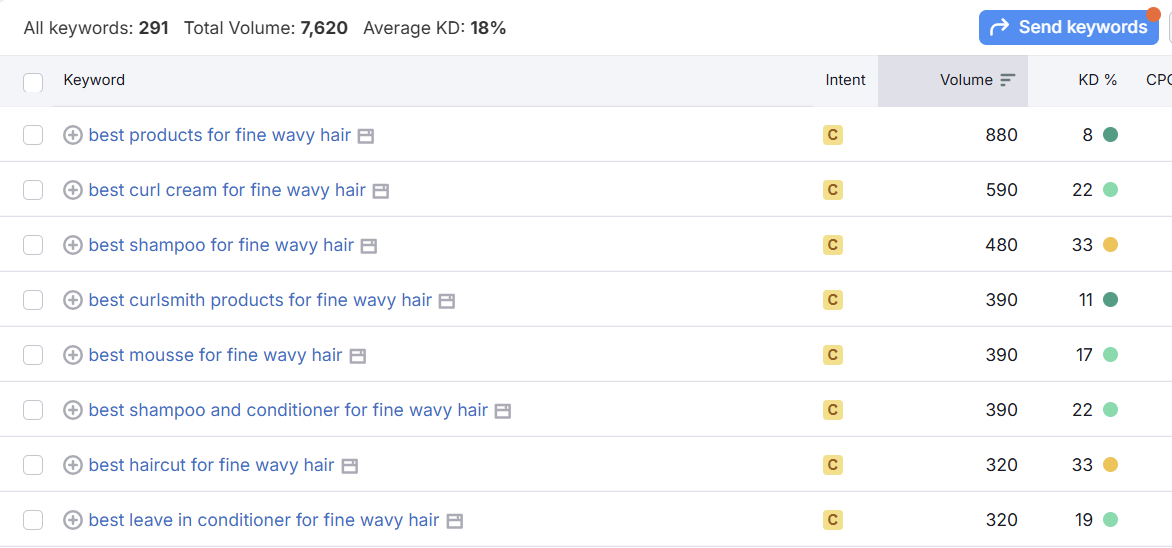
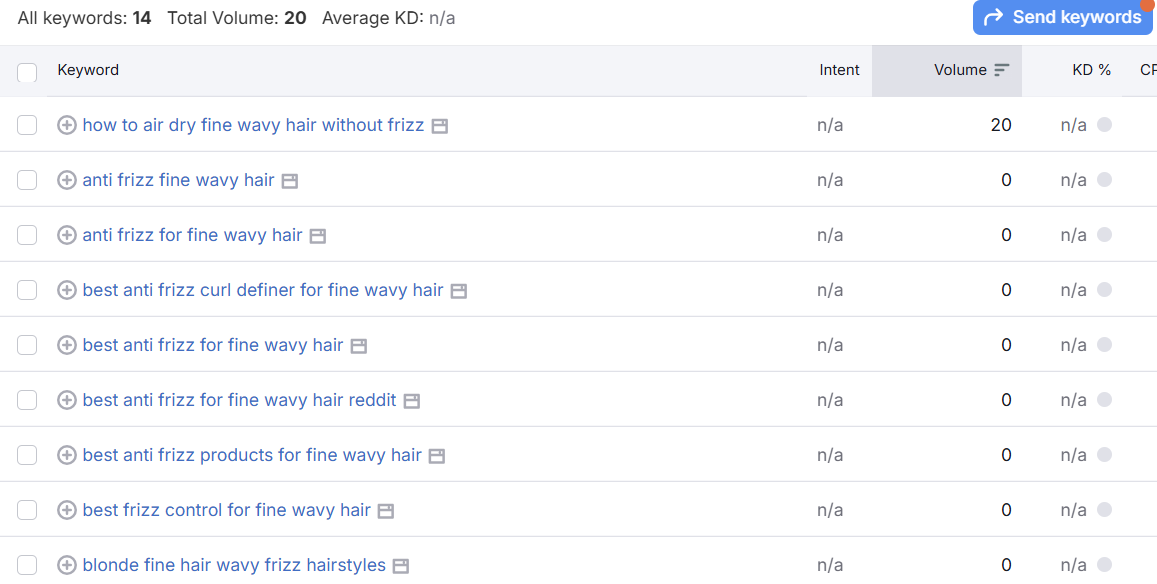
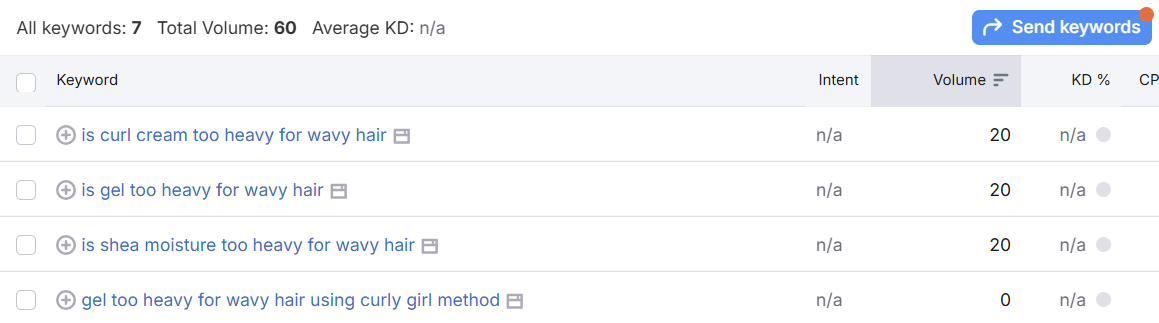
<p>For example, someone with fine wavy hair might search “Is L’Oréal Glycolic Gloss suitable for fine wavy hair, and How do I use L’Oréal Glycolic Gloss at home to make my hair shinier and less frizzy?” </p>

<p>You can quickly mine information about personas with sources SEOs already own: Google Search Console long-tail, internal site search, support tickets, site webchats, reviews, Reddit, PAA, <a href="https://alsoasked.com">alsoasked.com</a> and many others. Here is a concrete example for the fine wavy hair customer:</p>

<p><img src="/wp-content/uploads/2026/09/image-4.png" alt="" /></p>

<p><img src="/wp-content/uploads/2026/09/image-2.png" alt="" /></p>

<p><img src="/wp-content/uploads/2026/09/image-3.png" alt="" /></p>

<h3 id="example-question-templates">Example Question Templates</h3>

<p><img src="/wp-content/uploads/2026/09/image-1.png" alt="" /></p>

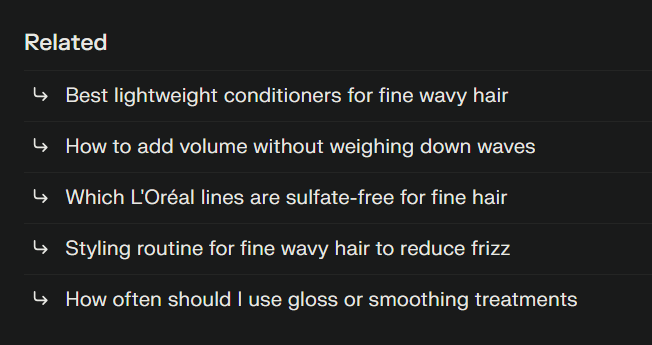
<p>Based on the prompts and questions considered for a L’Oréal product, we can establish question templates : </p>

<ul>
  <li>What are the best [product type] for fine wavy hair to [desired effect]?</li>
  <li>How do I [achieve goal] without [common problem for fine wavy hair]?</li>
  <li>Which [brand/line] products are suitable for fine wavy hair and [ingredient requirement]?</li>
  <li>What is an effective routine for fine wavy hair to [goal, e.g., “reduce frizz” or “boost volume”]?</li>
  <li>How often should [treatment/product] be used on fine wavy hair to avoid [negative outcome]?</li>
</ul>

<p>Effective prompt tracking overlays persona data to help you analyze how different customer segments discover, evaluate and act on your products along their customer journey. </p>

<h2 id="follow-the-conversation-with-multi-turn-prompt-tracking">Follow the conversation with multi-turn prompt tracking</h2>

<p>Customers’ buying journeys are not linear, this is why <a href="https://business.google.com/en-all/think/consumer-insights/messy-middle-2023/">Google refers to the messy middle</a>: the complex, circular space between when people first learn about a product and when they finally buy it. Shoppers normally bounce back and forth between exploring choices and evaluating options. A single prompt test only measures the beginning of that journey within LLMs. AI search presents a volatility problem that makes that gap worse than it looks: <a href="https://home.norg.ai/ai-search-answer-engines/answer-engine-architecture-citation-mechanics/measuring-ai-answer-engine-visibility-metrics-tracking-tools-and-citation-monitori/">independent research found citation drift by platform ranges from roughly 40% for Perplexity to about 60% for Google AI Overview across repeated runs of the same prompt.</a> This gets compounded as the conversation proceeds. </p>

<p>Add a real conversation sequence on top of that baseline drift, and the instability compounds turn by turn instead of resetting each time, the way a single SERP check would. <a href="https://searchengineland.com/how-generative-ai-is-quietly-distorting-your-brand-message-461094">Research supports this: once errors emerge, they tend to amplify across a conversation, producing a “growing deterioration in relevance, coherence, or truthfulness” (Voita et al., 2024</a>). </p>

<p>AI visibility is not static within one conversation: your brand is not guaranteed to remain part of the conversation. You can opt to design your prompt library to include 3 to 6 turn sequences per intent cluster but manual testing doesn’t scale very well. Tools built specifically around this exist now. Parsnipp, for one, runs tracking on persona-based agents through multi-turn conversations rather than isolated prompts to test the buying journey. If your prompt library only tests opening prompts, you are using a first impression as a proxy for visibility. </p>

<h2 id="going-forward">Going forward</h2>

<p>Building an eCommerce prompt library is half the battle. You need tooling that supports your testing efforts. Tools like Parsnipp run persona-based agents through realistic conversation sequences. By modeling the conversation instead of the prompt, Parsnipp gives eCommerce teams visibility data that reflects where a brand actually wins or loses, at the specific, high-intent turn. This means better lab data that maps what’s possible. You can calibrate it against whatever observational signal you can access (GA4, sales reports, customer feedback), so your prompt library becomes the hypothesis your real-world data either confirms or corrects. </p>]]></content><author><name>Myriam Jessier</name></author><category term="ai-search-geo" /><category term="chatgpt-ads" /><category term="ai-search" /><category term="ai-visibility" /><category term="chatgpt" /><category term="geo" /><category term="llm-ads" /><category term="parsnipp" /><summary type="html"><![CDATA[The customer journey has shifted from the open web (where tracking was straightforward with tools like Google Analytics) into LLM black boxes where direct observation is nearly impossible. Tools like Parsnipp help you curate a list of prompts for brands to map your brand’s presence in generative AI answers.]]></summary><media:thumbnail xmlns:media="http://search.yahoo.com/mrss/" url="https://parsnipp.com/%7B%22src%22%20=%3E%20%22/wp-content/uploads/2026/09/parsnipp-prompt-tracking-library-feature.png%22,%20%22alt%22%20=%3E%20%22%22,%20%22width%22%20=%3E%204200,%20%22height%22%20=%3E%202400%7D" /><media:content medium="image" url="https://parsnipp.com/%7B%22src%22%20=%3E%20%22/wp-content/uploads/2026/09/parsnipp-prompt-tracking-library-feature.png%22,%20%22alt%22%20=%3E%20%22%22,%20%22width%22%20=%3E%204200,%20%22height%22%20=%3E%202400%7D" xmlns:media="http://search.yahoo.com/mrss/" /></entry><entry><title type="html">How to launch higher converting ChatGPT ads with Parsnipp</title><link href="https://parsnipp.com/blog/how-to-launch-higher-converting-chatgpt-ads-with-parsnipp/" rel="alternate" type="text/html" title="How to launch higher converting ChatGPT ads with Parsnipp" /><published>2026-08-24T19:12:30+00:00</published><updated>2026-08-24T19:12:34+00:00</updated><id>https://parsnipp.com/blog/how-to-launch-higher-converting-chatgpt-ads-with-parsnipp</id><content type="html" xml:base="https://parsnipp.com/blog/how-to-launch-higher-converting-chatgpt-ads-with-parsnipp/"><![CDATA[<p>Some brands are using a tool for GEO / AEO (organic AI Search), and even fewer are starting to test paid LLM ads (mainly ChatGPT ads today). Almost zero are managing organic &amp; paid AI Search in one integrated platform. This is a missed opportunity. </p>

<p>With Parsnnipp you can buy and manage ChatGPT ads alongside organic GEO / SEO. We use the data from each to inform better AI Search marketing. </p>

<p>In the world of paid AI Search, this means we are able to use AI Visibility data to launch higher performing ChatGPT ads. We close the loop between organic efforts on the surface and integrate paid strategies alongside GEO – so the data from each can help inform a smarter, cohesive AI Search Marketing program. </p>

<p>TL;DR — You can now run your ChatGPT ad campaigns without ever leaving Parsnipp. Connect your OpenAI Ads account once, and every campaign you build is informed by the same GEO / AEO data already showing you where you’re winning and losing in AI Search — so you’re never writing context hints blind. Early results are strong: campaigns we’ve managed through Parsnipp are already outperforming the same accounts run natively in OpenAI’s own Ads Manager. Here’s exactly how to connect and launch.</p>

<p><strong>BEFORE YOU START</strong></p>

<p>You’ll need an approved OpenAI Ads Manager account with billing already set up — a payment method OpenAI can charge directly. Parsnipp manages and reports on your campaigns, but OpenAI bills your card, not Parsnipp. If you haven’t set that up yet, <a href="/blog/setting-up-chatgpt-ads-in-5-steps/">start here</a>.</p>

<p><strong>STEP 01</strong></p>

<p><em>Get access to Parsnipp Smart LLM Ads</em></p>

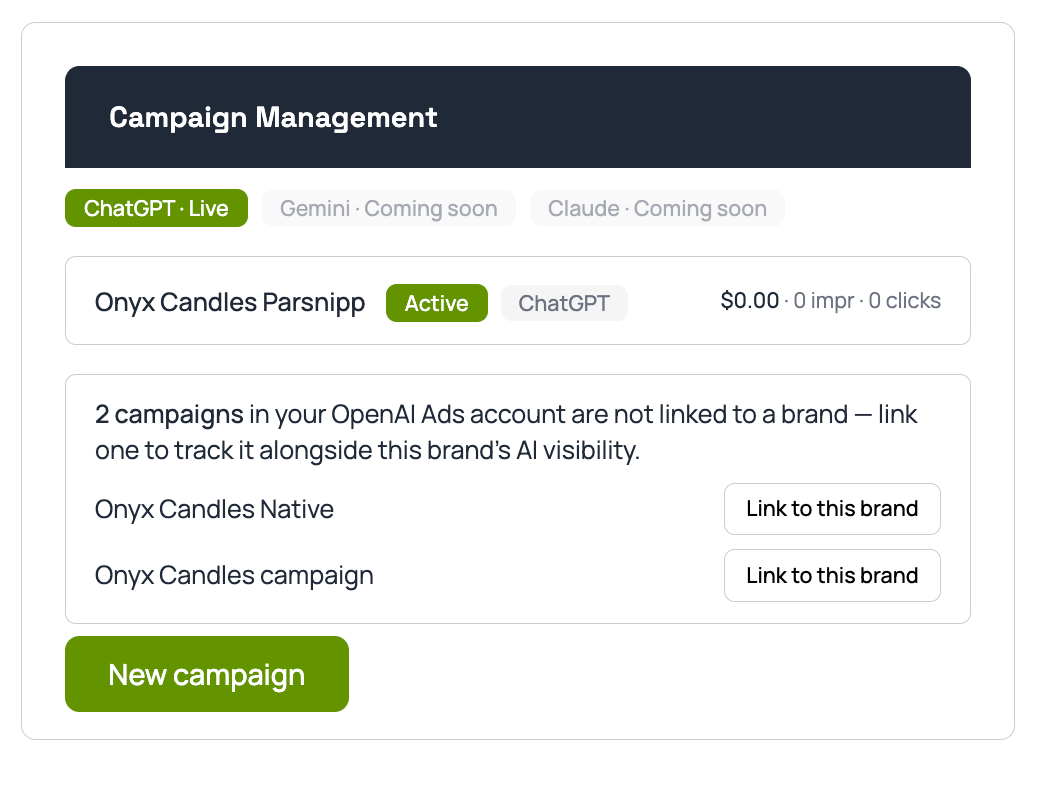
<p>Log in to Parsnipp and click <strong>Ads</strong> in the left-hand nav. You’ll land on <strong>OpenAI Ads</strong>, which shows your AI Search Coverage — your visibility across engines, your ChatGPT-specific score, and your <strong>ad opportunity gap</strong>: the percentage of relevant conversations where you’re not showing up organically, and where a paid placement will do the most work.</p>

<p><img src="/wp-content/uploads/2026/08/image-1.png" alt="" /></p>

<p><strong>STEP 02</strong></p>

<p><em>Connect your OpenAI Ads account</em></p>

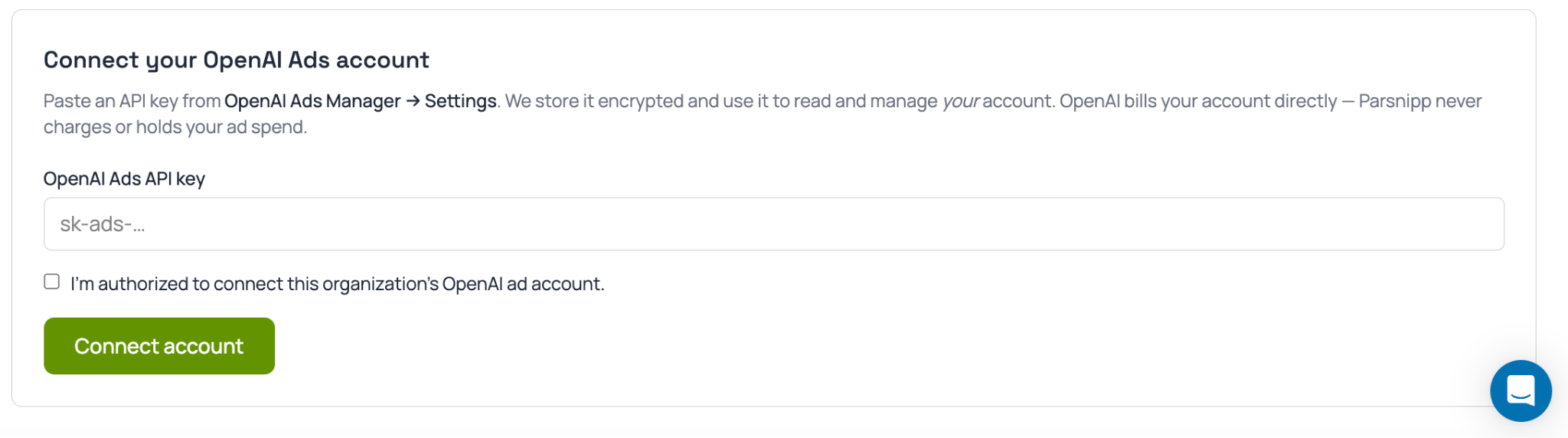
<p>Click <strong>Connect account</strong> under Campaign Management. You’ll need your <strong>OpenAI Ads API key</strong>, which you generate inside OpenAI Ads Manager at <strong>ads.openai.com → Settings →  General → Create new API key → Copy API key</strong>. Paste it into Parsnipp, confirm you’re authorized to connect the organization’s account, and click <strong>Connect account.</strong></p>

<p>Parsnipp stores the key encrypted and uses it to read and manage your OpenAI account on your behalf. It never touches or holds your ad spend — that stays entirely between you and OpenAI.</p>

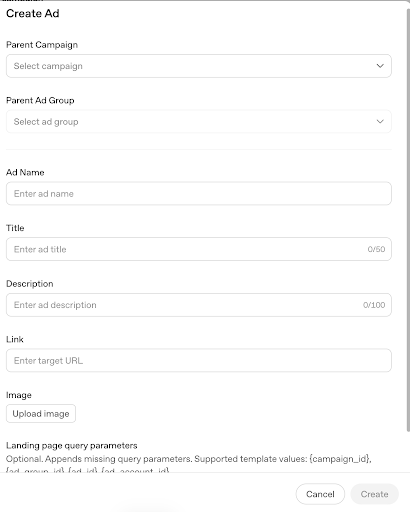
<p><img src="/wp-content/uploads/2026/08/image-4.png" alt="" /></p>

<p><strong>STEP 03</strong></p>

<p><em>Build your campaign</em></p>

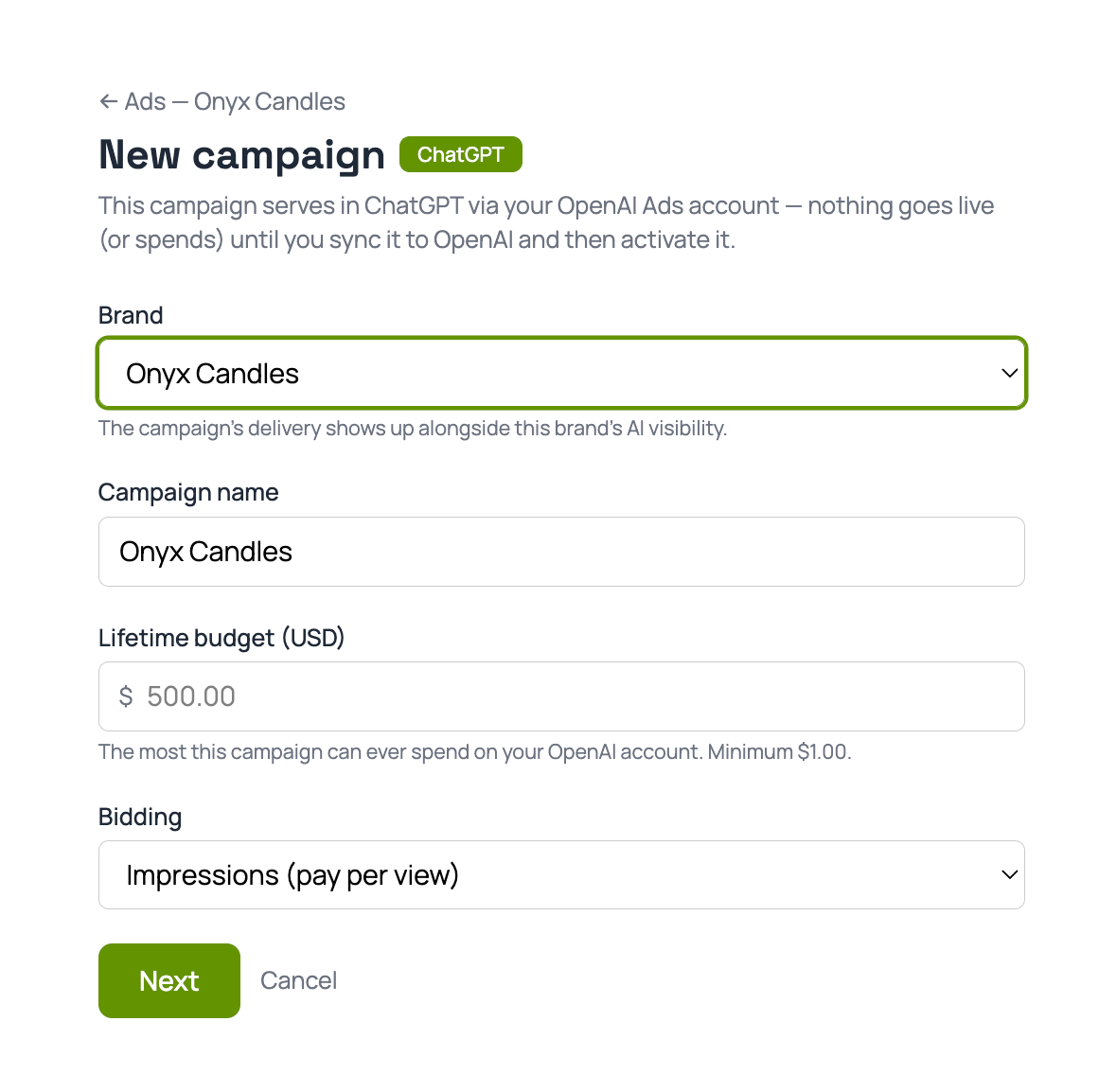
<p>From here, campaign setup follows the same structure as OpenAI’s native Ads Manager: name your campaign, choose an objective (Clicks/CPC for direct response, Reach/CPM for visibility), set your budget*, dates, and target country. The difference is that Parsnipp has already surfaced your gap data, so you’re building against a known opportunity instead of a blank page. </p>

<p>*Important to remember: Lifetime budget can be spent within any time frame, and ChatGPT does not have built-in pacing.</p>

<p><img src="/wp-content/uploads/2026/08/image-5.png" alt="" /></p>

<p><strong>STEP 04</strong></p>

<p><em>Build ads based on AI visibility gaps </em></p>

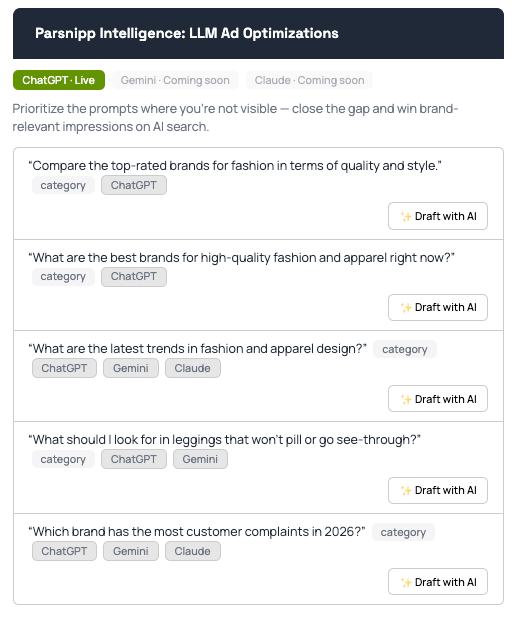
<p>Same principle as setting this up natively: one ad group per buyer situation, written as plain-language context hints rather than keywords. The upgrade here is that Parsnipp can build the ads themselves where you have the biggest visibility gap, so your ads are aimed at conversations you’re not already winning organically — not ones you’re already showing up for free.</p>

<p><img src="/wp-content/uploads/2026/08/image-2.png" alt="" /></p>

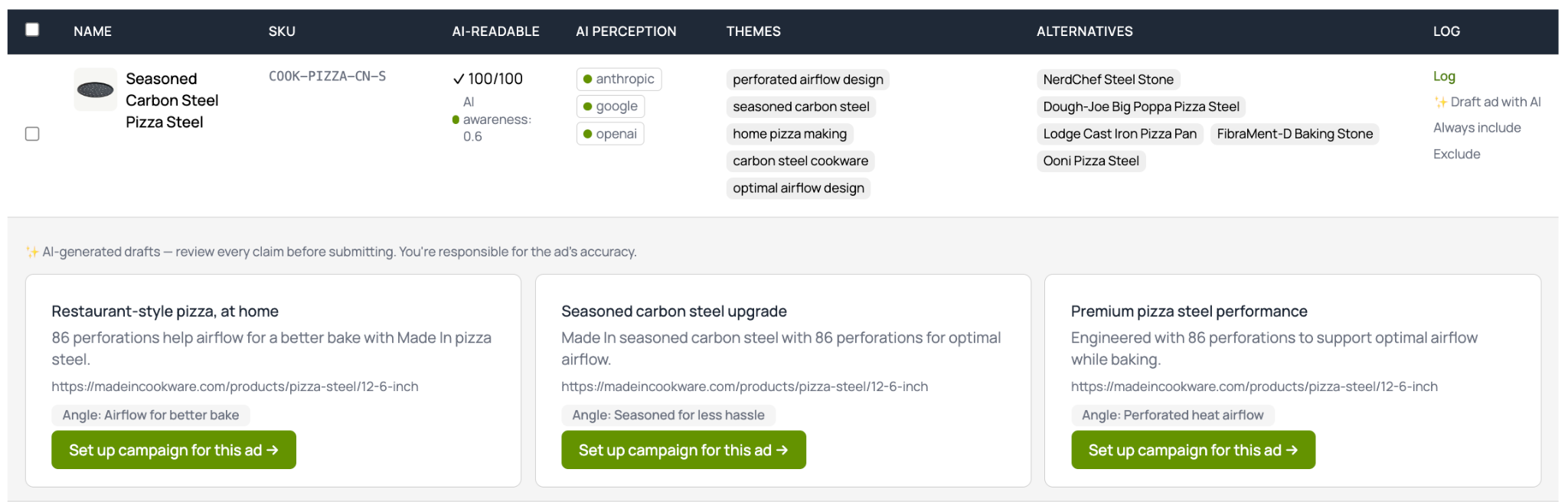
<p><strong>PRO TIP:</strong> You can also promote individual products in ads on ChatGPT through Parsnipp if you have your agentic commerce setup in the platform. </p>

<p><img src="/wp-content/uploads/2026/08/image-6.png" alt="" /></p>

<p><strong>STEP 05</strong></p>

<p><em>Launch, monitor, and optimize alongside GEO</em></p>

<p>Once your ad is live, performance reporting lives in the same Ads tab as your organic visibility data — no toggling between OpenAI’s dashboard and your GEO reporting to understand the full picture of how you’re showing up in ChatGPT.</p>

<p><img src="/wp-content/uploads/2026/08/image-3.png" alt="" /></p>

<p><strong>Why this is outperforming the native Ads Manager</strong></p>

<p>We’re still early, but the signal so far is strong. Our working theory is simple — context hints written against real, current organic visibility data beat context hints written from a marketer’s best guess. When you can see exactly where your brand isn’t showing up, you stop paying to reinforce conversations you were already winning and start paying for the ones you weren’t.</p>

<p><strong>THE PLAYBOOK IN ONE LINE</strong></p>

<p>Connect once, and every campaign after that is built on top of the gaps you can already see.</p>

<p><strong>FAQ</strong></p>

<p><strong>Does Parsnipp charge my card for ChatGPT ad spend?</strong> No. OpenAI bills your connected payment method directly through Ads Manager. Parsnipp never touches or holds your ad spend.</p>

<p><strong>Do I need an OpenAI Ads Manager account before I connect?</strong> Yes — an approved account with billing set up. Parsnipp manages campaigns on top of that account; it doesn’t create one for you.</p>

<p><strong>Where do I get my OpenAI Ads API key?</strong> Inside OpenAI Ads Manager at ads.openai.com, under Settings.</p>

<p><strong>Can I manage Gemini or Claude ads in Parsnipp the same way?</strong> Not yet — ChatGPT is live today, with Gemini and Claude ad management coming soon.</p>

<p><strong>Do I still need to understand OpenAI’s targeting limitations?</strong> Yes. Parsnipp gives you better inputs to work with, but the same principles apply — precision over reach, and paid as a layer on top of organic, not a replacement for it. Check out <a href="/blog/launching-chatgpt-ads-think-about-these-3-things-before-you-spend-a-dollar/">these three things</a> to get straight before you get started.</p>

<p><strong>This is exactly what we’re built for — bringing paid and organic AI Search into one system, so you’re never launching a campaign blind. Connect your OpenAI Ads account in Parsnipp to see your ad opportunity gap today.</strong></p>]]></content><author><name>Molly Pannell</name></author><category term="ai-search-geo" /><category term="chatgpt-ads" /><category term="ai-search" /><category term="ai-visibility" /><category term="chatgpt" /><category term="geo" /><category term="llm-ads" /><category term="parsnipp" /><summary type="html"><![CDATA[With Parsnnipp you can buy and manage ChatGPT ads alongside organic GEO / SEO. We use the data from each to inform better AI Search marketing.]]></summary><media:thumbnail xmlns:media="http://search.yahoo.com/mrss/" url="https://parsnipp.com/%7B%22src%22%20=%3E%20%22/wp-content/uploads/2026/08/parsnipp-higher-converting-ads-feature.png%22,%20%22alt%22%20=%3E%20%22%22,%20%22width%22%20=%3E%204200,%20%22height%22%20=%3E%202400%7D" /><media:content medium="image" url="https://parsnipp.com/%7B%22src%22%20=%3E%20%22/wp-content/uploads/2026/08/parsnipp-higher-converting-ads-feature.png%22,%20%22alt%22%20=%3E%20%22%22,%20%22width%22%20=%3E%204200,%20%22height%22%20=%3E%202400%7D" xmlns:media="http://search.yahoo.com/mrss/" /></entry><entry><title type="html">GEO Tip of the Week: Check Your AI Search Inclusion Settings in Google Search Console</title><link href="https://parsnipp.com/blog/geo-tip-of-the-week-check-your-ai-search-inclusion-settings-in-google-search-console/" rel="alternate" type="text/html" title="GEO Tip of the Week: Check Your AI Search Inclusion Settings in Google Search Console" /><published>2026-08-13T18:01:01+00:00</published><updated>2026-08-13T18:04:51+00:00</updated><id>https://parsnipp.com/blog/geo-tip-of-the-week-check-your-ai-search-inclusion-settings-in-google-search-console</id><content type="html" xml:base="https://parsnipp.com/blog/geo-tip-of-the-week-check-your-ai-search-inclusion-settings-in-google-search-console/"><![CDATA[<p>Google just gave site owners a direct on/off switch for whether their content can be used to ground AI Overviews and AI Mode answers — and most brands don’t know it exists yet. If you haven’t checked this setting, there’s a real chance you’re invisible to Google’s AI features for reasons that have nothing to do with the quality of your content.</p>

<h4 id="what-the-new-ai-inclusion-control-is-and-why-it-matters"><strong>What the new AI inclusion control is and why it matters</strong></h4>

<p>Google is rolling out a new setting inside Search Console, expanding beyond its initial UK rollout, that lets you explicitly choose whether your site can be used to ground Google’s generative AI answers. This is separate from your regular organic rankings — it does not touch the traditional “ten blue links” results. It only controls whether Google can pull from your content and cite your site inside AI Overviews and AI Mode.</p>

<p>There are three options:</p>

<ul>
  <li><strong>Include</strong>: Google can use your content to help write AI answers and can link back to your site as a source.</li>
  <li><strong>Exclude</strong>: Google cannot use your content to ground AI answers or cite your site in them.</li>
  <li><strong>Inherit from parent</strong>: for accounts with parent/child properties, the child follows whatever the parent property is set to, unless manually overridden.</li>
</ul>

<p>For almost every brand, ‘exclude’ is the wrong setting. Citation inside AI Overviews correlates with a real boost in click share, and being cited is one of the clearest ways to control your own narrative in a space where an AI model might otherwise describe your brand secondhand, or not at all. But settings like this have a way of getting misconfigured by default, inherited incorrectly from a parent property, or simply never checked — and an accidental Exclude is invisible until you go looking for it.</p>

<h4 id="heres-what-to-do"><strong>Here’s what to do</strong></h4>

<ol>
  <li><strong>Log into Search Console and go to Settings.</strong> It is under AI Controls. Availability is expanding market by market, so if you don’t see it yet, check back in the coming weeks — it’s rolling out broadly. </li>
  <li><strong>Confirm every property is set to Include.</strong> Check each property individually, especially if you manage multiple domains, subdomains, or international variants.</li>
  <li><strong>Audit parent/child relationships.</strong> If any property is set to “Inherit from parent,” confirm the parent property is actually set to Include, not Exclude by default.</li>
  <li><strong>Recheck after any Search Console restructuring.</strong> Adding new properties, verifying new domains, or reorganizing your account are all moments where this setting can silently reset — make it part of your setup checklist going forward.</li>
  <li><strong>Document the setting for your team.</strong> This is exactly the kind of toggle that gets flipped accidentally by someone troubleshooting an unrelated issue. A one-line note in your GEO or SEO playbook prevents that.</li>
</ol>

<h4 id="what-happens-when-you-get-this-right"><strong>What happens when you get this right</strong></h4>

<p>This is one of the lowest-effort, highest-stakes checks in GEO right now. It takes minutes to verify and costs nothing to fix, but getting it wrong means Google’s AI features simply cannot cite you — no matter how strong your content, trust signals, or technical foundation are. Every other GEO tip in this series assumes Google is even allowed to consider your content in the first place. This is the setting that determines whether that’s true.</p>

<p>Check it out today. It’s a two-minute task that could be the difference between showing up in AI Overviews and disappearing from them entirely.</p>]]></content><author><name>Brandon Robinson</name></author><category term="ai-search-geo" /><category term="ai-search" /><category term="ai-visibility" /><category term="chatgpt" /><category term="geo" /><category term="llm-ads" /><category term="parsnipp" /><summary type="html"><![CDATA[Google just gave site owners a direct on/off switch for whether their content can be used to ground AI Overviews and AI Mode answers — and most brands don't know it exists yet. If you haven't checked this setting, there's a real chance you're invisible to Google's AI features for reasons that have nothing to do with the quality of your content.]]></summary><media:thumbnail xmlns:media="http://search.yahoo.com/mrss/" url="https://parsnipp.com/%7B%22src%22%20=%3E%20%22/wp-content/uploads/2026/03/parsnipp-geo-tip-of-week.png%22,%20%22alt%22%20=%3E%20%22geo%20tip%20of%20the%20week%20llms.txt%20file%22,%20%22width%22%20=%3E%202012,%20%22height%22%20=%3E%20681%7D" /><media:content medium="image" url="https://parsnipp.com/%7B%22src%22%20=%3E%20%22/wp-content/uploads/2026/03/parsnipp-geo-tip-of-week.png%22,%20%22alt%22%20=%3E%20%22geo%20tip%20of%20the%20week%20llms.txt%20file%22,%20%22width%22%20=%3E%202012,%20%22height%22%20=%3E%20681%7D" xmlns:media="http://search.yahoo.com/mrss/" /></entry><entry><title type="html">Setting up ChatGPT Ads in 5 steps</title><link href="https://parsnipp.com/blog/setting-up-chatgpt-ads-in-5-steps/" rel="alternate" type="text/html" title="Setting up ChatGPT Ads in 5 steps" /><published>2026-08-12T18:59:49+00:00</published><updated>2026-08-12T19:04:17+00:00</updated><id>https://parsnipp.com/blog/setting-up-chatgpt-ads-in-5-steps</id><content type="html" xml:base="https://parsnipp.com/blog/setting-up-chatgpt-ads-in-5-steps/"><![CDATA[<p><strong><em>KNOW THIS BEFORE YOU START</em></strong></p>

<p>OpenAI opened its self-serve Ads Manager Beta to all US advertisers on May 5, 2026, moving ChatGPT ads beyond the invite-only pilot. One important caveat: ads currently show only to Free and Go tier ChatGPT users in the US, Canada, Australia, and New Zealand — never to Plus, Pro, or Business plans.</p>

<p>Remember to understand <a href="/blog/launching-chatgpt-ads-think-about-these-3-things-before-you-spend-a-dollar/">these 3 things before you spend</a> on ChatGPT ads. Got that covered? Then follow these 5 steps.</p>

<p><strong>S T E P 01</strong></p>

<p><em>Get Ads Manager Beta access</em></p>

<p>Sign in at <strong>ads.openai.com</strong>with an OpenAI account tied to a business email. Complete your business details (name, website, logo, industry) and account details (country, currency, time zone), then pass Persona identity verification for the account owner.</p>

<p>Pick one owner per business. Approval comes by email from OpenAI’s rolling review queue and can take days to weeks — start this early.</p>

<p><strong>S T E P 02</strong></p>

<p><strong><em>Lock in account info and billing</em></strong></p>

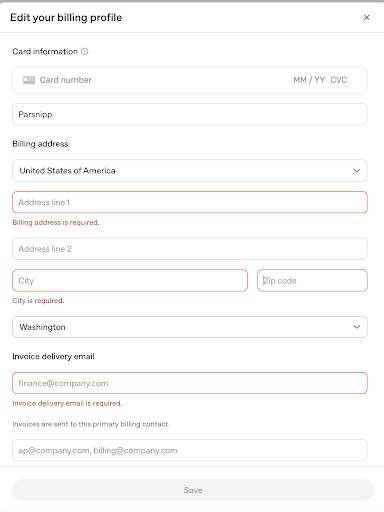
<p>Once access is granted, go to <strong>Settings → Account info</strong> and set your advertiser name and logo exactly as they should render in the ad unit. Then go to <strong>Settings → Billing</strong> and add a billing profile plus a payment method.</p>

<p>OpenAI is explicit: <strong>ads will not serve until both steps are complete</strong> — even if the campaign looks active.</p>

<p><img src="/wp-content/uploads/2026/08/step2.png" alt="" /></p>

<p><strong>S T E P 03</strong></p>

<p><strong><em>Build the campaign</em></strong></p>

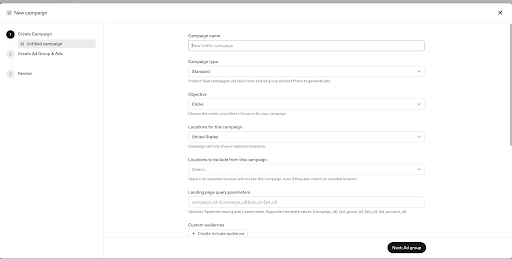
<p>Click Create → Create Campaign and set the name, objective, budget, start and end dates, and target country.</p>

<p>Choose your objective based on intent:</p>

<ul>
  <li>
    <p>Clicks (CPC) — for direct response. Recommended starting max bid $3 to $5.</p>
  </li>
  <li>
    <p>Reach (CPM) — for visibility and brand plays. Default max bid $60.</p>
  </li>
</ul>

<p><img src="/wp-content/uploads/2026/08/step3.png" alt="" /></p>

<p><strong>S T E P 04</strong></p>

<p><strong><em>Create an ad group with context hints</em></strong></p>

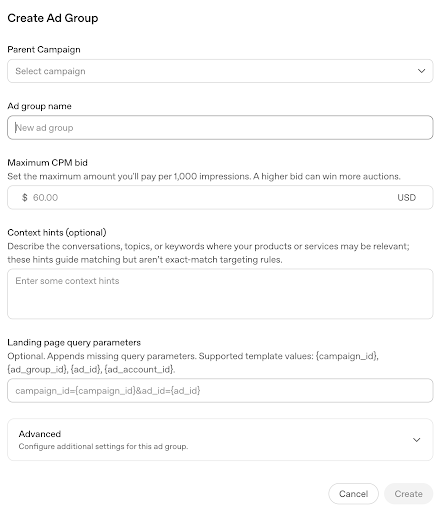
<p>Add an ad group under the campaign, set a max bid, and write context hints — plain-language descriptions of the conversation topics where the ad should be eligible to appear. There are no keywords or match types here.</p>

<p>Keep each ad group to one buyer situation so the hints stay coherent and reporting stays readable per theme. This is exactly where the targeting discipline from principle one pays off: the tighter and more specific your hints, the less budget you waste on the wrong conversations.</p>

<p><img src="/wp-content/uploads/2026/08/step4.png" alt="" /></p>

<p><strong>S T E P 05</strong></p>

<p><strong><em>Build the ad, validate, and launch</em></strong></p>

<p>Add your advertiser name, favicon/logo, and creative within OpenAI’s limits:</p>

<ul>
  <li>
    <p>Headline — 16 to 24 characters</p>
  </li>
  <li>
    <p>Ad copy — 32 to 48 characters</p>
  </li>
  <li>
    <p>Image — square, up to 1200×1200px</p>
  </li>
  <li>
    <p>Landing page URL — publicly accessible, with UTM parameters for tracking</p>
  </li>
</ul>

<p>Confirm naming is consistent and hints are correctly formatted, set status to Active, and submit. Impressions typically start within 24 hours; reporting can lag up to 7 hours.</p>

<p><img src="/wp-content/uploads/2026/08/step5.png" alt="" /></p>

<p><strong><em>Watch your budget pacing</em></strong>Budget pacing can vary across a 7-day period for <strong>daily budgets</strong> — some days may spend more than others. There is currently <strong>no budget pacing for lifetime budgets</strong>, so proceed carefully: end dates only control when the ad can run, not the pacing of the overall spend.</p>

<p><strong>THE PLAYBOOK IN ONE LINE</strong></p>

<p><em>Set it up in five steps, win it with three principles.</em></p>

<p>The setup is the easy part. The advertisers who get real return from ChatGPT ads are the ones who target with precision, run paid and organic as one surface, and work the whole funnel instead of camping at the top.</p>

<p><strong>01</strong> <em>Target</em>- Use every input to stay laser-focused. Know your customer, their problem, their journey stage.</p>

<p><strong>02</strong> <em>Layer</em> - Supplement organic visibility with paid. Maximize relevantn AI coverage as one system.</p>

<p><strong>03</strong>F<em>ull Funnel</em> - Map to product and prompt, not just brand. Middle-of-pack costs reward real intent.</p>]]></content><author><name>Molly Pannell</name></author><category term="ai-search-geo" /><category term="chatgpt-ads" /><category term="ai-search" /><category term="ai-visibility" /><category term="chatgpt" /><category term="geo" /><category term="llm-ads" /><category term="parsnipp" /><summary type="html"><![CDATA[We walk through the five steps — including two easy-to-miss settings that'll leave your campaign 'active' but invisible — to actually get impressions live.]]></summary><media:thumbnail xmlns:media="http://search.yahoo.com/mrss/" url="https://parsnipp.com/%7B%22src%22%20=%3E%20%22/wp-content/uploads/2026/08/parsnipp-chatgpt-ads-setup-feature.png%22,%20%22alt%22%20=%3E%20%22%22,%20%22width%22%20=%3E%204200,%20%22height%22%20=%3E%202400%7D" /><media:content medium="image" url="https://parsnipp.com/%7B%22src%22%20=%3E%20%22/wp-content/uploads/2026/08/parsnipp-chatgpt-ads-setup-feature.png%22,%20%22alt%22%20=%3E%20%22%22,%20%22width%22%20=%3E%204200,%20%22height%22%20=%3E%202400%7D" xmlns:media="http://search.yahoo.com/mrss/" /></entry><entry><title type="html">Launching ChatGPT ads? Think about these 3 things before you spend a dollar</title><link href="https://parsnipp.com/blog/launching-chatgpt-ads-think-about-these-3-things-before-you-spend-a-dollar/" rel="alternate" type="text/html" title="Launching ChatGPT ads? Think about these 3 things before you spend a dollar" /><published>2026-08-11T16:38:16+00:00</published><updated>2026-08-11T16:43:40+00:00</updated><id>https://parsnipp.com/blog/launching-chatgpt-ads-think-about-these-3-things-before-you-spend-a-dollar</id><content type="html" xml:base="https://parsnipp.com/blog/launching-chatgpt-ads-think-about-these-3-things-before-you-spend-a-dollar/"><![CDATA[<p><strong>TL;DR —</strong> Setting up a ChatGPT ad campaign is easy. Getting a real return is not. Before you touch the budget slider, get these three things straight: (1) <strong>targeting is everything</strong> — the labs are still releasing layers of targeting and so it’s not easy to target narrowly, precision beats reach; (2) <strong>don’t run paid in a vacuum</strong> — pair it with organic AI visibility; (3) <strong>play the whole funnel</strong> — resist the urge to treat this as top-of-funnel or brand advertising only. Nail these and the rest is just execution.</p>

<p>Paid AI search is here. ChatGPT started showing ads in early 2026 — small “chat cards” that appear below an answer, clearly labeled, on the Free and Go tiers. OpenAI moved fast: CPM buys at first, then CPC bidding, then self-serve. The mechanics of getting a campaign live are genuinely easy now. You can be spending money by this afternoon.</p>

<p>That’s exactly the problem.</p>

<p>Because the setup being easy tricks people into thinking the <em>strategy</em> is easy. It isn’t. Paid AI search behaves differently from Google, from Meta, from everything you’ve run before — different targeting, different inventory, different relationship to organic. Treat it like a search campaign with a new logo on it and you’ll light money on fire.</p>

<p>So here are the three principles to internalize <em>before</em> you spend a dollar. They shape every targeting, budget, and creative decision that comes after.</p>

<h2 id="1-targeting-is-everything-and-you-barely-have-any">1. Targeting is everything (and you barely have any)</h2>

<p>Here’s the uncomfortable truth about paid AI search right now: ChatGPT gives you very limited targeting. It’s getting better each day, but we’re still in the first few innings. No specific prompt lists. No demographics. No behavioral profiles. No negative exclusions. Today you mostly hand over “context hints” describing your business or where your product is relevant, and the model matches you semantically. That’s it.</p>

<p>So the targeting you <em>do</em> have has to be surgical. Every field, every input, every hint — used deliberately, aimed as tightly as you can aim it.</p>

<p>That means the real work happens upstream, before you’re anywhere near the Ads Manager. Three things you have to nail:</p>

<ul>
  <li><strong>Who is your customer</strong> — actually, specifically, not “SMBs” or “marketers.”</li>
  <li><strong>What problem are they trying to solve</strong> — the exact one, in their words, in the moment they’d be typing it into ChatGPT.</li>
  <li><strong>Where in their journey does an ad belong</strong> — the specific step where showing up helps instead of annoys.</li>
</ul>

<p>Skip that and you’re fishing with way too big a net. You’ll pay for a flood of conversations that were never going to convert, and you’ll blame the channel when the problem was the aim.</p>

<p><strong>Takeaway:</strong> Precision beats reach. Define customer, problem, and journey stage before you set a single input.</p>

<h2 id="2-dont-run-paid-in-a-vacuum">2. Don’t run paid in a vacuum</h2>

<p>The single biggest mistake I see coming: teams treating paid AI search as its own little island, walled off from everything else they’re doing to show up in AI.</p>

<p>Don’t. Instead you should be layering organic visibility right alongside paid.</p>

<p>The goal in AI search isn’t “impressions.” It’s <strong>maximum relevant AI visibility</strong> — enough presence that you’re actually influencing the brand-relevant conversations happening between your shopper and the model. Sometimes that presence comes from an ad. A lot of the time it comes from the model just <em>knowing</em> you — recommending you organically because your content, reviews, and mentions have made you the obvious answer.</p>

<p>Seen that way, paid isn’t the main event. It’s there to <strong>supplement</strong> your organic visibility — to fill the gaps organic can’t reach yet. Ads and organic aren’t two budgets fighting over the same spreadsheet cell. They’re one visibility surface, and you should plan them as one system.</p>

<p>Practical version: before you pay to appear in a conversation, check whether you’re already showing up organically. If you are, you might be paying for a recommendation you were getting for free. If you’re not, that gap is exactly where paid earns its keep.</p>

<p><strong>Takeaway:</strong> Paid fills the gaps organic can’t reach. Plan visibility as one surface, not two silos.</p>

<h2 id="3-play-the-whole-funnel-not-just-the-top">3. Play the whole funnel, not just the top</h2>

<p>Right now, ChatGPT ads are mostly being <em>sold</em> as brand advertising — top-of-funnel, awareness, “get your name in front of people.” Fine. There is so exciting new product-level carousel ads being released which are promising, but don’t let the pitch box you in.</p>

<p>Look for ways to use paid AI search across the <strong>entire</strong> customer journey. That means going below brand-level and getting to the product level: applying the laser targeting from principle one, and mapping your ads to the actual prompt conversations where someone’s ready to act.</p>

<p>Now, the honest caveat — you can’t always target a specific prompt today. The tracking happens post-click, and you often don’t even know which prompt triggered you. But limited targeting isn’t <em>no</em> targeting. Use the context hints and inputs you <em>do</em> have to reach for more than high-level brand awareness.</p>

<p>Why bother going deeper? Economics. LLM ad inventory is, at best, middle-of-the-pack on CPC/CPM. When you’re paying middle-of-the-pack prices, a purely top-of-funnel play — especially if you’re a growth marketer who lives and dies by CAC — is rarely going to pencil out. You need intent in the mix. Map ads to product and problem, not just brand, and the same click starts doing a lot more work.</p>

<p><strong>Takeaway:</strong> Middle-of-the-pack costs demand full-funnel intent. Map ads to product and prompt, not just brand.</p>

<h2 id="the-one-line-version">The one-line version</h2>

<p>Precision targeting, layered with organic, played across the whole funnel. Do those three things and you’re already ahead of most of the market — because most of the market is going to treat “easy to set up” as “easy to win.” It’s not.</p>

<h2 id="faq">FAQ</h2>

<p><strong>Are ChatGPT ads live?</strong> Yes. ChatGPT began showing ads in early 2026 — labeled “chat cards” that appear below answers for Free and Go tier users in the US. Paid tiers (Plus, Pro, Team, Enterprise) don’t see ads. OpenAI has moved from CPM buys toward CPC bidding and self-serve access.</p>

<p><strong>What targeting do you get with ChatGPT ads?</strong> Very little, for now. There are no prompt  or keyword lists, demographics, or behavioral audiences. You provide context about the conversations where your product is relevant, and the model matches you semantically. That’s exactly why upstream precision matters so much.</p>

<p><strong>Do ChatGPT ads affect the organic answers?</strong> OpenAI says ads don’t influence the answers ChatGPT gives — they sit separately, below the response, clearly labeled. Which is the whole reason you can’t ignore organic: your paid card and your organic mention are two different ways to show up in the same conversation.</p>

<p><strong>Should I run ChatGPT ads if I’m a growth/performance marketer?</strong> Only if you go past top-of-funnel. At middle-of-the-pack inventory costs, awareness-only spend is hard to justify. Push toward product-level, intent-mapped placements and the math gets a lot friendlier.</p>

<p><strong>What’s the first thing I should do before launching?</strong> Not open the Ads Manager. Define your customer, their exact problem, and the journey stage where an ad belongs — and audit where you already show up organically. Strategy first, slider second.</p>

<p><em>This is what we think about all day at parsnipp — helping brands win the AI search surface, paid and organic, as one system. If you want to see where you’re already showing up (and where you’re not) before you spend on ChatGPT ads, that’s exactly what we’re built for.</em></p>]]></content><author><name>Andrew Higgins</name></author><category term="ai-search-geo" /><category term="chatgpt-ads" /><category term="ai-search" /><category term="ai-visibility" /><category term="chatgpt" /><category term="geo" /><category term="llm-ads" /><category term="parsnipp" /><summary type="html"><![CDATA[Setting up a ChatGPT ad campaign is easy. Getting a real return is not. Before launch, get these three things straight.]]></summary><media:thumbnail xmlns:media="http://search.yahoo.com/mrss/" url="https://parsnipp.com/%7B%22src%22%20=%3E%20%22/wp-content/uploads/2026/08/parsnipp-chatgpt-ads-feature_1.png%22,%20%22alt%22%20=%3E%20%22%22,%20%22width%22%20=%3E%202800,%20%22height%22%20=%3E%201600%7D" /><media:content medium="image" url="https://parsnipp.com/%7B%22src%22%20=%3E%20%22/wp-content/uploads/2026/08/parsnipp-chatgpt-ads-feature_1.png%22,%20%22alt%22%20=%3E%20%22%22,%20%22width%22%20=%3E%202800,%20%22height%22%20=%3E%201600%7D" xmlns:media="http://search.yahoo.com/mrss/" /></entry><entry><title type="html">The agentic commerce feed stack: what eCommerce teams actually need to track</title><link href="https://parsnipp.com/blog/the-agentic-commerce-feed-stack-what-ecommerce-teams-actually-need-to-track/" rel="alternate" type="text/html" title="The agentic commerce feed stack: what eCommerce teams actually need to track" /><published>2026-07-29T14:46:10+00:00</published><updated>2026-07-29T14:58:20+00:00</updated><id>https://parsnipp.com/blog/the-agentic-commerce-feed-stack-what-ecommerce-teams-actually-need-to-track</id><content type="html" xml:base="https://parsnipp.com/blog/the-agentic-commerce-feed-stack-what-ecommerce-teams-actually-need-to-track/"><![CDATA[<p>Everyone’s asking “which protocol do I need for AI shopping?” That’s the wrong question. “Product feed” for agents is really three questions stacked on top of each other — and once you see the layers, the whole thing gets a lot less scary.</p>

<p>If you sit anywhere on an eCommerce team, you’ve probably had a version of this week: a stakeholder forwards you an article about ChatGPT shopping, your agency pitches you an “AI SEO package,” and somewhere in your inbox there’s an acronym soup — ACP, UCP, AP2, MCP — with no clear answer on what your team is actually supposed to <em>do</em> on Monday morning.</p>

<p>Here’s the reframe that makes it manageable. The protocols everyone keeps conflating aren’t competing for the same job. They sit on different layers of the stack. Sort them by layer and the picture snaps into focus — and so does your to-do list.</p>

<p><em>The mental model</em></p>

<h2 id="three-layers-not-one-feed"><strong>Three layers, not one feed</strong></h2>

<p>When people say “product feed for AI agents,” they’re smushing together three separate problems. Keep them separate and you’ll stop over-buying.</p>

<p><strong>Layer 1 — Discovery: how the agent finds you.</strong> This is the actual catalog: getting your products into an agent so it can surface them in a conversation. It’s the closest thing to the “feed” you already know.</p>

<p><strong>Layer 2 — Checkout: how the purchase gets executed.</strong> Whether the buy happens inside the AI surface or gets handed back to your own site. This is the layer that’s been the most turbulent in 2026.</p>

<p><strong>Layer 3 — Payment &amp; authorization: how consent is proven.</strong> How the agent proves the shopper actually agreed to spend the money, without exposing card details. Mostly your payments provider’s problem, not your feed’s.</p>

<p>A single agentic purchase can touch all three — discovered via one standard, checked out through another, authorized by a third. They stack. They don’t fight. Hold that thought, because it’s the whole argument.</p>

<p><em>The field guide</em></p>

<h2 id="what-you-actually-need-to-track"><strong>What you actually need to track</strong></h2>

<p>Here’s each standard worth knowing, sorted by how much it should occupy your roadmap right now — most actionable first.</p>

<h3 id="acp--agentic-commerce-protocol"><strong>ACP — Agentic Commerce Protocol</strong></h3>

<p><em>Backers: OpenAI + Stripe · Layer 1 &amp; 2</em></p>

<p>This is the one with a concrete feed spec you can act on today. You push a product feed — JSONL, CSV, or XML, gzip-compressed — to an OpenAI endpoint, ideally refreshed daily. The required fields are the usual suspects:</p>

<ul>
  <li>Item ID, title (150-char cap), description (up to 5,000 chars)</li>
  <li>Price with an ISO 4217 currency code, availability status</li>
  <li>Image URL, brand</li>
  <li>Eligibility flags controlling whether an item can be <em>searched</em> and whether it can be <em>checked out</em></li>
</ul>

<p>It’s Apache 2.0 licensed, and checkout runs on Stripe’s Shared Payment Token, so the agent never sees buyer credentials. <strong>The catch:</strong> OpenAI pulled back its native “Instant Checkout” in ChatGPT around March 2026 after underwhelming results, and pivoted toward a retailer-app integration model. But the ACP <em>spec and feed</em> are still live — so it remains the format to support if you want visibility inside ChatGPT.</p>

<h3 id="google-merchant-center-feeds--the-incumbent-that-quietly-matters-most"><strong>Google Merchant Center feeds — the incumbent that quietly matters most</strong></h3>

<p><em>Backer: Google · Layer 1</em></p>

<p>This isn’t new and it isn’t sexy, but it’s now the substrate feeding Google’s AI surfaces and the emerging UCP standard. XML, TSV, or API submission; 170+ possible attributes, though the ones that carry the weight are title, description, price, availability, GTIN, product category, images, and shipping. If your Merchant Center feed is clean, you’re already halfway ready for agents — cleaning it up is arguably higher-leverage than chasing any single shiny new protocol.</p>

<h3 id="ucp--universal-commerce-protocol"><strong>UCP — Universal Commerce Protocol</strong></h3>

<p><em>Backers: Google-led coalition · Layers 1, 2 &amp; beyond</em></p>

<p>The broad-coalition play: Google plus Shopify, Etsy, Walmart, Target, Wayfair, and a long list of payment and retail partners endorsing it. Announced in January 2026, self-serve since around June. Unlike ACP, it covers the <em>full journey</em> — discovery, cart, checkout, orders, and post-purchase — with a graceful hand-off to human checkout when needed. You publish a profile via a /.well-known/ucp JSON manifest, and it leans on your existing Merchant Center feed for the catalog itself. Transport is flexible (REST, MCP, Google’s A2A, or an embedded iframe). If you sell through Google Search’s AI Mode or Gemini and already run Merchant Center, this is the one to watch.</p>

<h3 id="ap2--agent-payments-protocol"><strong>AP2 — Agent Payments Protocol</strong></h3>

<p><em>Backers: Google-initiated, now FIDO Alliance · Layer 3</em></p>

<p>Pure authorization — not a feed you build. It uses three cryptographically signed “mandates” — Intent, Cart, and Payment — expressed as W3C Verifiable Credentials, and it’s payment-method-agnostic across cards, bank transfer, and stablecoins. Moving to neutral FIDO Alliance governance (60+ orgs) makes it the lowest single-vendor-risk piece of the whole stack. You’d support it through your payments provider, not your catalog team.</p>

<h3 id="mcp--model-context-protocol"><strong>MCP — Model Context Protocol</strong></h3>

<p><em>Backer: Anthropic · Transport layer</em></p>

<p>Worth understanding, but don’t file it as a rival feed standard. MCP is plumbing — a transport/context layer that other commerce standards (UCP included) use to expose merchant capabilities to agents. By raw developer adoption it dwarfs the commerce-specific standards, which is exactly why it’s likely to be the pipes underneath rather than a thing you “choose.”</p>

<h3 id="the-walled-gardens--amazon-meta-perplexity"><strong>The walled gardens — Amazon, Meta, Perplexity</strong></h3>

<p><em>Proprietary · Play by their rules</em></p>

<p>Amazon (Rufus, Alexa+, “Buy for Me”) is closed — it blocks external crawlers, keeps its own catalog structure, and sits out both ACP and UCP, so reaching it means playing inside Amazon. Meta is increasingly bundled into multi-standard adapters. Perplexity is a live shopping surface but without a well-documented open feed standard yet. Track them as channels, not as protocols to integrate.</p>

<figure class="wp-block-table"><table class="has-fixed-layout"><tbody>
<tr>
<td><strong>Standard</strong></td>
<td><strong>Layer</strong></td>
<td><strong>What it solves</strong></td>
<td><strong>Your move</strong></td>
</tr>
<tr>
<td><strong>ACP</strong></td>
<td>Discovery + checkout</td>
<td>Selling inside ChatGPT</td>
<td>Publish the feed if you're on Stripe</td>
</tr>
<tr>
<td><strong>Merchant Center</strong></td>
<td>Discovery</td>
<td>Feeding Google's AI surfaces</td>
<td>Clean it up now — highest leverage</td>
</tr>
<tr>
<td><strong>UCP</strong></td>
<td>Full journey</td>
<td>Discovery + checkout across Google/Gemini</td>
<td>Enable self-serve if on Shopify</td>
</tr>
<tr>
<td><strong>AP2</strong></td>
<td>Payment</td>
<td>Proving user consent</td>
<td>Support via your payments provider</td>
</tr>
<tr>
<td><strong>MCP</strong></td>
<td>Transport</td>
<td>The pipes underneath</td>
<td>Nothing to buy — it's plumbing</td>
</tr>
</tbody></table></figure>

<p><em>The bottom line</em></p>

<h2 id="support-the-layers-not-the-logos"><strong>Support the layers, not the logos</strong></h2>

<p>The single most useful principle in this whole space: these protocols stack rather than compete, so stop trying to bet on a winner. Instead, get each layer ready and switch on integrations as each channel proves out. Concretely, whatever your team’s size:</p>

<ul>
  <li><strong>Make your product data genuinely agent-ready first.</strong> A clean Merchant Center feed and solid Schema.org Product markup on your own pages benefit <em>every</em> protocol, whichever one wins. This is the durable investment.</li>
  <li><strong>Turn on ACP if you’re already on Stripe.</strong> Low effort, and it’s your ticket into the ChatGPT surface.</li>
  <li><strong>Enable UCP self-serve if you’re on Shopify / Merchant Center.</strong> It rides on infrastructure you already run.</li>
  <li><strong>Let your payments provider handle AP2.</strong> It’s their layer, not your catalog’s.</li>
</ul>

<blockquote class="wp-block-quote is-layout-flow wp-block-quote-is-layout-flow">
<p class="wp-block-paragraph">Bigger sellers increasingly route all of this through a single multi-standard adapter (Adyen Agentic and similar) to hit UCP + ACP + AP2 + Meta through one integration, rather than maintaining each by hand. If you're scaling fast, it's worth a look before you build four things separately.</p>
</blockquote>

<p><em>Straight talk</em></p>

<h2 id="one-honest-note-before-you-over-invest"><strong>One honest note before you over-invest</strong></h2>

<p>This space is moving fast, and the reporting on it is uneven. OpenAI’s checkout retreat in early 2026 is the clearest proof that “which protocol wins” is nowhere near settled — the leader in the category pulled back its flagship consumer feature after a few months. So treat <em>feed-readiness</em> as the thing you actually commit to, and treat the specific protocol integrations as switches you can flip relatively cheaply as each channel earns its place. Don’t torch a quarter’s roadmap building deep, bespoke plumbing for a standard that might get folded into another one by the time you ship it.</p>

<p>Get your data right. Stay flexible on everything above it. That’s the whole play.</p>

<p><strong>Sources we used to research this piece</strong></p>

<ul>
  <li><a href="https://www.digitalapplied.com/blog/agentic-commerce-standards-ucp-acp-ap2-2026-merchant-guide">Agentic Commerce Standards: UCP vs ACP vs AP2 in 2026 — Digital Applied</a></li>
  <li><a href="https://opascope.com/insights/ai-shopping-assistant-guide-2026-agentic-commerce-protocols/">AI Shopping Assistant Guide 2026: Agentic Commerce Protocols — Opascope</a></li>
  <li><a href="https://developers.openai.com/commerce">Agentic Commerce Protocol — OpenAI Developers</a></li>
  <li><a href="https://docs.stripe.com/agentic-commerce/acp">Agentic Commerce Protocol — Stripe Documentation</a></li>
  <li><a href="https://github.com/agentic-commerce-protocol/agentic-commerce-protocol">Agentic Commerce Protocol — GitHub (OpenAI/Stripe)</a></li>
  <li><a href="https://stellagent.ai/insights/openai-shopping-agent-strategy-pivot">OpenAI Ends Instant Checkout, Pivots to Retailer App Integration — Stellagent</a></li>
  <li><a href="https://www.forrester.com/blogs/what-it-means-that-the-leader-in-agentic-commerce-just-pulled-back/">What It Means That The Leader In “Agentic Commerce” Just Pulled Back — Forrester</a></li>
</ul>]]></content><author><name>Andrew Higgins</name></author><category term="ai-search-geo" /><category term="chatgpt-ads" /><category term="ai-search" /><category term="ai-visibility" /><category term="chatgpt" /><category term="geo" /><category term="llm-ads" /><category term="parsnipp" /><summary type="html"><![CDATA[Everyone's asking "which protocol do I need for AI shopping?" That's the wrong question. "Product feed" for agents is really three questions stacked on top of each other — and once you see the layers, the whole thing gets a lot less scary.]]></summary><media:thumbnail xmlns:media="http://search.yahoo.com/mrss/" url="https://parsnipp.com/%7B%22src%22%20=%3E%20%22/wp-content/uploads/2026/07/parsnipp-blog-agentic-commerce-feed-stack-simple_4.png%22,%20%22alt%22%20=%3E%20%22%22,%20%22width%22%20=%3E%202488,%20%22height%22%20=%3E%202520%7D" /><media:content medium="image" url="https://parsnipp.com/%7B%22src%22%20=%3E%20%22/wp-content/uploads/2026/07/parsnipp-blog-agentic-commerce-feed-stack-simple_4.png%22,%20%22alt%22%20=%3E%20%22%22,%20%22width%22%20=%3E%202488,%20%22height%22%20=%3E%202520%7D" xmlns:media="http://search.yahoo.com/mrss/" /></entry><entry><title type="html">Parsnipp Introduces Smart LLM Ads, the First Integrated, Market Ready AI Search Advertising Platform</title><link href="https://parsnipp.com/blog/parsnipp-introduces-smart-llm-ads-the-first-integrated-market-ready-ai-search-advertising-platform/" rel="alternate" type="text/html" title="Parsnipp Introduces Smart LLM Ads, the First Integrated, Market Ready AI Search Advertising Platform" /><published>2026-07-28T13:34:01+00:00</published><updated>2026-09-21T14:54:49+00:00</updated><id>https://parsnipp.com/blog/parsnipp-introduces-smart-llm-ads-the-first-integrated-market-ready-ai-search-advertising-platform</id><content type="html" xml:base="https://parsnipp.com/blog/parsnipp-introduces-smart-llm-ads-the-first-integrated-market-ready-ai-search-advertising-platform/"><![CDATA[<p>Note: This press release was first published on <a href="https://www.businesswire.com/news/home/20260728888582/en/Parsnipp-Introduces-Smart-LLM-Ads-the-First-Integrated-Market-Ready-AI-Search-Advertising-Platform">Business Wire</a>.</p>

<p><strong>Smart LLM Ads brings together organic AI discovery and AI Search Advertising, helping redefine GEO as AI Search Marketing continues to evolve</strong></p>

<h2 id="summary"><strong>Summary</strong></h2>

<ul>
  <li>Parsnipp is the first integrated, generally available GEO platform to combine AI Search Advertising with AI visibility in a single platform.</li>
  <li>Smart LLM Ads lets marketers create and manage ChatGPT advertising directly within its AI visibility platform using GEO visibility insights to help guide paid campaign strategies.</li>
  <li>The company believes AI search is rapidly evolving into the next major marketing channel, creating demand for unified AI Search Marketing platforms to cover organic optimization, paid advertising, commerce, and content marketing.</li>
</ul>

<p>SEATTLE–(<a href="https://www.businesswire.com/">BUSINESS WIRE</a>)–<a href="https://parsnipp.com/">Parsnipp</a>, a GEO and AI Search Marketing platform, has launched Smart LLM Ads, the industry’s first integrated, generally available AI Search Advertising solution. Smart LLM Ads brings together organic AI discovery and paid AI advertising in one place. Unlike standalone advertising tools, Parsnipp connects AI visibility intelligence directly to campaign creation, helping marketers identify where they are missing from AI conversations and transform those gaps into targeted advertising opportunities.</p>

<p><strong>Smart LLM Ads demo: </strong><a href="https://parsnipp.com/product-ai-search-geo-platform/solution-llm-ads/"><strong>/product-ai-search-geo-platform/solution-llm-ads/</strong></a></p>

<p>As consumers increasingly rely on AI platforms like ChatGPT to research products, compare brands and make purchasing decisions, AI search is evolving from an organic discovery channel into a broader marketing channel. As new capabilities like advertising emerge, marketers need a way to manage organic discovery and paid AI search together. Parsnipp gives marketers a single platform to measure AI visibility and activate advertising informed by those insights.</p>

<p>“AI visibility should directly inform where and how brands advertise,” said Andrew Higgins, CEO and co-founder of Parsnipp. “Every new capability, from AI visibility and advertising today to agentic commerce tomorrow, gives brands another way to influence how they’re discovered, recommended, and ultimately chosen through AI.”</p>

<p>Rather than adding AI advertising to an existing GEO platform, Smart LLM Ads connects AI visibility insights directly to advertising strategy. By identifying where brands are underrepresented across AI conversations, marketers can generate targeted advertising campaigns designed to improve discovery where it matters most.</p>

<p>Parsnipp gives marketers the tools to create and manage ChatGPT advertising while monitoring AI discoverability, citations and competitive positioning across leading AI platforms. Because advertising is connected directly to Parsnipp’s GEO insights, marketers can identify where they are not being discovered organically and launch campaigns designed to close those visibility gaps.</p>

<p>The launch also reflects a broader shift taking place across digital marketing. As AI systems become the starting point for product research, recommendations and eventually transactions, marketers will increasingly need to manage both organic and paid visibility across AI search. Parsnipp believes GEO is evolving beyond AI visibility into a broader AI Search Marketing discipline.</p>

<p>“We’re always looking for smarter ways to tell our story and meet our customers where they are. Right now, AI is completely rewriting the playbook for brand discovery,” said Shamaila Usmani, Co-Owner, Onyx Candles. “That’s why we’re so thrilled to team up with Parsnipp. They really get this space, and together, we’re figuring out how AI advertising can supercharge our existing marketing strategy.”</p>

<p>As additional AI advertising APIs become available, Parsnipp plans to expand support across multiple AI ecosystems while developing recommendations informed by AI search insights. The long-term vision is a unified platform spanning AI visibility, advertising and future AI commerce capabilities.</p>

<p>“Every digital channel in our marketing mix has different strategies and emphasis,” said Kish Chopra, Founder and CEO, NPHub. “As AI search evolves into a broader marketing channel, we’re working to build cohesive playbooks to manage organic visibility, paid targeting, and commerce across AI Search surfaces.”</p>

<p>Key capabilities include:</p>

<ul>
  <li><strong>Smart LLM Ads</strong> – Create and manage ChatGPT advertising campaigns directly within Parsnipp.</li>
  <li><strong>Visibility Gap Targeting – </strong>Identify where your brand is underrepresented in AI conversations and generate targeted campaigns to improve discovery.</li>
  <li><strong>Unified Organic + Paid Intelligence – </strong>Connect AI visibility insights with AI Search Advertising to understand how paid campaigns complement organic discovery.</li>
  <li><strong>AI-Powered Campaign Recommendations – </strong>Use persona modeling, conversational search insights and AI visibility analysis to create more targeted OpenAI advertising campaigns.</li>
  <li><strong>Multi-Platform Architecture </strong>– Support additional AI advertising ecosystems as they become available.</li>
</ul>

<p>Smart LLM Ads builds on Parsnipp’s AI Search and GEO platform, which models real buyer behavior through persona-based agents and multi-turn conversations to help brands improve AI discoverability.</p>

<p>To learn more about Parsnipp AI Search and LLM Ads, visit: <a href="https://parsnipp.com/product-ai-search-geo-platform/solution-llm-ads/">/product-ai-search-geo-platform/solution-llm-ads/</a>.</p>

<h2 id="about-parsnipp"><strong>About Parsnipp</strong></h2>

<p>Parsnipp is an AI Search Marketing platform that helps brands understand how they are represented inside generative AI systems. By modeling real customer personas and multi-turn conversations, Parsnipp provides a more accurate view of how AI influences discovery and decision-making. The platform also includes capabilities designed for emerging AI-driven use cases, including agentic commerce and AI-native advertising. Learn more at <a href="https://parsnipp.com/">/</a>.</p>

<h2 id="ai-search-advertising-faq"><strong>AI Search Advertising FAQ</strong></h2>

<ol>
  <li><strong>What is Smart LLM Ads? </strong>Smart LLM Ads allows brands to advertise directly within AI-powered search and conversational experiences. Similar to how paid search evolved alongside SEO, AI Search Advertising represents the next stage of AI-driven discovery, enabling marketers to complement organic AI visibility with paid placements as AI platforms introduce advertising capabilities.</li>
  <li><strong>Why combine organic AI discovery and AI Search Advertising in one platform?</strong> Organic AI visibility and paid AI advertising are closely connected. Understanding how a brand naturally appears across AI systems helps marketers make more informed advertising decisions, while advertising can complement organic visibility in competitive or high-value conversations. Parsnipp identifies where brands are missing from AI conversations and helps marketers turn those visibility gaps into targeted advertising opportunities.</li>
  <li><strong>Which AI advertising platforms does Parsnipp support? </strong>The initial release supports ChatGPT advertising and is designed to expand as additional AI platforms introduce advertising APIs and commercial capabilities. Parsnipp is building a unified AI Search Marketing platform that evolves alongside the rapidly changing AI ecosystem.</li>
  <li><strong>Is AI Search Advertising replacing GEO? </strong>No. AI Search Advertising builds on GEO rather than replacing it. GEO helps brands improve their organic visibility across AI search, while AI Search Advertising introduces paid opportunities within those same environments. As AI search continues to mature, marketers will increasingly need both organic and paid strategies, similar to how SEO and paid search evolved together.</li>
</ol>

<h2 id="contacts">Contacts</h2>

<p><strong>Media Contact</strong><br />
Matt Stubbs<br />
VoxusPR<br />
<a href="mailto:mstubbs@voxuspr.com">mstubbs@voxuspr.com</a></p>]]></content><author><name>Molly Pannell</name></author><category term="announcements" /><summary type="html"><![CDATA[Parsnipp models real buyer behavior with persona-based agents and multi-turn conversations to show brands exactly where they stand in AI search.]]></summary><media:thumbnail xmlns:media="http://search.yahoo.com/mrss/" url="https://parsnipp.com/%7B%22src%22%20=%3E%20%22/wp-content/uploads/2026/07/smart-llm-advertising-product-parsnipp-1200x0-c-default-1.webp%22,%20%22alt%22%20=%3E%20%22%22,%20%22width%22%20=%3E%201200,%20%22height%22%20=%3E%20679%7D" /><media:content medium="image" url="https://parsnipp.com/%7B%22src%22%20=%3E%20%22/wp-content/uploads/2026/07/smart-llm-advertising-product-parsnipp-1200x0-c-default-1.webp%22,%20%22alt%22%20=%3E%20%22%22,%20%22width%22%20=%3E%201200,%20%22height%22%20=%3E%20679%7D" xmlns:media="http://search.yahoo.com/mrss/" /></entry><entry><title type="html">How NPHub Quadrupled LLM Traffic in 30 Days</title><link href="https://parsnipp.com/blog/how-nphub-quadrupled-llm-traffic-in-30-days/" rel="alternate" type="text/html" title="How NPHub Quadrupled LLM Traffic in 30 Days" /><published>2026-07-24T09:14:14+00:00</published><updated>2026-07-24T12:37:35+00:00</updated><id>https://parsnipp.com/blog/how-nphub-quadrupled-llm-traffic-in-30-days</id><content type="html" xml:base="https://parsnipp.com/blog/how-nphub-quadrupled-llm-traffic-in-30-days/"><![CDATA[<p>NPHub is the #1 preceptor matching service &amp; clinical placement agency for Nurse Practitioner students. Like many brands today, they were grappling with a shift in how their customers were finding them: students were increasingly turning to AI models like ChatGPT, Claude, and Gemini to find clinical rotations and vetted preceptors — and NPHub didn’t have a clear read on how, or whether, they were showing up.</p>

<p>That was the core challenge we set out to solve together, and why NPHub prioritized GEO (Generative Engine Optimization): making sure they’re visible in AI models, and spoken about accurately in what those models tell people.</p>

<p>NPHub partnered with Parsnipp to get real insight into that visibility — not just a dataset to analyze, but actionable recommendations to actually improve it. We started with the basics first: foundational GEO/AEO strategies, and the results have been great. NPHub continues to evolve its AI search marketing strategy, but we’ve already seen a massive increase in weekly LLM referral traffic and a significant rise in its AI Visibility Score in the first 30 days..</p>

<p>Let’s get into the details below.</p>

<p><img src="/wp-content/uploads/2026/07/case-study-results-thus-far.png" alt="NPHub's results so far include an increase of 380% of LLM traffic to their site (data via Google Analytics); an increase of 76 points to their GEO score, a 44% increase in their AI Visibility score, and 378 brand citations in LLMs (via Parsnipp)" /></p>

<h4 id="nphub-is-investing-in-geo-with-parsnipp">NPHub is investing in GEO with Parsnipp</h4>

<p>NPHub’s target customer had started using LLMs to search for clinical rotations, vetted preceptors, and NP clinical placement services. When a buyer asks ChatGPT, Claude, or Gemini for a recommendation and the brand doesn’t show up, that demand is invisible — and it’s demand a competitor can pick up instead.</p>

<p>That’s the business case for GEO. For NP students and university program directors, securing timely clinical placements is a high-stakes race against strict graduation deadlines and severe preceptor shortages — so as those buyers shift from search engines to AI assistants, being the recommended brand isn’t just an advantage, it’s a critical revenue driver. So NPHub partnered with Parsnipp to measure exactly where they stood in AI search and start closing the gap.</p>

<h4 id="it-starts-with-a-baseline">It starts with a baseline</h4>

<p>Getting started with Parsnipp means setting up NPHub’s AI Visibility Report and capturing baseline metrics — where they ranked, how they compared to competitors, and what the major LLMs were saying about them — before turning any recommendations into action.</p>

<p>NPHub’s starting point: a GEO Score of 230, an AI Visibility Score of 34.7%, roughly 5 weekly LLM referral sessions — and only 36.9% of the citations LLMs used in NPHub’s space mentioned the brand at all.</p>

<h4 id="turning-recommendations-into-action">Turning recommendations into action</h4>

<p>Using Parsnipp’s recommendation engine, NPHub started implementing the highest-impact, GEO-specific optimizations first — a custom checklist built for their brand, not a generic SEO playbook.</p>

<p><img src="/wp-content/uploads/2026/07/what-we-implemented-whats-next.png" alt="" /></p>

<h4 id="almost-immediate-impact-in-30-days">Almost immediate impact in 30 days</h4>

<p>Scores climbed across the Parsnipp dashboard — and just as importantly, traffic to NPHub’s website from LLMs spiked, measured independently in Google Analytics.</p>

<p><img src="/wp-content/uploads/2026/07/weekly-llm-referral-sessions.png" alt="" /></p>

<p><strong>Our data, validated by theirs.</strong> Three of these metrics are Parsnipp-native. The fourth (traffic) is measured independently in NPHub’s own Google Analytics. When our scores go up and third-party traffic follows, the improvement is real, not just a number on our dashboard.</p>

<blockquote class="wp-block-quote is-layout-flow wp-block-quote-is-layout-flow">
<p class="wp-block-paragraph">"Parsnipp didn't just give us a generic audit — they gave us deep visibility across brand, competitors, and prompts. Then, they provided an actionable, high-impact checklist built specifically for NPHub's audience. Seeing our weekly LLM traffic increase nearly 5x in just 30 days proves that when you combine the right GEO insights with fast implementation, the payoff is immediate." <br /><br /><a href="https://www.linkedin.com/in/krishchopra/" target="_blank" rel="noopener">Krish Chopra</a> — CEO &amp; Founder, NPHub </p>
</blockquote>

<h4 id="this-is-just-the-beginning">This is just the beginning</h4>

<p>Parsnipp will keep analyzing NPHub as they build out and implement more of the custom GEO program. The most encouraging part is the direct, immediate impact from the specific checks and recs already live — and that only 6 of the 33 recommendations Parsnipp identified have been implemented. There’s meaningful headroom once the foundational checks and recs are fully built out.</p>

<p>From here, NPHub is also looking at paid advertising opportunities in ChatGPT and other parts of the Parsnipp platform that make a brand more AI-ready — including building content for the GEO content-gap recommendations Parsnipp has identified. The gains so far have come primarily from strengthening the value and weight of NPHub’s own website; recommendations across PR, social, content marketing, and review sites haven’t been prioritized yet.</p>

<h2 id="try-parsnipp-for-free">Try Parsnipp for Free</h2>

<p>Parsnipp evaluates your digital presence, measures AI Search effectiveness, and provides a strategic roadmap to guide you towards improvement.</p>

<p><a href="https://app.parsnipp.com/users/sign_up" class="btn primary big" target="_self">
        <span>Try It Free</span>
    </a></p>]]></content><author><name>Molly Pannell</name></author><category term="ai-search-geo" /><category term="ai-search" /><category term="ai-visibility" /><category term="chatgpt" /><category term="claude" /><category term="gemini" /><category term="geo" /><category term="llm" /><category term="parsnipp" /><summary type="html"><![CDATA[By implementing foundational GEO optimizations, NPHub drove a 380% increase in weekly LLM referral traffic and raised its AI Visibility Score by 44% in the first 30 days.]]></summary><media:thumbnail xmlns:media="http://search.yahoo.com/mrss/" url="https://parsnipp.com/%7B%22src%22%20=%3E%20%22/wp-content/uploads/2026/07/nphub-parsnipp-featured_1.png%22,%20%22alt%22%20=%3E%20%22%22,%20%22width%22%20=%3E%201200,%20%22height%22%20=%3E%20800%7D" /><media:content medium="image" url="https://parsnipp.com/%7B%22src%22%20=%3E%20%22/wp-content/uploads/2026/07/nphub-parsnipp-featured_1.png%22,%20%22alt%22%20=%3E%20%22%22,%20%22width%22%20=%3E%201200,%20%22height%22%20=%3E%20800%7D" xmlns:media="http://search.yahoo.com/mrss/" /></entry><entry><title type="html">GEO Tip of the Week: Add Trust Signals to Key Pages</title><link href="https://parsnipp.com/blog/geo-tip-of-the-week-trust-signals-to-key-pages/" rel="alternate" type="text/html" title="GEO Tip of the Week: Add Trust Signals to Key Pages" /><published>2026-07-09T19:54:43+00:00</published><updated>2026-07-09T19:57:07+00:00</updated><id>https://parsnipp.com/blog/geo-tip-of-the-week-trust-signals-to-key-pages</id><content type="html" xml:base="https://parsnipp.com/blog/geo-tip-of-the-week-trust-signals-to-key-pages/"><![CDATA[<p>AI models don’t just read your content - they evaluate whether your content is worth citing. Explicit trust signals like author credentials, security certifications, publication dates, and sourced claims are the difference between a brand AI recommends and one it passes over. Eight pages is a meaningful start. The impact compounds from there.</p>

<p>Most brands have trust-building elements somewhere on their site - a badge in the footer, a bio on the About page, a date stamp buried in a blog post. But scattered, inconsistent trust signals don’t build a credibility stack. AI systems are looking for clear, repeatable indicators of authority and reliability across your entire digital presence. When those signals are present and consistent, AI has the confidence it needs to cite you.</p>

<h4 id="what-are-trust-signals-and-why-do-they-matter-for-ai-search">What are trust signals and why do they matter for AI search</h4>

<p>Trust signals are explicit indicators that your content is accurate, authoritative, and safe to recommend. They include author credentials and expertise statements, publication and last-updated timestamps, source citations and references, security badges and certifications, guarantees, and third-party validation.</p>

<p>AI systems powering tools like ChatGPT, Gemini, Perplexity, and Google AI Overviews use these signals to assess whether a source is credible enough to surface in a response. A page that makes strong claims without attribution, has no named author, and hasn’t been updated in two years is a liability to an AI model trying to give accurate recommendations. A page that clearly states who wrote it, when it was last reviewed, and what sources back it up is an asset.</p>

<p>This is why Google’s E-E-A-T framework - Experience, Expertise, Authoritativeness, and Trustworthiness — has become even more relevant in the AI search era. These aren’t just SEO signals anymore. They are the criteria AI uses to decide whether your brand deserves a recommendation.</p>

<h4 id="heres-what-to-do">Here’s what to do</h4>

<ol>
  <li><strong>Identify the right trust signals for each page type</strong>: A product page needs security badges and guarantee statements. A blog post needs an author bio and citations. A service page needs credentials and client outcomes. Match the signal to the content.</li>
  <li><strong>Add author credentials and expertise indicators</strong>: Every piece of content that makes a claim should have a named author with a stated area of expertise. Link author bios to credentials, LinkedIn profiles, or other established references where possible.</li>
  <li><strong>Include publication dates and update timestamps</strong>: Clearly display when content was published and when it was last reviewed or updated. Outdated content without a timestamp is a trust liability. Fresh timestamps signal that your information is current and maintained.</li>
  <li><strong>Add source citations and references</strong>: Back up claims with links to primary sources, original research, or authoritative third parties. Sourced content gives AI systems a verifiable trail to follow and increases the likelihood your content is treated as reliable.</li>
  <li><strong>Include security badges and certifications where relevant</strong>: On transactional pages, checkout flows, and anywhere users share sensitive information, display applicable security certifications prominently. These signals matter to both human visitors and AI evaluation systems assessing site legitimacy.</li>
</ol>

<h4 id="what-happens-when-you-get-this-right">What happens when you get this right</h4>

<p>Trust signals create a feedback loop. AI systems find credible, well-attributed content, cite it in responses, and drive more qualified traffic back to your site. That traffic engages with content that reinforces trust further - completing the cycle.</p>

<p>Eight pages is the right place to start because it forces prioritization. Identify the pages that matter most to your brand’s AI visibility strategy — the ones covering topics AI is frequently asked about in your category - and make those pages the most credible versions of themselves on the web.</p>

<p>The effort here is low. The lift required to add an author bio, a timestamp, and a cited source to a page is minimal. But the cumulative effect across eight pages, built into a consistent pattern across your site, is significant. AI systems reward brands that make their credibility legible. Make yours impossible to miss.</p>

<p>The brands winning in AI search aren’t just publishing authoritative content - they are making it unmistakably clear to AI systems that their content is authoritative. Trust signals are how you make that case. Start with eight pages and build the habit from there. The foundation you lay now becomes the credibility advantage that is hardest for competitors to replicate later.</p>

<p>Want to learn more? <a href="/blog/">Visit our blog</a></p>

<h2 id="try-parsnipp-for-free">Try Parsnipp for Free</h2>

<p>Parsnipp evaluates your digital presence, measures AI Search effectiveness, and provides a strategic roadmap to guide you towards improvement.</p>

<p><a href="https://app.parsnipp.com/users/sign_up" class="btn primary big" target="_self">
        <span>Try It Free</span>
    </a></p>]]></content><author><name>Brandon Robinson</name></author><category term="ai-search-geo" /><category term="ai-search" /><category term="ai-visibility" /><category term="chatgpt" /><category term="claude" /><category term="gemini" /><category term="geo" /><category term="llm" /><category term="parsnipp" /><summary type="html"><![CDATA[AI models don't just read your content - they evaluate whether your content is worth citing. Explicit trust signals like author credentials, security certifications, publication dates, and sourced claims are the difference between a brand AI recommends and one it passes over. Eight pages is a meaningful start. The impact compounds from there.]]></summary><media:thumbnail xmlns:media="http://search.yahoo.com/mrss/" url="https://parsnipp.com/%7B%22src%22%20=%3E%20%22/wp-content/uploads/2026/03/parsnipp-geo-tip-of-week.png%22,%20%22alt%22%20=%3E%20%22geo%20tip%20of%20the%20week%20llms.txt%20file%22,%20%22width%22%20=%3E%202012,%20%22height%22%20=%3E%20681%7D" /><media:content medium="image" url="https://parsnipp.com/%7B%22src%22%20=%3E%20%22/wp-content/uploads/2026/03/parsnipp-geo-tip-of-week.png%22,%20%22alt%22%20=%3E%20%22geo%20tip%20of%20the%20week%20llms.txt%20file%22,%20%22width%22%20=%3E%202012,%20%22height%22%20=%3E%20681%7D" xmlns:media="http://search.yahoo.com/mrss/" /></entry><entry><title type="html">LLMs &amp;amp; Advertising: A Snapshot of Where Each Platform Stands (Q2 2026)</title><link href="https://parsnipp.com/blog/infographic-llms-advertising-a-snapshot-of-where-each-platform-stands-q2-2026/" rel="alternate" type="text/html" title="LLMs &amp;amp; Advertising: A Snapshot of Where Each Platform Stands (Q2 2026)" /><published>2026-07-01T18:11:51+00:00</published><updated>2026-09-17T16:35:31+00:00</updated><id>https://parsnipp.com/blog/infographic-llms-advertising-a-snapshot-of-where-each-platform-stands-q2-2026</id><content type="html" xml:base="https://parsnipp.com/blog/infographic-llms-advertising-a-snapshot-of-where-each-platform-stands-q2-2026/"><![CDATA[<p>Back in March, we mapped out where the major LLMs stood on advertising — and predicted it wouldn’t stay static for long. Three months later, that’s an understatement. Q2 is the quarter ChatGPT Ads stopped being a pilot and started being a real ad platform, and it’s the quarter we’re adding a fifth name to this list: Perplexity, which spent the quarter drawing a hard line in the opposite direction.</p>

<h2 id="llm-advertising-geo--ai-search-is-still-not-only-about-content--organic-visibility">LLM Advertising: GEO / AI Search Is Still Not Only About Content &amp; Organic Visibility</h2>

<p>As we said in our <a href="about:blank">Q1 breakdown</a>, ChatGPT referral traffic was already converting at roughly 1.5x the rate of other channels before a single paid placement existed. Now that paid placements exist at scale, that gap is exactly why brands need a point of view on each platform — not just a content strategy.</p>

<p><strong>ChatGPT (OpenAI) — pro-ads, and now shipping at scale.</strong> The Criteo pilot we covered in Q1 is old news. ChatGPT Ads reportedly crossed a $1 billion annualized revenue run rate roughly 200 days after launch, and OpenAI used Q2 to go wide: ads expanded to Free and Go-tier users in India, with WPP and Omnicom named as the first agency partners for that market, and the program grew to tens of thousands of advertisers across 40+ countries. Paid tiers — Plus, Pro, Business, Enterprise — remain ad-free, which is worth repeating to clients who assume “ChatGPT has ads now” means all of ChatGPT.</p>

<p><strong>Claude (Anthropic) — firmly anti-ads, with one asterisk.</strong> Anthropic hasn’t moved off the position it staked out with its “Ads are coming to AI, but not to Claude” Super Bowl spot. No ads have shipped inside Claude. The one nuance worth flagging: a PropellerAds connector went live in Anthropic’s official Connectors Directory via MCP in Q2. That’s a third-party ad-tech company plugging into Claude’s ecosystem, not Anthropic serving ads itself — but it’s the first crack in “no ads, full stop” worth watching as the line between “connector” and “ad unit” gets tested.</p>

<p><strong>Gemini (Google) — still no ads in the app, but Google is getting closer.</strong> Google executive Philipp Schindler said in Q2 that Google is “open” to putting ads in the standalone Gemini app, floating the idea that formats from other Google AI surfaces could be adapted for it. Nothing shipped. What did ship: Gemini got wired directly into Google’s ad tooling — an “Ask Ad Manager” agent inside Google Ad Manager to help publishers troubleshoot campaigns, and Gemini Omni video generation inside Google Ads’ Asset Studio to auto-generate creative. Gemini-as-chatbot stayed ad-free; Gemini-as-ad-infrastructure got a lot more real.</p>

<p><strong>Grok (xAI) — pro-ads on paper, still no shipped product.</strong> The position hasn’t changed since Q1: xAI is grouped with OpenAI as an AI company “walking into the ad business” (versus Meta’s subscription bet), and Grok’s user base has grown to a reported ~117 million monthly active users. But we found no confirmed rollout of ads inside Grok responses themselves, or firm details on how it would tie into X’s existing ad stack. This one’s still a “coming soon” — same as last quarter.</p>

<p><strong>Perplexity — new to this list, and betting the opposite way.</strong> We’re adding Perplexity this quarter because its position is the sharpest contrast on this page: reporting in Q2 pointed to Perplexity signaling a premium, ad-free future, positioning itself directly against Google’s ads-first direction for search. Its monetization case rests on subscriptions (Perplexity Pro/Max) and its Comet browser rather than sponsored placements inside answers.</p>

<p><img src="/wp-content/uploads/2026/09/parsnipp-llm-ads-status-q2-2026.png" alt="" /></p>

<p>LLM Ads Status by Platform as of June 2026</p>

<h2 id="what-this-means-for-brands">What This Means for Brands</h2>

<p>Three things changed this quarter:</p>

<ol>
  <li>ChatGPT Ads is no longer a pilot you can wait out — it’s a live, scaling channel with real budgets moving through it, which means the window to get placement and measurement right before it gets crowded is closing. </li>
  <li>“Ad-free” is doing different work on different platforms: Claude and Perplexity are ad-free because they’ve chosen not to build the ad unit; Gemini is ad-free in the chatbot only while Google reroutes ad dollars through AI Overviews and its own ad tooling instead. Treat those as three different bets, not one category.</li>
  <li>Perplexity’s arrival on this list is itself a signal — as more assistants pick a side, brands need a placement strategy for the pro-ads platforms and a pure-GEO strategy for the anti-ads ones, and increasingly can’t use the same playbook for both.</li>
</ol>

<p>That’s exactly the split we built Parsnipp’s LLM Ads product to handle. It’s live now — <a href="https://app.parsnipp.com/users/sign_up">try it free</a> or <a href="/product-ai-search-geo-platform/solution-llm-ads/">explore LLM Ads</a> to see how we use your organic AI-search visibility data to find efficient paid placement opportunities on the platforms that support them, while keeping your GEO strategy sharp on the ones that don’t. We’re running a private alpha with limited spots — <a href="/pricing/">chat with our team</a> for a walkthrough and packaging options, or <a href="https://app.parsnipp.com/users/sign_up">request access</a>.</p>

<p><strong>Sources used </strong></p>

<ul>
  <li>ChatGPT Ads $1B annualized run rate ~200 days post-launch — reported via <a href="https://www.bizcommunity.com/article/chatgpt-ads-hits-1bn-revenue-run-rate-297147a"><strong><em>Bizcommunity</em></strong></a>, Aug/Sep 2026 coverage citing OpenAI figures</li>
  <li>ChatGPT Ads India expansion, WPP/Omnicom as first agency partners — <a href="https://economictimes.indiatimes.com/tech/artificial-intelligence/openai-launches-chatgpt-ads-in-india/articleshow/133557730.cms?from=mdr"><strong><em>The Economic Times</em></strong></a>, Q2 2026</li>
  <li>Anthropic PropellerAds MCP connector in Connectors Directory —<a href="https://finance.yahoo.com/media-advertising/articles/propellerads-mcp-connector-now-available-123200336.html?guccounter=1&amp;guce_referrer=aHR0cHM6Ly93d3cuZ29vZ2xlLmNvbS8&amp;guce_referrer_sig=AQAAAKMftNIebdFTqBEKKDJrq9nInA_twMC59W12UtzZU-VVt0uXnrP6kWqpQaw-LDWJHEjtH-P9N6nL8tsTWBwhA6OkSsd9PI6waRFH-C4o_bwFmSbNQbGH53xVZtU7THE33guOMFKjHCcb1aG0KE9y13idCeB9eCbilEFzQjb6VblS"><strong><em>Yahoo Finance</em></strong></a></li>
  <li>Google’s Philipp Schindler on being “open” to Gemini app ads — <a href="https://www.androidauthority.com/google-gemini-could-soon-get-ads-3662450/"><strong><em>Android Authority</em></strong></a></li>
  <li>Google Ad Manager “Ask Ad Manager” Gemini agent, launched June 20, 2026 — <a href="https://www.techtimes.com/articles/318761/20260620/google-ad-manager-launches-ask-ad-manager-gemini-powered-publisher-ai-beta.htm"><strong><em>TechTimes</em></strong></a> </li>
  <li>Grok ~117M MAU as of May 2026 — <a href="https://pulse2.com/spacex-grok-reaches-117-million-users-as-ai-push-accelerates/"><strong><em>Pulse 2.0</em></strong></a></li>
  <li>“Meta sells AI subscriptions while OpenAI and xAI walk into the ad business” May 2026 — <strong><em><a href="https://thenextweb.com/news/meta-ai-subscriptions-openai-xai-ad-business-collision">The Next Web</a> </em></strong></li>
  <li>“Perplexity signals a premium, no-ad future” — <a href="https://finance.yahoo.com/sectors/technology/articles/exclusive-google-rebuilds-ads-ai-203138337.html"><strong><em>Yahoo Finance</em></strong></a></li>
</ul>]]></content><author><name>Molly Pannell</name></author><category term="ai-search-geo" /><category term="chatgpt-ads" /><category term="ai-search" /><category term="ai-visibility" /><category term="chatgpt" /><category term="geo" /><category term="llm-ads" /><category term="parsnipp" /><summary type="html"><![CDATA[The customer journey has shifted from the open web (where tracking was straightforward with tools like Google Analytics) into LLM black boxes where direct observation is nearly impossible. Tools like Parsnipp help you curate a list of prompts for brands to map your brand’s presence in generative AI answers.]]></summary><media:thumbnail xmlns:media="http://search.yahoo.com/mrss/" url="https://parsnipp.com/%7B%22src%22%20=%3E%20%22/wp-content/uploads/2026/09/parsnipp-llm-ads-status-q2-2026.png%22,%20%22alt%22%20=%3E%20%22%22,%20%22width%22%20=%3E%203640,%20%22height%22%20=%3E%202476%7D" /><media:content medium="image" url="https://parsnipp.com/%7B%22src%22%20=%3E%20%22/wp-content/uploads/2026/09/parsnipp-llm-ads-status-q2-2026.png%22,%20%22alt%22%20=%3E%20%22%22,%20%22width%22%20=%3E%203640,%20%22height%22%20=%3E%202476%7D" xmlns:media="http://search.yahoo.com/mrss/" /></entry><entry><title type="html">Parsnipp Releases Content Recommendations to Help Improve AI Visibility</title><link href="https://parsnipp.com/blog/parsnipp-releases-content-recommendations/" rel="alternate" type="text/html" title="Parsnipp Releases Content Recommendations to Help Improve AI Visibility" /><published>2026-06-25T15:07:20+00:00</published><updated>2026-06-25T15:12:03+00:00</updated><id>https://parsnipp.com/blog/parsnipp-releases-content-recommendations</id><content type="html" xml:base="https://parsnipp.com/blog/parsnipp-releases-content-recommendations/"><![CDATA[<p>Today we’re releasing Content Recommendations, our newest functionality to support GEO Content functionality inside Parsnipp. Before I get to what it does, I want to be honest about how we think about content in GEO. Because we’re a little bit of two minds about it.</p>

<h2 id="introducing-content-recommendations"><strong>Introducing Content Recommendations.</strong></h2>

<p>Here’s what we built.</p>

<p>As Parsnipp evaluates AI visibility for your brand, we go through all of the citations contributing to the answers in those shopper-and-AI conversations. Your branded prompts. Your category-level prompts. Your competitor prompts. We analyze thousands of these interactions and figure out which citations are actually governing AI responses.</p>

<p>That gives us a pretty thorough schematic of how AI interprets your brand, and what data it is pulling from to answer brand-relevant prompts.</p>

<p>The useful part is what that reveals. We don’t just see what’s driving positive answers about you. We can clearly map where you’re falling short. Where competitors are getting recommended instead. Where you’re not breaking through at the category level. And which citations are governing the conversations where your brand and products simply aren’t showing up.</p>

<p>Content Recommendations takes that whole citation map and surfaces the biggest thematic gaps. The content areas where, if you actually published something, you would have the highest impact on your AI visibility.</p>

<p><img src="/wp-content/uploads/2026/06/Screenshot-2026-06-25-at-15.45.42.png" alt="Content Recommendations" /></p>

<h2 id="geo-is-broad-content-is-one-of-the-biggest-pieces"><strong>GEO is broad. Content is one of the biggest pieces.</strong></h2>

<p><a href="https://gnwconsulting.com/state-of-geo/">Generative engine optimization</a> can be a very broad discussion. A lot of it rhymes with traditional search. There are so many different inputs that shape how an AI talks about your brand, your products, and your service, and how likely you are to be visible, to be recommended, and to persist through a conversation between a shopper and an AI.</p>

<p>Website architecture. On-page content. <a href="https://www.searchenginejournal.com/seo-hygiene-long-term-rankings/403445/">SEO hygiene</a>. Link building. Ratings and reviews. Social. It all contributes. And it’s a moving target, because different models weigh each of these things differently. GEO is a new discipline and an evolving expertise, and anyone who tells you they have it fully figured out is guessing.</p>

<p>One of the biggest pieces of GEO, undoubtedly, is content marketing. This is where we’re of two minds.</p>

<h2 id="the-part-we-believe-in-and-the-part-we-dont"><strong>The part we believe in, and the part we don’t.</strong></h2>

<p>On one hand, we want to help brands do everything they can to be visible. Content is a huge part of that. We’re in.</p>

<p>On the other hand, we don’t think GEO companies are the right organizations to become content marketing shops long term. And we think there’s a real risk of GEO turning into an AI slop strategy. That’s not how the internet should work. Agents creating endless derivative content to speak to other agents, bunny-hopping to get out in front of every permutation of a prompt with prefilled junk. It’s not good for the consumer. It’s not good for AI as a whole. And it should not be a long-term GEO strategy, even though we have absolutely seen it show up in early playbooks, especially in B2B.</p>

<p>So we asked ourselves a simpler question. What can we actually do to help, and where should our functionality sit?</p>

<h2 id="what-we-do-and-what-we-dont"><strong>What we do, and what we don’t.</strong></h2>

<p>We don’t create the content. We don’t upsell you to go write a pile of blogs.</p>

<p>We have partners who can do that work, and plenty of brands already have great content people in house. That’s the point. We don’t want to take an AI and crank out a bunch of derivative content to feed the slop machine. That work should be done by you in a more thoughtful way, or by partners who are genuinely experts at content marketing.</p>

<p>Where we want to specialize is the part nobody else is doing well. Telling you which topics will actually move your AI visibility, backed by the data and the citation map to prove it. <strong>You bring the craft. We’ll bring the targets.</strong></p>

<p>That’s Content Recommendations. It’s live in Parsnipp now. If you’re already running an account, go take a look at your biggest gaps. I think a few of them will surprise you.</p>]]></content><author><name>Awad Sayeed</name></author><category term="ai-search-geo" /><category term="announcements" /><category term="agentic-commerce" /><category term="ai-search" /><category term="ai-visibility" /><category term="chatgpt" /><category term="commerce" /><category term="parsnipp" /><summary type="html"><![CDATA[Today we're releasing Content Recommendations, our newest functionality to support GEO Content functionality inside Parsnipp. Before I get to what it does, I want to be honest about how we think about content in GEO. Because we're a little bit of two minds about it.]]></summary><media:thumbnail xmlns:media="http://search.yahoo.com/mrss/" url="https://parsnipp.com/%7B%22src%22%20=%3E%20%22/wp-content/uploads/2026/03/geo-content-feature-ai-readability_parsnipp.png%22,%20%22alt%22%20=%3E%20%22AI%20readability%20Parsnipp%20geo%20Platform%22,%20%22width%22%20=%3E%201200,%20%22height%22%20=%3E%201040%7D" /><media:content medium="image" url="https://parsnipp.com/%7B%22src%22%20=%3E%20%22/wp-content/uploads/2026/03/geo-content-feature-ai-readability_parsnipp.png%22,%20%22alt%22%20=%3E%20%22AI%20readability%20Parsnipp%20geo%20Platform%22,%20%22width%22%20=%3E%201200,%20%22height%22%20=%3E%201040%7D" xmlns:media="http://search.yahoo.com/mrss/" /></entry><entry><title type="html">GEO Tip of the Week: Enrich editorial metadata to anchor your brand’s expertise in AI search</title><link href="https://parsnipp.com/blog/geo-tip-of-the-week-enrich-editorial-metadata/" rel="alternate" type="text/html" title="GEO Tip of the Week: Enrich editorial metadata to anchor your brand’s expertise in AI search" /><published>2026-06-23T22:35:00+00:00</published><updated>2026-07-22T11:13:54+00:00</updated><id>https://parsnipp.com/blog/geo-tip-of-the-week-enrich-editorial-metadata</id><content type="html" xml:base="https://parsnipp.com/blog/geo-tip-of-the-week-enrich-editorial-metadata/"><![CDATA[<p>Every blog post your brand publishes is an opportunity to tell AI systems who wrote it, when it was published, and what it’s about – and if you’re not doing that, you’re missing out. Adding editorial metadata, article schema and author attribution to your content isn’t a technical nicety; this is how AI decides whether your brand is a <a href="/glossary/source-credibility-signals/">credible, citable source</a> or just another unattributed page on the web.</p>

<p>Most brands treat blog posts as finished once they’re live. But without structured editorial metadata (e.g author identity, publication dates, featured images with descriptive alt text) that content is invisible to the systems that decide what gets recommended. The fix is systematic and largely one-time. Do it once per article template, and every post you publish from that point forward carries the right signals automatically.</p>

<h4 id="what-is-editorial-metadata-and-why-does-it-matter-for-geo"><strong>What is editorial metadata and why does it matter for GEO</strong></h4>

<p>Editorial metadata is the structured information attached to a piece of content that tells AI systems — and the <a href="https://developer.nvidia.com/blog/rag-101-demystifying-retrieval-augmented-generation-pipelines/">RAG pipelines</a> powering tools like ChatGPT, Perplexity, and Gemini — not just what an article says, but who wrote it, when it was written, and whether it has been kept current.</p>

<p>AI systems prioritize content that is accountable. When a blog post includes a machine-readable <a href="/glossary/author-authority/">author entity</a> (a named person linked to a LinkedIn profile or author bio), RAG systems can cross-reference that author’s expertise across the web. That cross-referencing is how AI builds confidence that your brand is a trustworthy source worth citing. Anonymous content, undated posts, and images without alt text all register as weak signals at best and invisible at worst.</p>

<p>Publication and modification dates matter separately. <a href="/glossary/content-freshness/">Freshness</a> is a ranking factor for AI-generated responses, particularly on topics where recency signals accuracy. A post that was last modified recently reads differently to an AI crawler than one with no date at all. And featured images with descriptive alt text extend your content’s reach into multimodal AI systems that are increasingly part of how users discover and consume information.</p>

<p>Without these signals, your content competes with one hand tied behind its back. With them, every article you publish carries the attribution, freshness, and visual context that AI systems need to confidently recommend you over a competitor.</p>

<h4 id="heres-what-to-do"><strong>Here’s what to do</strong></h4>

<ol>
  <li><strong>Add Article or BlogPosting schema to all article pages</strong> - Use JSON-LD format for best compatibility with AI crawlers. </li>
  <li><strong>Include the core schema fields</strong> - At minimum: headline, description, author, datePublished, dateModified, and image. </li>
  <li><strong>Link authors to real, verifiable profiles</strong> - The author field should point to a LinkedIn profile or a dedicated author bio page on your site.</li>
  <li><strong>Display visible publish dates on every article</strong> - AI systems look for human-readable and machine-readable dates. Put them in the byline.</li>
  <li><strong>Format all dates in ISO 8601</strong> - That’s YYYY-MM-DDTHH:MM:SSZ. This is the machine-readable standard AI crawlers expect.</li>
  <li><strong>Include both</strong><strong>datePublished</strong><strong>and</strong><strong>dateModified</strong> — Published tells AI when the content was created. Modified tells it whether the content has been kept current. </li>
  <li><strong>Add a featured image to every article</strong> - AI systems use images as content signals. </li>
  <li><strong>Write alt text that describes the image</strong> - Alt text should tell AI what the image actually shows. Describe the content plainly and accurately.</li>
</ol>

<h4 id="what-happens-when-you-get-this-right"><strong>What happens when you get this right</strong></h4>

<p>Your articles become fully legible to AI. Not just readable – legible in the sense that AI systems can verify who wrote them, confirm they’re current, and cross-reference the author’s expertise against other sources on the web. That verification process is what transforms a blog post into a citation.</p>

<p>The compounding effect is real. Each article you publish with complete editorial metadata adds to a growing body of attributed, structured, verifiable content. Over time, AI systems learn that your domain produces accountable content and that increases the probability that any given post gets surfaced in a response.</p>

<p>This is moderate effort with high structural impact — the kind of improvement that quietly makes everything else you do in <a href="https://gnwconsulting.com/state-of-geo/">GEO</a> perform better. Schema implementation rates around a 2 out of 5 on effort. The impact on AI citation probability is a 4 out of 5 and climbs as your content library grows.</p>

<p>The brands consistently cited by AI aren’t just producing good content. They are making sure every piece of that content carries the editorial metadata that lets AI systems confidently stand behind the recommendation. Get your Article schema right, link your authors, and date your posts — and give AI every reason to cite you instead of someone else. Get the foundation right now, while the window to build an early data advantage is still open.</p>

<p>Want to learn more? <a href="/blog/">Visit our blog</a></p>

<h2 id="try-parsnipp-for-free">Try Parsnipp for Free</h2>

<p>Parsnipp evaluates your digital presence, measures AI Search effectiveness, and provides a strategic roadmap to guide you towards improvement.</p>

<p><a href="https://app.parsnipp.com/users/sign_up" class="btn primary big" target="_self">
        <span>Try It Free</span>
    </a></p>]]></content><author><name>Brandon Robinson</name></author><category term="ai-search-geo" /><category term="ai-search" /><category term="ai-visibility" /><category term="chatgpt" /><category term="claude" /><category term="gemini" /><category term="geo" /><category term="llm" /><category term="parsnipp" /><summary type="html"><![CDATA[Author entities, freshness, and article schema tell AI systems who wrote your content and why to trust it. Here is how to set them up.]]></summary><media:thumbnail xmlns:media="http://search.yahoo.com/mrss/" url="https://parsnipp.com/%7B%22src%22%20=%3E%20%22/wp-content/uploads/2026/03/parsnipp-geo-tip-of-week.png%22,%20%22alt%22%20=%3E%20%22geo%20tip%20of%20the%20week%20llms.txt%20file%22,%20%22width%22%20=%3E%202012,%20%22height%22%20=%3E%20681%7D" /><media:content medium="image" url="https://parsnipp.com/%7B%22src%22%20=%3E%20%22/wp-content/uploads/2026/03/parsnipp-geo-tip-of-week.png%22,%20%22alt%22%20=%3E%20%22geo%20tip%20of%20the%20week%20llms.txt%20file%22,%20%22width%22%20=%3E%202012,%20%22height%22%20=%3E%20681%7D" xmlns:media="http://search.yahoo.com/mrss/" /></entry><entry><title type="html">Why I Chose To Join Parsnipp After Years Of Building Brands</title><link href="https://parsnipp.com/blog/applying-ai-to-brand-management/" rel="alternate" type="text/html" title="Why I Chose To Join Parsnipp After Years Of Building Brands" /><published>2026-06-22T20:29:06+00:00</published><updated>2026-09-29T18:05:19+00:00</updated><id>https://parsnipp.com/blog/applying-ai-to-brand-management</id><content type="html" xml:base="https://parsnipp.com/blog/applying-ai-to-brand-management/"><![CDATA[<p>I spent nearly 13 years selling and building brands at Gallo — an experience that shaped me in more ways than I can count, through the people, the wins, the hard lessons, and the craft of brand management itself. Those years gave me something I couldn’t have manufactured any other way: experience building brands from market introduction to national scale-up. That experience showed me the gaps in brand marketing discipline that so commonly plague brands. They’re clear to me because I made those missteps myself. It’s not for lack of ambition — quite the opposite. Translating vision into a disciplined brand strategy, and executing that strategy consistently across channels, is where many brands, and the marketers behind them, misfire. I learned a tremendous amount from incredibly sharp operators during my time at Gallo, from people inside and outside the organization — but the pattern is real, and it’s the foundation my practice is built on. That’s why I’ve decided to take on the new challenge of building a brand management practice for CPG brands, enabled through AI tools and embedded inside Parsnipp.</p>

<p>Brand management consulting services aren’t new - the<a href="https://brandingstrategyinsider.com/great-moments-in-branding-neil-mcelroy-memo/">McElroy Memo</a> was authored in 1931, and I’m sure consultancy emerged shortly thereafter. New channels have emerged that require brands to re-underwrite their marketing practice, though. Consumer AI tools, including LLMs (Large Language Models) like ChatGPT, Gemini, and Claude, are becoming channels, and <a href="/glossary/generative-engine-optimization-geo/">GEO</a> (Generative Engine Optimization) is the process of optimizing for those channels. GEO has the potential to become a preferred way for consumers and marketers to find, shop, and enjoy brands, shortcutting some of the time and heavy investment brands have historically needed to drive salience. Because LLMs gain such rich user context from consumers, they can make sharper recommendations by putting the right product in front of the right user at the right moment in time — evidenced by much <a href="/glossary/ai-attributed-conversion">higher conversion</a> compared to other digital marketing channels. Here’s the catch: marketers must level up to be successful in this channel. The disciplined brands — the ones that are clear on their segmentation, targeting, positioning, and strategy — will win in this emerging channel. That meritocracy is exciting because it tilts the playing field slightly back from distribution scale that only the big players can achieve. These challenges, old ones around brand marketing discipline and new ones around GEO, are what I’ll be helping companies solve inside Parsnipp.</p>

<h2 id="breaking-down-why-ive-chosen-to-build-my-ai-focused-brand-management-practice-at-parsnipp"><strong>Breaking down why I’ve chosen to build my AI-focused brand management practice at Parsnipp:</strong></h2>

<h3 id="ai-will-up-level-our-work-if-were-intentional-about-our-approach-to-it"><strong>AI will up-level our work, if we’re intentional about our approach to it.</strong></h3>

<p>The step change in productivity afforded by LLMs makes 2026 the best time in history to go from “I’m thinking about it” to “I’m doing it,” with so many barriers to entry lowered, though not removed. My consultancy is built on a simple premise: founders have superpowers that often don’t include brand marketing discipline. I seek to bring momentum to their vision through sound brand management and a network of amazing agencies, subject matter experts, and tactics. Equipping founders, brands, and my network with AI tools and practices that drive efficiency and effectiveness further supports this mission and reduces the capital intensity of building a brand, regardless of phase. Working alongside the Parsnipp team, which is quite literally shaping the state of the art of an emerging channel, helps me add more value to small and scaled brands alike.</p>

<h3 id="ai-can-reinforce-sound-marketing-practice-and-reduce-boring-work"><strong>AI can reinforce sound marketing practice and reduce boring work</strong></h3>

<p>An embedded brand consultancy in Parsnipp gives me the ability to translate client learnings into scalable solutions. No shocker here — the goal of all software is to replace repetitive work. But what if we made marketing fun again? PowerPoint font incompatibility, fighting with the template your agency produced two years ago, reiterating the same concepts into different decks to translate them to the commercial side of your organization, hiding slides to make copies shareable for outside agencies, monitoring version creep — all this busy work is friction in the system of sound brand management. If we gave ourselves this time back, how much more time could we spend closer listening to the voice of the customer, writing a better brief, or diagnosing our brand performance? What if the brief was built largely by an AI agent and laddered back to our marketing objectives? What if our mid-year pivots were aligned upon and the financial plan tied back to the tactical plan in real time? LLMs are reducing the importance of user interface building (decks) as the way organizations and brand teams translate information internally; let the model build the artifact and let the marketer focus on the thinking revealed by it. I’m seeking to solve this with clients who feel the same pain, and I’m backed by world-class developer talent at Parsnipp to help advance this effort within our services offerings.</p>

<p>AI can help organizations leverage the plurality of thought within them and refine the work before it ever sees the light of a meeting. It’s widely recognized that AI will amplify its inputs — not unlike an agency. Garbage in from the brand team, garbage out from the agency or the LLM. AI agents can be used to drive marketing discipline across organizations, drawing from organization-defined best practices and even leader-specific proclivities. The brand plan, the business review, and the brief can all get a once-over before they’re presented. These agents won’t have the final say, but they will help organizations catch unsound practice before it ever sees the light of a meeting. If I could have given my junior marketer this gift, I’d have a lot of time back and alleviated the stress that came before those meetings.</p>

<h3 id="im-betting-on-the-people-myself-included"><strong>I’m betting on the people, myself included.</strong></h3>

<p>My last and most important reason for building this practice inside Parsnipp is that <a href="/andrew-higgins/">Andrew Higgins</a> is a leader I’ve known, trusted, and called a friend for over a decade. He has given me license to run the practice by my design, while surrounding me with great technology and outstanding people to support my client work. I may very well be mowing a client’s grass as I get this practice underway; I haven’t had to write that SOW yet. Over time, our services and our products will converge, and I’ll have the opportunity to contribute to building products that will shape brand management and how consumers discover and transact with brands moving forward. So, I’m launching my consultancy, but I’ve been given momentum at the outset the same way I plan to build momentum for my clients. This is what I help brands solve and win. Let’s get started. </p>]]></content><author><name>Brandon Robinson</name></author><category term="ai-search-geo" /><category term="announcements" /><category term="ai-search" /><category term="ai-visibility" /><category term="chatgpt" /><category term="geo" /><category term="llm-ads" /><category term="parsnipp" /><summary type="html"><![CDATA[Brand management is being reshaped by AI-driven discovery. Here is why a career brand builder bet on GEO and joined Parsnipp.]]></summary><media:thumbnail xmlns:media="http://search.yahoo.com/mrss/" url="https://parsnipp.com/%7B%22src%22%20=%3E%20%22/wp-content/uploads/2026/06/john-chambers-director-brand-strategy-parsnipp-1.png%22,%20%22alt%22%20=%3E%20%22John%20Chambers%22,%20%22width%22%20=%3E%201432,%20%22height%22%20=%3E%201364%7D" /><media:content medium="image" url="https://parsnipp.com/%7B%22src%22%20=%3E%20%22/wp-content/uploads/2026/06/john-chambers-director-brand-strategy-parsnipp-1.png%22,%20%22alt%22%20=%3E%20%22John%20Chambers%22,%20%22width%22%20=%3E%201432,%20%22height%22%20=%3E%201364%7D" xmlns:media="http://search.yahoo.com/mrss/" /></entry><entry><title type="html">How to Buy ChatGPT Ads Today (June, 2026)</title><link href="https://parsnipp.com/blog/how-to-buy-chatgpt-ads-today/" rel="alternate" type="text/html" title="How to Buy ChatGPT Ads Today (June, 2026)" /><published>2026-06-19T14:35:27+00:00</published><updated>2026-07-22T11:14:35+00:00</updated><id>https://parsnipp.com/blog/how-to-buy-chatgpt-ads-today</id><content type="html" xml:base="https://parsnipp.com/blog/how-to-buy-chatgpt-ads-today/"><![CDATA[<p><a href="/glossary/chatgpt-ads/">ChatGPT ads</a> went from a closed pilot to a self-serve platform in about three months.</p>

<p>As of right now, you can open an account, set a budget with no minimum, and run a campaign that shows up inside real, live conversations.</p>

<p>Here’s where the platform actually stands as of June 2026: what you can run, how it works, what you can measure, and where it’s headed.</p>

<h2 id="what-you-can-do-right-now"><strong>What You Can Do Right Now</strong></h2>

<p>OpenAI runs ads inside ChatGPT for logged-in adults on the <strong>Free</strong> and <strong>Go</strong> ($8/month) tiers. For now, it’s live in the US, Canada, Australia, and New Zealand. Paid tiers (Plus, Pro, Business, Enterprise, Edu) stay ad-free.</p>

<p><strong>The takeaway:</strong> Your reachable audience is the free and low-cost base. Not the power users.</p>

<p>Ads show up as a <a href="/glossary/llm-advertising/">labeled, sponsored unit</a> below the answer, visually separate from the response itself: </p>

<p><img src="/wp-content/uploads/2026/06/image.png" alt="" /></p>

<p><em>Image source:</em><a href="https://www.searchenginejournal.com/see-competitor-ads-chatgpt-trendos-spa/575883/"><em>Search Engine Journal</em></a><em>, “Screenshot of [Which CRM is the best?] on ChatGPT, May 2026.”</em></p>

<p>OpenAI’s hard line is that ads never change what ChatGPT actually says. This “answer independence” is the whole premise, and it shapes what the format can and can’t do.</p>

<p>There are two ways in:</p>

<ul>
  <li><strong>Self-serve:</strong> Head to ads.openai.com (Ads Manager Beta). Zero minimum spend.</li>
  <li><strong>Partners:</strong> Major agencies (Dentsu, Omnicom, Publicis, WPP) or tech partners (Adobe, Criteo) if you prefer your existing enterprise tool stack.</li>
</ul>

<h3 id="the-gated-categories"><strong>The Gated Categories</strong></h3>

<p>Not everyone is allowed to play yet.</p>

<p><img src="/wp-content/uploads/2026/06/image-1.png" alt="" /></p>

<p><strong>How It Actually Works</strong></p>

<p>The basic structure will feel incredibly familiar if you’ve ever run Google or Meta ads: Campaign →  Ad Group → Ad.</p>

<p>But the setup has a few distinct hurdles.</p>

<h3 id="the-onboarding-flow"><strong>The Onboarding Flow</strong></h3>

<ol>
  <li><strong>Sign up:</strong> Go to ads.openai.com using a corporate work email.</li>
  <li><strong>Verify:</strong> You have to pass identity verification via Persona (the same vendor fintechs use). Expect this to take a few business days.</li>
  <li><strong>Assets:</strong> Add your billing method, advertiser name, and a high-res favicon. (The favicon renders inside every single ad unit).</li>
</ol>

<h3 id="the-objectives--pricing"><strong>The Objectives &amp; Pricing</strong></h3>

<p>You pick one of two paths:</p>

<ul>
  <li><strong>Reach (CPM):</strong> Billed on impressions. Early rates are floating roughly between $25 and $60 depending on how competitive your category is.</li>
  <li><strong>Clicks (CPC):</strong> OpenAI suggests starting your bids around $3 to $5. Go much lower and you won’t clear delivery in the auction.</li>
</ul>

<p>The auction itself is relevance-weighted and second-price. Translation: A tighter, highly relevant ad on a lower bid can easily beat a lazy ad backed by a massive budget.</p>

<h3 id="the-twist-context-hints"><strong>The Twist: Context Hints</strong></h3>

<p>Here is the part that is different: You don’t target keywords. You write “context hints.” </p>

<p>Context hints are short, plain-language descriptions (up to 280 characters) of the exact conversations where your product belongs. You get one hint per ad group.</p>

<p>You are describing intent and situational context in the <a href="/glossary/conversational-query/">language people actually <em>use</em></a> with a chatbot, rather than stuffing a rigid match-type keyword list. This is the highest-leverage field in the entire setup. It rewards thinking in personas and user prompts rather than raw head terms.</p>

<h3 id="the-creative-specs"><strong>The Creative Specs</strong></h3>

<p>Keep it incredibly tight:</p>

<ul>
  <li><strong>Title:</strong> 16 to 24 characters.</li>
  <li><strong>Body Copy:</strong> 32 to 48 characters.</li>
  <li><strong>Image:</strong> Minimum 256x256 pixels. Square works best.</li>
  <li><strong>Landing Page:</strong> Needs to match the offer exactly. Generic homepages fail review almost instantly.</li>
</ul>

<p>Build three to five variations, submit, and wait. Most ads clear review within 24 hours if your creative and landing pages are clean.</p>

<h2 id="what-you-can-and-cant-measure"><strong>What You Can (and Can’t) Measure</strong></h2>

<p>The dashboard gives you standard aggregated reporting: impressions, clicks, spend, CTR, average CPC, average CPM, and conversions. You can export it all to CSV.</p>

<p><em>Note: There is a reporting lag of up to several hours. Don’t panic and kill a campaign at hour two because the dashboard reads zero.</em></p>

<p>For everything that happens post-click, you’ll need to install OpenAI’s pixel or wire up their Conversions API (server-side, identical in concept to Meta’s CAPI). That’s how you tie signups, purchases, and add-to-carts back to the ad. Standard UTMs pass through seamlessly, so your existing Google Analytics setup will track the traffic normally.</p>

<h3 id="the-blind-spots"><strong>The Blind Spots</strong></h3>

<p>What you don’t get matters just as much:</p>

<ul>
  <li><strong>The conversation:</strong> The user’s prompt stays strictly private. You see the post-click signal, never the text they typed.</li>
  <li><strong>Individual-level data:</strong> Everything is strictly aggregated.</li>
  <li><strong>Third-party verification:</strong> There is no independent measurement yet. For now, you are grading OpenAI’s homework with OpenAI’s pen.</li>
</ul>

<p>Early performance numbers are still soft and mostly secondhand, but the rough baseline looks like this: CTRs hover around 1% to 3%, CPMs are settling into the $20s to $30s, and CPCs are landing near the $3 to $5 range. Treat those as orientation, not benchmarks.</p>

<h2 id="where-this-is-headed"><strong>Where This is Headed</strong></h2>

<p>OpenAI is shipping incredibly fast.</p>

<p>In the near term, expect the performance toolkit to round out. Third-party measurement is actively in the works (the massive gap enterprise buyers are waiting for). CPA bidding is planned next, alongside optimization models that reward deeper, multi-turn conversations rather than accidental single clicks.</p>

<p>Geographic expansion is also moving. While self-serve is US-first today, the pilot quietly widened to the UK, Mexico, Japan, Brazil, and South Korea. More markets are a matter of when, not if.</p>

<h3 id="the-real-play-commerce-collision"><strong>The Real Play: Commerce Collision</strong></h3>

<p>The bigger macro move is the intersection with actual commerce.</p>

<p>OpenAI already has native, in-chat checkout running with Shopify, Etsy, and Walmart via its <a href="/glossary/agentic-commerce/">agentic commerce</a> infrastructure. Once users can seamlessly discover and buy entirely inside the conversation thread, sponsored products and featured offers are a tiny step away.</p>

<p>That is the version of ChatGPT ads that actually threatens traditional retail media: the ad, the intent, and the transaction all happening on the exact same surface.</p>

<p>The revenue pressure underneath all of this points in one direction. The initial ad pilot reportedly pulled in over $100 million in just six weeks, and OpenAI’s ad targets for the next few years are massive. Read that as a standing commitment to continuously drop friction and launch new formats.</p>

<p>Two things won’t change anytime soon: premium paid tiers will stay ad-free, and answer independence remains non-negotiable. Both are load-bearing pillars for user trust. And trust is the one currency OpenAI cannot afford to spend.</p>

<h2 id="the-short-version"><strong>The Short Version</strong></h2>

<p>You can run ChatGPT ads today with zero minimum spend and less than an hour of actual setup.</p>

<p>The mechanics are entirely familiar. The targeting is absolutely not. Context hints mean the winners will be the brands that deeply understand the specific <em>conversations</em> they want to show up in, and can actually prove what happens after the user clicks.</p>

<p>The measurement gap is real, and it’s exactly where the next year of this platform will be decided.</p>

<h2 id="chatgpt-ads-platform">ChatGPT Ads Platform</h2>

<p>Do you have a plan for testing advertising on ChatGPT? Parsnipp manages your entire AI ChatGPT Ads program from strategy and content, to ad purchase and execution, to analysis and reporting.</p>

<form action="#" method="post" target="_blank" novalidate="" class="mc-form mc-form--stacked " data-mailchimp="contact" data-success="Thanks — we&#39;ll be in touch." data-unconfigured="true">
    <div class="grid gap-4 sm:grid-cols-2"><div class="flex flex-col ">
            <label for="contact--FNAME" class="">First name <span aria-hidden="true">*</span></label>
            <input id="contact--FNAME" type="text" name="FNAME" required="" autocomplete="given-name" placeholder="First name *" />
        </div><div class="flex flex-col ">
            <label for="contact--LNAME" class="">Last name <span aria-hidden="true">*</span></label>
            <input id="contact--LNAME" type="text" name="LNAME" required="" autocomplete="family-name" placeholder="Last name *" />
        </div><div class="flex flex-col ">
            <label for="contact--EMAIL" class="">Email <span aria-hidden="true">*</span></label>
            <input id="contact--EMAIL" type="email" name="EMAIL" required="" autocomplete="email" placeholder="Email *" />
        </div><div class="flex flex-col ">
            <label for="contact--COMPANY" class="">Company <span aria-hidden="true">*</span></label>
            <input id="contact--COMPANY" type="text" name="COMPANY" required="" autocomplete="organization" placeholder="Company *" />
        </div><div class="flex flex-col sm:col-span-2 w-full">
            <label for="contact--COMMENTS" class="">Comments <span aria-hidden="true">*</span></label>
            <textarea id="contact--COMMENTS" name="COMMENTS" class="small" required="" maxlength="255" placeholder="Comments"></textarea>
        </div>
        <div style="position:absolute;left:-5000px" aria-hidden="true"><input type="text" name="website_url_hp" tabindex="-1" value="" autocomplete="off" /></div>
        <div class="sm:col-span-2 shrink-0">
            <button type="submit" class="btn primary expanded">Send</button>
        </div>
    </div>
    <p class="text-sm mt-3 mb-0" data-form-status="" hidden=""></p>
    <p class="text-xs opacity-75 mt-3 mb-0">By submitting you agree to receive email from Parsnipp. Unsubscribe any time. <a href="/privacy-policy/" class="underline">Privacy Policy</a>.</p>
</form>]]></content><author><name>Andrew Higgins</name></author><category term="announcements" /><category term="ai-search-geo" /><category term="chatgpt-ads" /><category term="ai-search" /><category term="ai-visibility" /><category term="chatgpt" /><category term="geo" /><category term="llm-ads" /><category term="parsnipp" /><summary type="html"><![CDATA[ChatGPT ads went from closed pilot to self-serve. Here is a practical guide to buying them, how targeting works, and what to expect.]]></summary><media:thumbnail xmlns:media="http://search.yahoo.com/mrss/" url="https://parsnipp.com/%7B%22src%22%20=%3E%20%22/wp-content/uploads/2026/06/chatgpt-ads-banner-light-e1781885053404.png%22,%20%22alt%22%20=%3E%20%22how%20to%20buy%20Chatgpt%20ads%22,%20%22width%22%20=%3E%201244,%20%22height%22%20=%3E%201260%7D" /><media:content medium="image" url="https://parsnipp.com/%7B%22src%22%20=%3E%20%22/wp-content/uploads/2026/06/chatgpt-ads-banner-light-e1781885053404.png%22,%20%22alt%22%20=%3E%20%22how%20to%20buy%20Chatgpt%20ads%22,%20%22width%22%20=%3E%201244,%20%22height%22%20=%3E%201260%7D" xmlns:media="http://search.yahoo.com/mrss/" /></entry><entry><title type="html">Agentic commerce, and what it can actually do right now</title><link href="https://parsnipp.com/blog/agentic-commerce-what-it-can-do-now/" rel="alternate" type="text/html" title="Agentic commerce, and what it can actually do right now" /><published>2026-06-10T22:38:48+00:00</published><updated>2026-07-22T11:14:29+00:00</updated><id>https://parsnipp.com/blog/agentic-commerce-what-it-can-do-now</id><content type="html" xml:base="https://parsnipp.com/blog/agentic-commerce-what-it-can-do-now/"><![CDATA[<p><a href="/glossary/agentic-commerce/">Agentic commerce</a> is a simple idea buried under a complicated name. Strip it back and it’s this: instead of a person doing the shopping, an AI does it for them.</p>

<p>That’s the whole thing. The shopper stops being the one clicking through a site, weighing up tabs, typing in a card number. Software does that work instead. Sometimes with a human watching every step. Sometimes not.</p>

<p>Where it happens varies a lot. An agent might shop on a brand’s own store, or a retailer, or a marketplace like Amazon, or off a link someone tapped in a social feed. So “<a href="/product-ai-search-geo-platform/solution-agentic-commerce/">agentic commerce</a>,” broadly, just means agent-led ecommerce, wherever it lands. Lots of doors into the same room.</p>

<p>We care about one of those doors more than the rest.</p>

<h2 id="the-slice-we-actually-care-about-for-agentic-commerce"><strong>The slice we actually care about</strong> for agentic commerce</h2>

<p>A big chunk of agent-led shopping is going to happen inside the AI platforms themselves. The <a href="/glossary/large-language-model-llm/">large language models</a> people now open out of habit when they want an answer. That’s the busiest corner of consumer AI, and more and more, it’s where the shopping starts.</p>

<p>Some of it runs through the model directly. The rest runs on the plumbing underneath, and that plumbing is not settling into one tidy standard. It’s splitting. OpenAI and Stripe have built one rail (they call it <a href="/glossary/agentic-commerce-protocol-acp/">ACP</a>). Google is pushing a different one with Shopify, Walmart and Target (<a href="/glossary/universal-commerce-protocol-ucp/">UCP</a>). There’s a separate standard just for the payment leg (AP2), and another from Anthropic for how an agent even talks to your systems in the first place (<a href="/glossary/model-context-protocol-mcp/">MCP</a>). Four-plus competing protocols, no clear winner yet, and most brands are going to end up supporting more than one whether they like it or not.</p>

<p>That mess is the whole argument for not wiring your store to a single rail. You want to sit a layer above the protocols, not get married to one of them. That layer is the part we work on.</p>

<p>So set the plumbing aside for a second. The thing that actually decides whether you sell is the discipline sitting on top of it. If you sell something online, how do you set yourself up so an agent finds you, recommends you, and eventually buys from you? Two jobs, really. One is visibility: getting discovered by AI, getting recommended by it, then surviving a back-and-forth where the model is acting as the shopper’s guide. The other is technical readiness: inventory, price variants, currencies, regional offers, and the messy difference between an agent buying on your own site versus through a retail partner versus on Amazon. You need both. Most brands have started on neither.</p>

<h2 id="so-what-can-a-shopper-actually-do-on-an-llm-today"><strong>So what can a shopper actually do on an LLM today?</strong></h2>

<p>This is the question that cuts through it. Forget the roadmaps on agentic commerce for a second. Open ChatGPT, or Gemini, or Perplexity, or Claude right now, and what can you do? Discover products, sure. Get recommendations. Compare. Check a price. And the one everyone really wants answered: can you just buy?</p>

<p>Here’s where it stands.</p>

<p><img src="/wp-content/uploads/2026/06/agentic-commerce-llm-state_Parsnipp.png" alt="Agentic Commerce What can shoppers do today inside an LLM" /></p>

<p>The top of the funnel is done. Discovery, recommendations, comparison, price checks, all of it works across every platform today. Settled.</p>

<p>The bottom of the funnel is where the pitch and the reality split. Buying inside the chat is real, but it’s narrow. ChatGPT runs Instant Checkout on the protocol it built with Stripe, Etsy first, Shopify rolling out behind it. Perplexity lets its Pro users check out without leaving the app, no merchant fee, free shipping it covers itself. Google does it through Search and Gemini with a handful of merchants and a “buy for me” button that still asks you to confirm. Claude is the odd one out. It owns the open protocol most of this runs on, but it has no buy button of its own.</p>

<p>Look at what those have in common. Nearly all US-first. Limited to merchants who’ve signed up. And confirmed by a human, not actually handed off. Which matters, because there’s a line worth holding: an agent that helps you decide and then dumps you on a checkout page is <a href="/glossary/conversational-commerce/">conversational commerce</a>. Agentic commerce is when the agent finishes the job. By that test, most of what’s live on LLMs today is still the assisted version. The fully delegated kind is the thin end of the wedge. For now.</p>

<p>Now step back from the grid, because it’s pointing at something. The only stage that’s live everywhere is the top of the funnel. Discovery. Recommendation. Evaluation. That isn’t a detail. It means the competition right now isn’t happening at checkout at all. It’s happening earlier, at the moment an agent decides which handful of products to put in front of the shopper in the first place. The checkout race gets the headlines. The fight you can actually win today is being the product that gets recommended.</p>

<h2 id="when-the-whole-journey-moves-into-the-chat"><strong>When the whole journey moves into the chat</strong></h2>

<p>The direction isn’t in doubt. The timing is where people get loose, so here’s the honest version. Right now we’re in the assisted phase. Over the next year or so, expect bigger carts, a lot more merchants plugging in, and checkout creeping past the US. After that, delegated buying, where the agent purchases against rules you’ve set without checking in at every step, once the payment rails are grown up enough to carry it. The full version, where the whole journey including the transaction happens inside the model, is a 2028-to-2030 thing. Not this year.</p>

<p>And it won’t move in a straight line. <a href="https://openai.com/index/buy-it-in-chatgpt/">OpenAI</a> reportedly pulled its in-chat checkout back in early 2026 over fee friction, which is a good reminder that shipping a feature and maturing a channel aren’t the same thing. If you sell into the UK or EU, remember almost all of this is US-first today. That should shape how hard you sprint.</p>

<h2 id="what-this-means-if-you-sell-online"><strong>What this means if you sell online</strong></h2>

<p>So don’t sit around waiting for the buy button to land on every platform for agentic commerce. The version of your store an agent can read, the one an AI can find, parse, trust and keep bringing up as a conversation unfolds, is the thing to build now. Get that right and you’re set for every phase that comes after it, checkout included. Skip it and none of the rails matter, because the agent never reaches your store to begin with.</p>

<p>That’s the visibility problem, being the product an AI recommends, and it’s the one Parsnipp is built around. Everything downstream waits on clearing it first.</p>]]></content><author><name>Andrew Higgins</name></author><category term="ai-search-geo" /><category term="announcements" /><category term="agentic-commerce" /><category term="ai-search" /><category term="ai-visibility" /><category term="chatgpt" /><category term="commerce" /><category term="llm" /><summary type="html"><![CDATA[Agentic commerce is a simple idea buried under a complicated name. Here is what it really means for brands, and what works today.]]></summary><media:thumbnail xmlns:media="http://search.yahoo.com/mrss/" url="https://parsnipp.com/%7B%22src%22%20=%3E%20%22/wp-content/uploads/2026/06/agentic-commerce-llm-state_Parsnipp.png%22,%20%22alt%22%20=%3E%20%22%22,%20%22width%22%20=%3E%202240,%20%22height%22%20=%3E%202828%7D" /><media:content medium="image" url="https://parsnipp.com/%7B%22src%22%20=%3E%20%22/wp-content/uploads/2026/06/agentic-commerce-llm-state_Parsnipp.png%22,%20%22alt%22%20=%3E%20%22%22,%20%22width%22%20=%3E%202240,%20%22height%22%20=%3E%202828%7D" xmlns:media="http://search.yahoo.com/mrss/" /></entry><entry><title type="html">GEO Tip of the Week: Install AI conversion tracking to measure revenue from AI search</title><link href="https://parsnipp.com/blog/geo-tip-of-the-week-ai-conversion-tracking/" rel="alternate" type="text/html" title="GEO Tip of the Week: Install AI conversion tracking to measure revenue from AI search" /><published>2026-05-29T17:59:01+00:00</published><updated>2026-07-22T11:13:45+00:00</updated><id>https://parsnipp.com/blog/geo-tip-of-the-week-ai-conversion-tracking</id><content type="html" xml:base="https://parsnipp.com/blog/geo-tip-of-the-week-ai-conversion-tracking/"><![CDATA[<p>AI search is sending customers to your site right now. Without conversion tracking pixels from AI platforms like OpenAI, you have no way of knowing which AI surfaces are driving sign-ups and purchases - or how to optimize for them. This is a one-hour fix with a direct line to revenue <a href="/glossary/ai-attributed-conversion/">attribution</a>.</p>

<p>Most brands have conversion tracking configured for Google, Meta, and other established channels. But AI search products have quietly become a meaningful <a href="/glossary/ai-search-traffic/">traffic source</a>, and the attribution infrastructure hasn’t kept pace. Installing an AI conversion tracking pixel closes that gap and brings AI-driven revenue into the same reporting framework as every other channel.</p>

<h4 id="what-is-ai-conversion-tracking-and-why-does-it-matter-for-geo">What is AI conversion tracking and why does it matter for GEO</h4>

<p>AI conversion tracking refers to the pixel-based measurement tools that AI search and chat platforms provide to attribute customer actions — sign-ups, purchases, form completions — back to their surfaces. OpenAI’s pixel (<code>oaiq.js</code>) is one of the first widely available implementations.</p>

<p>Without it, revenue that originates from a ChatGPT recommendation or an AI-assisted search session shows up as direct or <a href="/glossary/dark-traffic/">unattributed traffic</a>. You cannot optimize what you cannot measure. As AI products like ChatGPT increasingly function as discovery and decision-making tools, understanding which AI surfaces drive conversion is a core competency for any brand serious about AI search performance.</p>

<p>Brands that install these pixels early gain a compounding advantage: they accumulate attribution data while competitors are still flying blind. That data directly informs where to invest in GEO content, structured data, and AI-specific visibility work.</p>

<h4 id="heres-what-to-do">Here’s what to do</h4>

<ol>
  <li><strong>Access the OpenAI conversions dashboard</strong> - Go to <a href="https://platform.openai.com/conversions">platform.openai.com/conversions</a> and confirm your account has access to the conversion tracking feature.</li>
  <li><strong>Copy your pixel setup script</strong> - Retrieve the <code>oaiq.js</code> setup script and your unique pixel ID from the dashboard.</li>
  <li><strong>Install the pixel in your site’s <code>&lt;head&gt;</code></strong> - Place the snippet near the top of <code>&lt;head&gt;</code>, before any other conversion event scripts. Add only one pixel setup script per page.</li>
  <li><strong>Replace the placeholder with your pixel ID</strong> — Swap <code>YOUR_PIXEL_ID</code> in the snippet with the value from your OpenAI dashboard.</li>
  <li><strong>Fire conversion events at key actions</strong> - Call <code>oaiq('measure', 'registration_completed', {...})</code> on sign-up and <code>oaiq('measure', 'purchase', {amount: ..., currency: 'USD'})</code> on order completion.</li>
  <li><strong>Verify the pixel is firing</strong> - Confirm via your browser’s DevTools network tab and the OpenAI vendor dashboard that events are being received correctly.</li>
</ol>

<p>For full implementation details, refer to the <a href="https://developers.openai.com/ads/measurement-pixel">OpenAI Conversion Tracking documentation</a>.</p>

<h4 id="what-happens-when-you-get-this-right">What happens when you get this right</h4>

<p>Once the pixel is in place, every conversion that can be attributed to an AI surface gets logged. You gain a clear view of how much revenue AI search is generating today, which specific AI products are performing, and where there is room to improve your visibility strategy.</p>

<p>This is low-effort, high-impact work. The implementation rates 1 out of 5 on effort and 5 out of 5 on impact — that ratio is rare. Most meaningful GEO improvements require sustained content investment. This one requires an afternoon.</p>

<p>The brands that understand their AI-driven revenue will be better positioned to justify investment in GEO, prioritize the right platforms, and build a measurement foundation that compounds in value as AI search continues to grow.</p>

<p>AI search attribution starts here. Install the pixel, fire the events, and start measuring what has likely already been working for you.</p>

<p>The brands that understand their AI-driven revenue will be better positioned to justify investment in GEO, prioritize the right platforms, and build a measurement foundation that compounds in value as AI search continues to grow.</p>

<p>AI search attribution starts here. Install the pixel, fire the events, and start measuring what has likely already been working for you. Every day without AI conversion tracking is a day of revenue data you will never recover. Get the foundation right now, while the window to build an early data advantage is still open.</p>

<p>Want to learn more? <a href="/blog/">Visit our blog</a></p>

<h2 id="try-parsnipp-for-free">Try Parsnipp for Free</h2>

<p>Parsnipp evaluates your digital presence, measures AI Search effectiveness, and provides a strategic roadmap to guide you towards improvement.</p>

<p><a href="https://app.parsnipp.com/users/sign_up" class="btn primary big" target="_self">
        <span>Try It Free</span>
    </a></p>]]></content><author><name>Brandon Robinson</name></author><category term="ai-search-geo" /><category term="ai-search" /><category term="ai-visibility" /><category term="chatgpt" /><category term="claude" /><category term="gemini" /><category term="geo" /><category term="llm" /><category term="parsnipp" /><summary type="html"><![CDATA[AI search is already sending you customers. Here is how to track that revenue instead of losing it to direct or unattributed traffic.]]></summary><media:thumbnail xmlns:media="http://search.yahoo.com/mrss/" url="https://parsnipp.com/%7B%22src%22%20=%3E%20%22/wp-content/uploads/2026/03/parsnipp-geo-tip-of-week.png%22,%20%22alt%22%20=%3E%20%22geo%20tip%20of%20the%20week%20llms.txt%20file%22,%20%22width%22%20=%3E%202012,%20%22height%22%20=%3E%20681%7D" /><media:content medium="image" url="https://parsnipp.com/%7B%22src%22%20=%3E%20%22/wp-content/uploads/2026/03/parsnipp-geo-tip-of-week.png%22,%20%22alt%22%20=%3E%20%22geo%20tip%20of%20the%20week%20llms.txt%20file%22,%20%22width%22%20=%3E%202012,%20%22height%22%20=%3E%20681%7D" xmlns:media="http://search.yahoo.com/mrss/" /></entry><entry><title type="html">GEO Tip of the Week</title><link href="https://parsnipp.com/blog/geo-tip-of-the-week-enrich-brand-context/" rel="alternate" type="text/html" title="GEO Tip of the Week" /><published>2026-05-21T13:20:00+00:00</published><updated>2026-07-22T11:13:50+00:00</updated><id>https://parsnipp.com/blog/geo-tip-of-the-week-enrich-brand-context</id><content type="html" xml:base="https://parsnipp.com/blog/geo-tip-of-the-week-enrich-brand-context/"><![CDATA[<h2 id="enrich-brand-context-to-build-ai-credibility">Enrich brand context to build AI credibility</h2>

<p>AI models cite brands they can verify. If your site lacks authored, sourced, and structured claims, AI systems have little to work with and less reason to recommend you. More attribution and <a href="/glossary/factual-density/">factual density</a> across your content builds a credibility stack that tips the balance in your favor.</p>

<p>Most brands invest heavily in content, blog posts, product pages, case studies, guides. But if the underlying signals of authority and expertise are thin or missing, all of that effort operates below its potential. Enriching brand context is one of the highest-leverage moves you can make in AI search.</p>

<h3 id="what-is-brand-context-and-why-does-it-matter-for-ai">What is brand context and why does it matter for AI</h3>

<p>To Enrich Brand context is the totality of verifiable, attributed, and structured information AI systems can find about your brand across your site and the web. AI models don’t just read your content, they assess how trustworthy and authoritative the source is before deciding whether to cite it.</p>

<p>AI systems powering tools like ChatGPT, Gemini, Perplexity, and Google AI Overviews rely on signals of credibility to generate accurate, cited responses. Brands with strong factual density, named authors, sourced claims, <a href="/glossary/original-research/">original research</a>, and structured information consistently outperform brands that publish undifferentiated content with no clear authority behind it.</p>

<p>Without a strong credibility stack, AI is guessing at your authority. And when AI cannot confidently verify who you are and what you know, it moves on to a competitor it can. this is why it is important to enrich brand context.</p>

<h3 id="heres-what-to-do">Here’s what to do</h3>

<ol>
  <li>Audit your on-site content for completeness Identify gaps where your brand story is thin, unsupported, or missing entirely. Look for pages that make claims without sourcing, or topics your brand should own but doesn’t cover.</li>
  <li>Ensure your site covers all aspects of your brand story From founding to current positioning, your site should tell a complete, consistent, and verifiable narrative about who you are and what you stand for.</li>
  <li>Add comprehensive About, Mission, and Product pages These are the pages AI looks to first to understand your brand. Specific, verifiable claims on these pages signal that your brand is real, established, and worth citing.</li>
  <li>Strengthen<a href="https://developers.google.com/search/docs/fundamentals/creating-helpful-content"></a><a href="/glossary/e-e-a-t/">E-E-A-T</a><a href="https://developers.google.com/search/docs/fundamentals/creating-helpful-content"></a>signals throughout your site Experience, Expertise, Authoritativeness, and Trustworthiness are the framework AI systems use to evaluate content quality. Every page should demonstrate at least one of these signals clearly.</li>
  <li>Add author bios with credentials Named authors with real credentials, affiliations, and links to established profiles are a direct attribution signal. Anonymous content carries far less weight in AI evaluation.</li>
  <li>Include case studies and testimonials Real outcomes with named sources, specific results, and verifiable details give AI systems concrete, citable evidence of your brand’s impact and credibility.</li>
  <li>Publish original research and thought leadership Primary sources are gold for AI systems. When your brand publishes original data, analysis, or perspective, you become the reference point rather than the footnote.</li>
  <li>Create definitive pages for key topics Identify the topics your brand should own and build pages that are genuinely the best, most comprehensive resource available. Make your site the go-to reference AI turns to first.</li>
  <li>Build comprehensive guides on topics AI asks about your brand If AI is frequently asked questions that touch on your category or brand, those questions should have thorough, authoritative answers living on your site and not on a competitor’s.</li>
  <li>Target questions AI currently answers using external sources Find where AI is citing third parties to answer questions about your brand or industry. Those are content gaps you should close with on-site pages that provide deeper, more authoritative answers.</li>
</ol>

<h3 id="what-happens-when-you-get-this-right">What happens when you get this right</h3>

<p>The result is compounding. AI systems can verify, attribute, and confidently cite your brand. Pages that were previously passed over become part of the conversation. Content you have worked hard to create finally has the authority signals needed to be found, referenced, and recommended.</p>

<p>This is one of the highest-leverage content investments available to any brand operating in AI search. The effort builds over time. The impact is real and lasting. Enrich brand context</p>

<p>Geography tells you where your customers are. Your credibility stack tells AI why your brand deserves to be recommended.</p>

<p>The brands winning in <a href="/blog/category/announcements/ai-search-geo/">AI search</a> are not just publishing great content. They are ensuring that every piece of content carries enough attribution, structure, and authority that AI systems have no reason to look elsewhere. Fix your credibility foundation first, and everything built on top of it performs better.</p>

<p>Want to learn more? <a href="/blog/">Visit our blog</a></p>

<h2 id="try-parsnipp-for-free">Try Parsnipp for Free</h2>

<p>Parsnipp evaluates your digital presence, measures AI Search effectiveness, and provides a strategic roadmap to guide you towards improvement.</p>

<p><a href="https://app.parsnipp.com/users/sign_up" class="btn primary big" target="_self">
        <span>Try It Free</span>
    </a></p>]]></content><author><name>Brandon Robinson</name></author><category term="ai-search-geo" /><category term="ai-search" /><category term="ai-visibility" /><category term="chatgpt" /><category term="claude" /><category term="gemini" /><category term="geo" /><category term="llm" /><category term="parsnipp" /><summary type="html"><![CDATA[AI cites brands it can verify. Here is how to add the attribution, factual density, and authorship that make you a trusted, citable source.]]></summary><media:thumbnail xmlns:media="http://search.yahoo.com/mrss/" url="https://parsnipp.com/%7B%22src%22%20=%3E%20%22/wp-content/uploads/2026/03/parsnipp-geo-tip-of-week.png%22,%20%22alt%22%20=%3E%20%22geo%20tip%20of%20the%20week%20llms.txt%20file%22,%20%22width%22%20=%3E%202012,%20%22height%22%20=%3E%20681%7D" /><media:content medium="image" url="https://parsnipp.com/%7B%22src%22%20=%3E%20%22/wp-content/uploads/2026/03/parsnipp-geo-tip-of-week.png%22,%20%22alt%22%20=%3E%20%22geo%20tip%20of%20the%20week%20llms.txt%20file%22,%20%22width%22%20=%3E%202012,%20%22height%22%20=%3E%20681%7D" xmlns:media="http://search.yahoo.com/mrss/" /></entry><entry><title type="html">The GEO industry is right to be skeptical of itself. That doesn’t mean marketers can sit this one out.</title><link href="https://parsnipp.com/blog/geo-industry-skeptical-marketers-cant-sit-it-out/" rel="alternate" type="text/html" title="The GEO industry is right to be skeptical of itself. That doesn’t mean marketers can sit this one out." /><published>2026-05-19T09:19:06+00:00</published><updated>2026-07-22T11:14:24+00:00</updated><id>https://parsnipp.com/blog/geo-industry-skeptical-marketers-cant-sit-it-out</id><content type="html" xml:base="https://parsnipp.com/blog/geo-industry-skeptical-marketers-cant-sit-it-out/"><![CDATA[<p>A few weeks ago,<a href="https://digiday.com/marketing/marketers-question-expensive-ai-visibility-tools-as-inconsistent-results-fuel-skepticism/">Digiday published a piece</a> that captured something a lot of people in the GEO Industry have been saying privately for months. Marketers are paying real money for <a href="/glossary/llm-visibility/">AI visibility</a> tools, getting inconsistent results, and starting to ask whether the category is a strategic necessity or the latest ad tech grift. The piece quotes agency leaders from VML, Markacy, Noise Media Group, and /prompt, and the consensus is striking. Three tools, same prompts, three different answers. Point-in-time snapshots dressed up as ongoing measurement. Prices that don’t yet match proven value.</p>

<p>I want to be transparent about something. <a href="/">Parsnipp</a> is a GEO Industry vendor. I’m the CEO. So you’d expect me to push back on a piece like this. I’m not going to.</p>

<p>The article is mostly right.</p>

<h3 id="why-we-built-parsnipp-after-the-first-wave-not-during-it"><strong>Why we built Parsnipp after the first wave, not during</strong> it</h3>

<p>We didn’t start Parsnipp to ride the GEO wave. We started it because we thought the first wave was getting the problem wrong, and we wanted to wait long enough to be sure we weren’t getting it wrong too.</p>

<p>Most of the tools that arrived first treated GEO as SEO with a new vocabulary. They swapped “keyword” for “prompt,” ran millions of single-turn queries, counted brand mentions, and called it visibility. That methodology produces data, and the data looks compelling in a dashboard. But it doesn’t reflect how people actually use AI to make purchase decisions. Real shoppers don’t fire off one prompt and accept the first answer. They describe a situation, get a recommendation, push back, narrow down, ask follow-ups, and arrive at a shortlist three or four turns into the conversation. If your measurement methodology can’t model that, you’re not measuring AI visibility. You’re measuring something that looks like it.</p>

<p>That’s the gap we built Parsnipp to close.</p>

<h3 id="the-leading-geo-industry-vendors-are-overpriced-and-underdelivering-and-brands-are-paying-the-price"><strong>The leading GEO Industry vendors are overpriced and underdelivering, and brands are paying the price</strong></h3>

<p>The bigger problem with the first wave isn’t just methodology. It’s that the leading vendors are charging premium prices for products that aren’t yet delivering premium value, and they’re doing it without offering brands any real practitioner perspective on what to actually do with the data.</p>

<p>This is the gap that nobody is talking about clearly enough. A marketer buys an <a href="/product-ai-search-geo-platform/solution-ai-visibility/">AI visibility</a> tool, sees that their brand shows up in 12% of queries versus a competitor’s 18%, and then what? Most of these platforms hand over a dashboard and offer to generate content. Buyers are left to reverse-engineer a discipline that the vendor themselves is still figuring out, while paying enterprise prices for the privilege.</p>

<p>Brands don’t know how or where to start with GEO. That’s not their fault. The category is new and moving fast. But the answer can’t be that they pay hundreds to thousands of dollars a month for a dashboard and a polite suggestion that they “optimize their content.” They need partners with an actual practitioner’s view of the space, not just a sales motion dressed up as a strategy.</p>

<h3 id="the-channel-itself-is-not-optional"><strong>The channel itself is not optional</strong></h3>

<p>Here is the part of this I want every marketer reading to internalize, even if you take nothing else from this post.</p>

<p>The fact that the first wave of GEO Industry tools are imperfect, overpriced, or inconsistent does not mean the channel is overhyped. It means the tooling is immature. Those are very different statements.</p>

<p>AI is earning more of the customer journey every single quarter. Pew Research (cited in the Digiday piece) shows that users encountering an AI summary <a href="/glossary/zero-click-search/">click through</a> to traditional results at less than half the rate of users who don’t. ChatGPT, Gemini, Perplexity, and Claude are increasingly where product research starts and, more and more, where it ends. If you sell goods or services and rely on the internet to do it, you cannot opt out of the question of how your brand shows up in these environments. You can opt out of any specific tool; you cannot opt out of the channel.</p>

<p>The marketers who treat the GEO industry like they treated mobile in 2010, or social in 2012, or programmatic in 2014, are going to look back and wish they’d started earlier. Waiting for the category to be perfectly measured before you engage with it is how you fall behind.</p>

<h3 id="the-benchmark-data-isnt-perfect-its-still-important"><strong>The benchmark data isn’t perfect. It’s still important.</strong></h3>

<p>I want to be unequivocal about this, because it’s where I think a lot of the current skepticism in the GEO Industry overshoots.</p>

<p>The way AI visibility data is collected today by simulating thousands of interactions between <a href="/glossary/synthetic-query/">synthetic customers</a> and AI models, is not direct usage data. We’ll get direct usage data eventually, as the LLM providers open up more measurement infrastructure and as ad and commerce ecosystems mature around these platforms. We’re not there yet.</p>

<p>But the benchmark data we have today is still important. It’s directionally correct, with some vendors more directionally correct than others, and while it’s not definitive, it absolutely needs to start influencing how brands think about marketing in 2026 and beyond. Knowing that your brand shows up in 12% of relevant AI conversations versus a competitor’s 30% is not a vanity metric. It’s a real signal about how the AI layer is currently representing your brand to potential customers, and it’s a signal you can act on. Imperfect measurement is still measurement. Directional truth is still truth. </p>

<p>The right posture isn’t “the data isn’t perfect, so I’ll wait.” It’s “the data is directionally useful, so I’ll use it, while pressing my vendors to keep getting better.”</p>

<h3 id="how-we-think-about-pricing-parsnipp-and-why-it-matters"><strong>How we think about pricing Parsnipp, and why it matters</strong></h3>

<p>Here’s where I’ll be direct about what we’re doing differently, because the alternative is dancing around it.</p>

<p>Parsnipp is free to test with and $39 a month after that. That’s not a promo price or an early-stage discount we’re going to reset later. It’s the price because we think it’s the right price for what AI visibility data is worth to a brand today. The GEO Industry category is real, the data is directionally useful, our methodology produces a more accurate read on actual shopper behavior than most tools we’ve seen, and the product is genuinely useful right now. You can buy it today and get value today. But we don’t think AI visibility tracking is a thousand-dollar-a-month problem, and we’re not going to pretend it is to justify a fatter price tag.</p>

<p>Visibility data should be inexpensive, and it’s going to get better and cheaper as the LLM labs share more direct usage data with the ecosystem. The real software value is going to be in what brands do with that data, how they manage + optimize for agentic commerce, how they participate in LLM-native advertising as it emerges, and how they adapt their content and brand strategy to a world where AI is the front door. That’s where we’re building toward.</p>

<p>For now, what we’re providing is AI visibility tracking and recommendations that are easy to use, easy to understand, priced to match the current maturity of the data in the GEO Industry, and accurate enough to actually inform real decisions. As the category evolves, we’ll evolve with it, and we’ll help the brands we work with become subject matter experts on this discipline alongside us.</p>]]></content><author><name>Andrew Higgins</name></author><category term="ai-search-geo" /><category term="ai-search" /><category term="ai-visibility" /><category term="geo" /><category term="parsnipp" /><summary type="html"><![CDATA[There is real snake oil in GEO right now. That is a reason to measure honestly, not a reason for marketers to wait on the sidelines.]]></summary><media:thumbnail xmlns:media="http://search.yahoo.com/mrss/" url="https://parsnipp.com/%7B%22src%22%20=%3E%20%22/wp-content/uploads/2026/05/parsnipp_geo_state_banner_1-e1782400385225.jpg%22,%20%22alt%22%20=%3E%20%22%22,%20%22width%22%20=%3E%20832,%20%22height%22%20=%3E%20640%7D" /><media:content medium="image" url="https://parsnipp.com/%7B%22src%22%20=%3E%20%22/wp-content/uploads/2026/05/parsnipp_geo_state_banner_1-e1782400385225.jpg%22,%20%22alt%22%20=%3E%20%22%22,%20%22width%22%20=%3E%20832,%20%22height%22%20=%3E%20640%7D" xmlns:media="http://search.yahoo.com/mrss/" /></entry><entry><title type="html">GEO Tip of the Week</title><link href="https://parsnipp.com/blog/geo-tip-of-the-week-xml-sitemap-creation/" rel="alternate" type="text/html" title="GEO Tip of the Week" /><published>2026-04-30T22:47:29+00:00</published><updated>2026-07-22T11:13:20+00:00</updated><id>https://parsnipp.com/blog/geo-tip-of-the-week-xml-sitemap-creation</id><content type="html" xml:base="https://parsnipp.com/blog/geo-tip-of-the-week-xml-sitemap-creation/"><![CDATA[<h2 id="create-or-improve-your-xml-sitemap">Create or Improve Your XML Sitemap.</h2>

<p>AI doesn’t browse your website the way a human does. It crawls. And if your sitemap isn’t giving it a clear, complete map of your content, entire pages of your site may never get discovered, indexed, or cited.</p>

<p>Most brands invest heavily in content. Blog posts, product pages, landing pages, guides. But if the technical foundation underneath that content isn’t sound, all of that effort operates at a fraction of its potential. An XML sitemap is one of the most fundamental technical signals you can send to any <a href="/glossary/crawlability">crawling system</a> — and one of the most commonly overlooked.</p>

<h3 id="what-is-an-xml-sitemap-and-why-does-it-matter-for-ai">What Is an XML Sitemap and Why Does It Matter for AI</h3>

<p>An XML Sitemap is a structured file that lives at your domain root and tells crawlers — both traditional search engines and AI systems — exactly what pages exist on your site, when they were last updated, and how important they are relative to each other. Think of it as handing AI a table of contents for your entire digital presence.</p>

<p>AI systems that power tools like ChatGPT, Gemini, Perplexity, and Google AI Overviews rely on <a href="/glossary/indexability/">indexed content</a> to generate accurate, cited responses. If a page isn’t indexed, it doesn’t exist in the eyes of AI. If your sitemap is missing, incomplete, or malformed, you are actively limiting how much of your content AI can access and reference.</p>

<p>Without a valid sitemap, AI is navigating your site blind. And when AI can’t find your content with confidence, it moves on to a competitor whose content it can.</p>

<h3 id="heres-what-to-do">Here’s What to Do</h3>

<p><strong>1. Create or update your XML sitemap</strong> Generate a sitemap.xml file at your domain root that includes all indexable HTML pages on your site. If you are on WordPress, plugins like Yoast or Rank Math can generate this automatically.</p>

<p><strong>2. Add lastmod dates for <a href="/glossary/content-freshness/">content freshness</a> signals</strong> AI crawlers use these dates to prioritize what to re-crawl and when. Fresh signals matter, especially for product pages where price and availability change frequently.</p>

<p><strong>3. Ensure proper sitemap format</strong> Use valid XML with the sitemap protocol namespace. An invalid sitemap is worse than no sitemap — it signals technical unreliability to crawlers and can actively harm your indexing.</p>

<p><strong>4. Include priority and changefreq for key pages</strong> Help crawlers understand which pages matter most and how often they change. Your highest value product and category pages should be signaled as priority.</p>

<p><strong>5. Keep your sitemap under 50MB and 50,000 URLs</strong> For larger sites, use a sitemap index file to break it into manageable chunks. This keeps crawling efficient and ensures nothing gets missed.</p>

<p><strong>6. Reference your sitemap in robots.txt</strong> Add <code>Sitemap: https://yoursite.com/sitemap.xml</code> to your robots.txt file so crawlers find it immediately on arrival without having to hunt for it.</p>

<p><strong>7. Submit your sitemap via <a href="https://search.google.com/search-console/about">Google Search Console</a></strong> Submission accelerates indexing and gives you direct visibility into crawl errors, coverage gaps, and pages that aren’t being picked up. This is your diagnostic dashboard for sitemap health.</p>

<h3 id="what-happens-when-you-get-this-right">What Happens When You Get This Right</h3>

<p>The result is compounding. AI crawlers can discover, index, and cite your content with confidence. Pages that were previously invisible become part of the conversation. Content you have worked hard to create finally has a clear and reliable path to being found, referenced, and recommended.</p>

<p>This is one of the highest leverage technical fixes available to any brand operating in AI search. The effort is low. The impact is real and lasting.</p>

<p>Geography tells you where your customers are. Your sitemap tells AI where your content is.</p>

<p>The brands winning in AI search aren’t just publishing great content. They’re making sure AI can actually find it. A missing or broken sitemap is one of the most common reasons strong content never gets the visibility it deserves. Fix the foundation first, and everything built on top of it performs better.</p>

<p>Want to learn more? <a href="/blog/">Visit our blog</a></p>

<h2 id="try-parsnipp-for-free">Try Parsnipp for Free</h2>

<p>Parsnipp evaluates your digital presence, measures AI Search effectiveness, and provides a strategic roadmap to guide you towards improvement.</p>

<p><a href="https://app.parsnipp.com/users/sign_up" class="btn primary big" target="_self">
        <span>Try It Free</span>
    </a></p>]]></content><author><name>Brandon Robinson</name></author><category term="ai-search-geo" /><category term="ai-search" /><category term="ai-visibility" /><category term="chatgpt" /><category term="claude" /><category term="gemini" /><category term="geo" /><category term="llm" /><category term="parsnipp" /><summary type="html"><![CDATA[AI crawls your site, it doesn't browse it. Here is how to build or fix an XML sitemap so your pages get discovered, indexed, and cited.]]></summary><media:thumbnail xmlns:media="http://search.yahoo.com/mrss/" url="https://parsnipp.com/%7B%22src%22%20=%3E%20%22/wp-content/uploads/2026/03/parsnipp-geo-tip-of-week.png%22,%20%22alt%22%20=%3E%20%22geo%20tip%20of%20the%20week%20llms.txt%20file%22,%20%22width%22%20=%3E%202012,%20%22height%22%20=%3E%20681%7D" /><media:content medium="image" url="https://parsnipp.com/%7B%22src%22%20=%3E%20%22/wp-content/uploads/2026/03/parsnipp-geo-tip-of-week.png%22,%20%22alt%22%20=%3E%20%22geo%20tip%20of%20the%20week%20llms.txt%20file%22,%20%22width%22%20=%3E%202012,%20%22height%22%20=%3E%20681%7D" xmlns:media="http://search.yahoo.com/mrss/" /></entry></feed>