How to Buy ChatGPT Ads Today (June, 2026)

ChatGPT ads went from a closed pilot to a self-serve platform in about three months.
As of right now, you can open an account, set a budget with no minimum, and run a campaign that shows up inside real, live conversations.
Here’s where the platform actually stands as of June 2026: what you can run, how it works, what you can measure, and where it’s headed.
What You Can Do Right Now
OpenAI runs ads inside ChatGPT for logged-in adults on the Free and Go ($8/month) tiers. For now, it’s live in the US, Canada, Australia, and New Zealand. Paid tiers (Plus, Pro, Business, Enterprise, Edu) stay ad-free.
The takeaway: Your reachable audience is the free and low-cost base. Not the power users.
Ads show up as a labeled, sponsored unit below the answer, visually separate from the response itself:
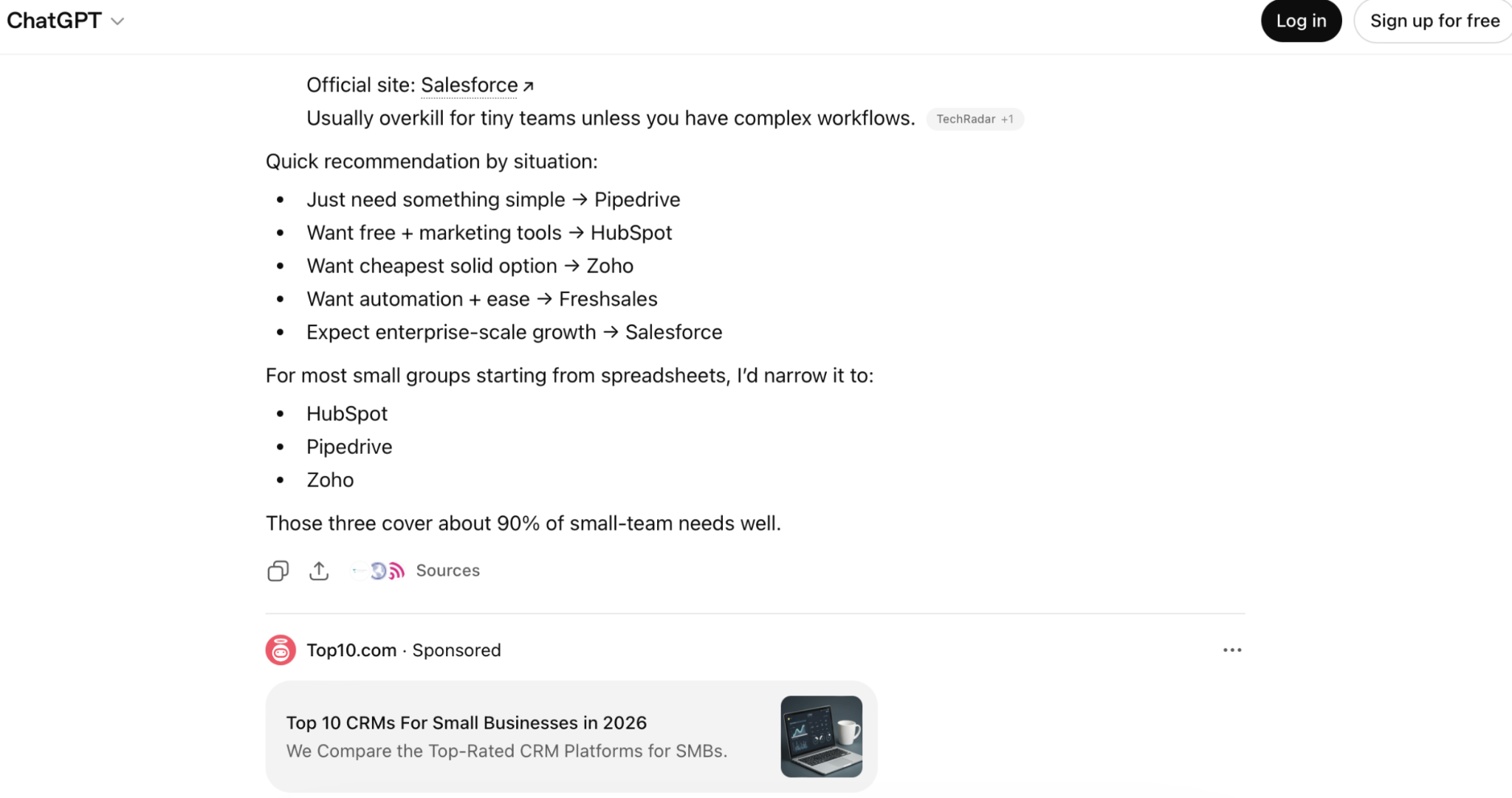
Image source:Search Engine Journal, “Screenshot of [Which CRM is the best?] on ChatGPT, May 2026.”
OpenAI’s hard line is that ads never change what ChatGPT actually says. This “answer independence” is the whole premise, and it shapes what the format can and can’t do.
There are two ways in:
- Self-serve: Head to ads.openai.com (Ads Manager Beta). Zero minimum spend.
- Partners: Major agencies (Dentsu, Omnicom, Publicis, WPP) or tech partners (Adobe, Criteo) if you prefer your existing enterprise tool stack.
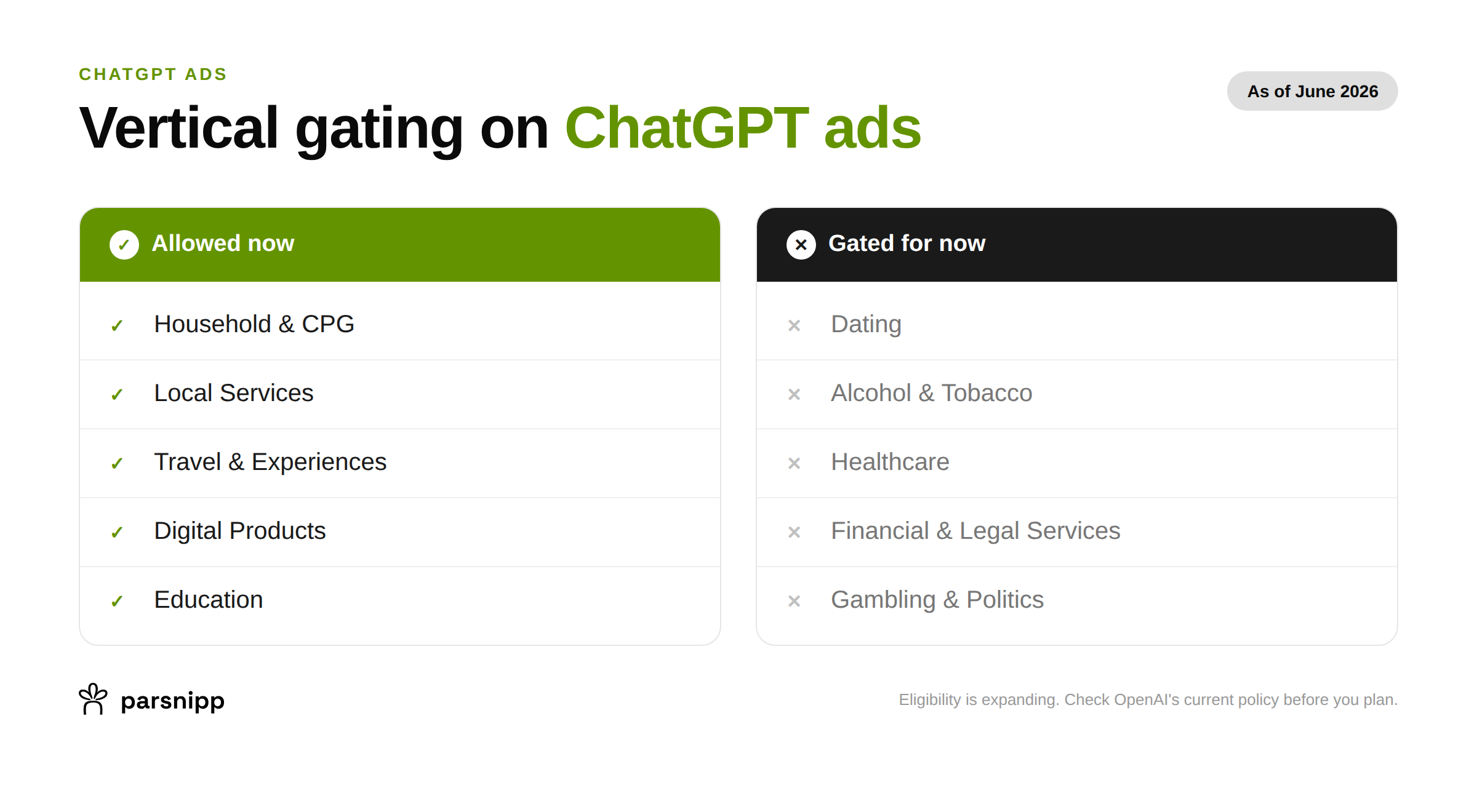
The Gated Categories
Not everyone is allowed to play yet.
How It Actually Works
The basic structure will feel incredibly familiar if you’ve ever run Google or Meta ads: Campaign → Ad Group → Ad.
But the setup has a few distinct hurdles.
The Onboarding Flow
- Sign up: Go to ads.openai.com using a corporate work email.
- Verify: You have to pass identity verification via Persona (the same vendor fintechs use). Expect this to take a few business days.
- Assets: Add your billing method, advertiser name, and a high-res favicon. (The favicon renders inside every single ad unit).
The Objectives & Pricing
You pick one of two paths:
- Reach (CPM): Billed on impressions. Early rates are floating roughly between $25 and $60 depending on how competitive your category is.
- Clicks (CPC): OpenAI suggests starting your bids around $3 to $5. Go much lower and you won’t clear delivery in the auction.
The auction itself is relevance-weighted and second-price. Translation: A tighter, highly relevant ad on a lower bid can easily beat a lazy ad backed by a massive budget.
The Twist: Context Hints
Here is the part that is different: You don’t target keywords. You write “context hints.”
Context hints are short, plain-language descriptions (up to 280 characters) of the exact conversations where your product belongs. You get one hint per ad group.
You are describing intent and situational context in the language people actually use with a chatbot, rather than stuffing a rigid match-type keyword list. This is the highest-leverage field in the entire setup. It rewards thinking in personas and user prompts rather than raw head terms.
The Creative Specs
Keep it incredibly tight:
- Title: 16 to 24 characters.
- Body Copy: 32 to 48 characters.
- Image: Minimum 256x256 pixels. Square works best.
- Landing Page: Needs to match the offer exactly. Generic homepages fail review almost instantly.
Build three to five variations, submit, and wait. Most ads clear review within 24 hours if your creative and landing pages are clean.
What You Can (and Can’t) Measure
The dashboard gives you standard aggregated reporting: impressions, clicks, spend, CTR, average CPC, average CPM, and conversions. You can export it all to CSV.
Note: There is a reporting lag of up to several hours. Don’t panic and kill a campaign at hour two because the dashboard reads zero.
For everything that happens post-click, you’ll need to install OpenAI’s pixel or wire up their Conversions API (server-side, identical in concept to Meta’s CAPI). That’s how you tie signups, purchases, and add-to-carts back to the ad. Standard UTMs pass through seamlessly, so your existing Google Analytics setup will track the traffic normally.
The Blind Spots
What you don’t get matters just as much:
- The conversation: The user’s prompt stays strictly private. You see the post-click signal, never the text they typed.
- Individual-level data: Everything is strictly aggregated.
- Third-party verification: There is no independent measurement yet. For now, you are grading OpenAI’s homework with OpenAI’s pen.
Early performance numbers are still soft and mostly secondhand, but the rough baseline looks like this: CTRs hover around 1% to 3%, CPMs are settling into the $20s to $30s, and CPCs are landing near the $3 to $5 range. Treat those as orientation, not benchmarks.
Where This is Headed
OpenAI is shipping incredibly fast.
In the near term, expect the performance toolkit to round out. Third-party measurement is actively in the works (the massive gap enterprise buyers are waiting for). CPA bidding is planned next, alongside optimization models that reward deeper, multi-turn conversations rather than accidental single clicks.
Geographic expansion is also moving. While self-serve is US-first today, the pilot quietly widened to the UK, Mexico, Japan, Brazil, and South Korea. More markets are a matter of when, not if.
The Real Play: Commerce Collision
The bigger macro move is the intersection with actual commerce.
OpenAI already has native, in-chat checkout running with Shopify, Etsy, and Walmart via its agentic commerce infrastructure. Once users can seamlessly discover and buy entirely inside the conversation thread, sponsored products and featured offers are a tiny step away.
That is the version of ChatGPT ads that actually threatens traditional retail media: the ad, the intent, and the transaction all happening on the exact same surface.
The revenue pressure underneath all of this points in one direction. The initial ad pilot reportedly pulled in over $100 million in just six weeks, and OpenAI’s ad targets for the next few years are massive. Read that as a standing commitment to continuously drop friction and launch new formats.
Two things won’t change anytime soon: premium paid tiers will stay ad-free, and answer independence remains non-negotiable. Both are load-bearing pillars for user trust. And trust is the one currency OpenAI cannot afford to spend.
The Short Version
You can run ChatGPT ads today with zero minimum spend and less than an hour of actual setup.
The mechanics are entirely familiar. The targeting is absolutely not. Context hints mean the winners will be the brands that deeply understand the specific conversations they want to show up in, and can actually prove what happens after the user clicks.
The measurement gap is real, and it’s exactly where the next year of this platform will be decided.
ChatGPT Ads Platform
Do you have a plan for testing advertising on ChatGPT? Parsnipp manages your entire AI ChatGPT Ads program from strategy and content, to ad purchase and execution, to analysis and reporting.