Agentic commerce, and what it can actually do right now

Agentic commerce is a simple idea buried under a complicated name. Strip it back and it’s this: instead of a person doing the shopping, an AI does it for them.
That’s the whole thing. The shopper stops being the one clicking through a site, weighing up tabs, typing in a card number. Software does that work instead. Sometimes with a human watching every step. Sometimes not.
Where it happens varies a lot. An agent might shop on a brand’s own store, or a retailer, or a marketplace like Amazon, or off a link someone tapped in a social feed. So “agentic commerce,” broadly, just means agent-led ecommerce, wherever it lands. Lots of doors into the same room.
We care about one of those doors more than the rest.
The slice we actually care about for agentic commerce
A big chunk of agent-led shopping is going to happen inside the AI platforms themselves. The large language models people now open out of habit when they want an answer. That’s the busiest corner of consumer AI, and more and more, it’s where the shopping starts.
Some of it runs through the model directly. The rest runs on the plumbing underneath, and that plumbing is not settling into one tidy standard. It’s splitting. OpenAI and Stripe have built one rail (they call it ACP). Google is pushing a different one with Shopify, Walmart and Target (UCP). There’s a separate standard just for the payment leg (AP2), and another from Anthropic for how an agent even talks to your systems in the first place (MCP). Four-plus competing protocols, no clear winner yet, and most brands are going to end up supporting more than one whether they like it or not.
That mess is the whole argument for not wiring your store to a single rail. You want to sit a layer above the protocols, not get married to one of them. That layer is the part we work on.
So set the plumbing aside for a second. The thing that actually decides whether you sell is the discipline sitting on top of it. If you sell something online, how do you set yourself up so an agent finds you, recommends you, and eventually buys from you? Two jobs, really. One is visibility: getting discovered by AI, getting recommended by it, then surviving a back-and-forth where the model is acting as the shopper’s guide. The other is technical readiness: inventory, price variants, currencies, regional offers, and the messy difference between an agent buying on your own site versus through a retail partner versus on Amazon. You need both. Most brands have started on neither.
So what can a shopper actually do on an LLM today?
This is the question that cuts through it. Forget the roadmaps on agentic commerce for a second. Open ChatGPT, or Gemini, or Perplexity, or Claude right now, and what can you do? Discover products, sure. Get recommendations. Compare. Check a price. And the one everyone really wants answered: can you just buy?
Here’s where it stands.
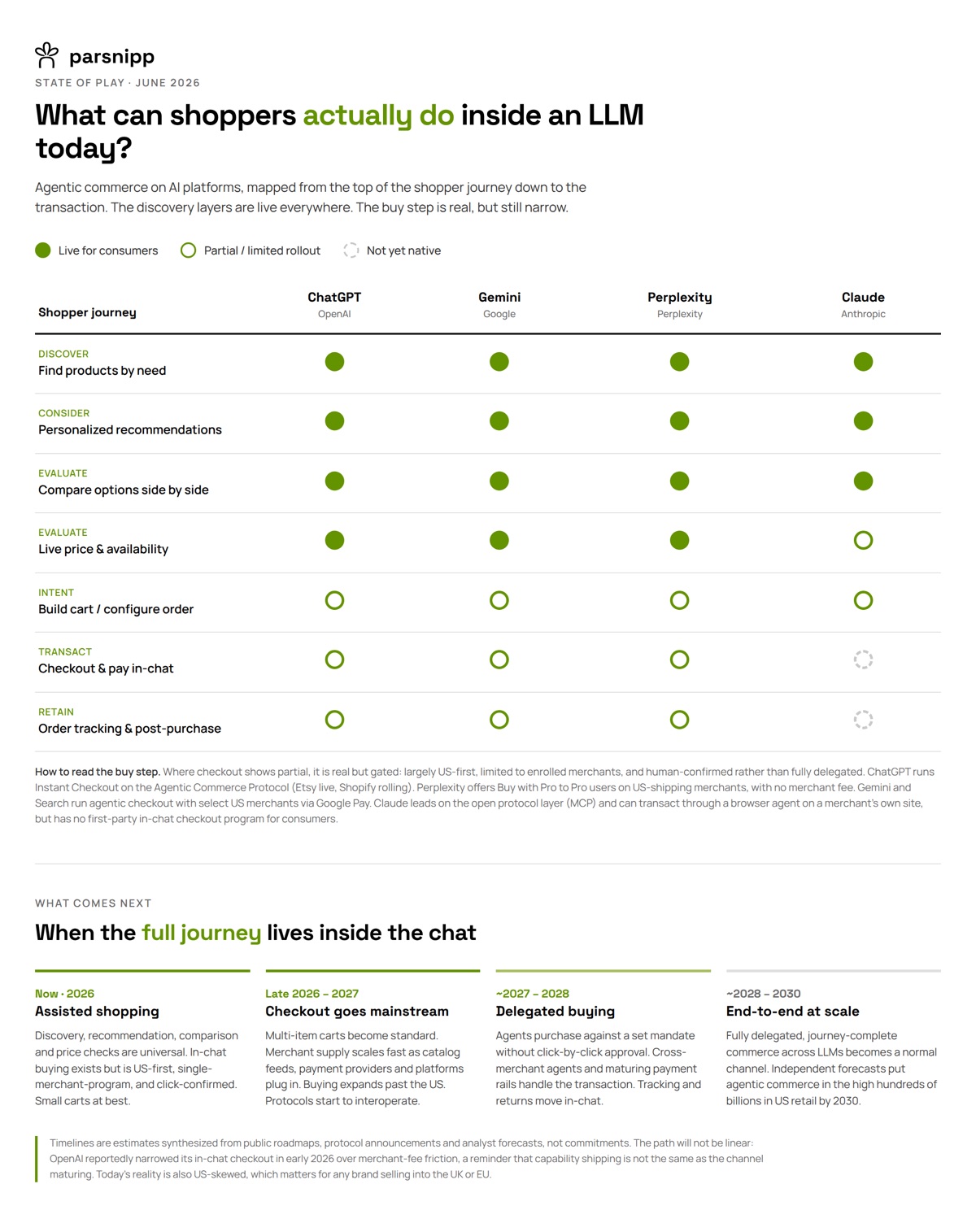
The top of the funnel is done. Discovery, recommendations, comparison, price checks, all of it works across every platform today. Settled.
The bottom of the funnel is where the pitch and the reality split. Buying inside the chat is real, but it’s narrow. ChatGPT runs Instant Checkout on the protocol it built with Stripe, Etsy first, Shopify rolling out behind it. Perplexity lets its Pro users check out without leaving the app, no merchant fee, free shipping it covers itself. Google does it through Search and Gemini with a handful of merchants and a “buy for me” button that still asks you to confirm. Claude is the odd one out. It owns the open protocol most of this runs on, but it has no buy button of its own.
Look at what those have in common. Nearly all US-first. Limited to merchants who’ve signed up. And confirmed by a human, not actually handed off. Which matters, because there’s a line worth holding: an agent that helps you decide and then dumps you on a checkout page is conversational commerce. Agentic commerce is when the agent finishes the job. By that test, most of what’s live on LLMs today is still the assisted version. The fully delegated kind is the thin end of the wedge. For now.
Now step back from the grid, because it’s pointing at something. The only stage that’s live everywhere is the top of the funnel. Discovery. Recommendation. Evaluation. That isn’t a detail. It means the competition right now isn’t happening at checkout at all. It’s happening earlier, at the moment an agent decides which handful of products to put in front of the shopper in the first place. The checkout race gets the headlines. The fight you can actually win today is being the product that gets recommended.
When the whole journey moves into the chat
The direction isn’t in doubt. The timing is where people get loose, so here’s the honest version. Right now we’re in the assisted phase. Over the next year or so, expect bigger carts, a lot more merchants plugging in, and checkout creeping past the US. After that, delegated buying, where the agent purchases against rules you’ve set without checking in at every step, once the payment rails are grown up enough to carry it. The full version, where the whole journey including the transaction happens inside the model, is a 2028-to-2030 thing. Not this year.
And it won’t move in a straight line. OpenAI reportedly pulled its in-chat checkout back in early 2026 over fee friction, which is a good reminder that shipping a feature and maturing a channel aren’t the same thing. If you sell into the UK or EU, remember almost all of this is US-first today. That should shape how hard you sprint.
What this means if you sell online
So don’t sit around waiting for the buy button to land on every platform for agentic commerce. The version of your store an agent can read, the one an AI can find, parse, trust and keep bringing up as a conversation unfolds, is the thing to build now. Get that right and you’re set for every phase that comes after it, checkout included. Skip it and none of the rails matter, because the agent never reaches your store to begin with.
That’s the visibility problem, being the product an AI recommends, and it’s the one Parsnipp is built around. Everything downstream waits on clearing it first.