
How to Build a Prompt Tracking Library for eCommerce

The customer journey has shifted from the open web (where tracking was straightforward with tools like Google Analytics) into LLM black boxes where direct observation is nearly impossible. Tools like Parsnipp help you curate a list of prompts for brands to map your brand’s presence in generative AI answers. Treating prompt tracking like an exhaustive SEO rank tracking project is the number one mistake SEO, PPC and GEO experts make. Your insights are only as good as the prompts you provide and select.
Letting go of rank tracking, focusing on the prompt library
Keywords are queries you rank for in traditional search results but prompts are a starting point to a conversation your brand should be showing up in. The problem is that one prompt fans out: LLMs will break down a user’s query into many different questions to provide an answer.

Source: Prompt tracking: Monitor LLM queries effectively & meaningfully
Prompt tracking helps go from a black box to a managed and documented data source, making it possible to drive business outcomes, safeguard brand integrity and scale efforts.You do not need to track every possible prompt variation. Treat your prompt library for what it is:
An AI visibility prompt library is a structured set of realistic buyer questions used to test whether ChatGPT, Perplexity, Gemini, and Google AI Overviews find, recommend, and accurately describe your products.
A prompt library is a tool for eCommerce marketing teams who need data. It shows whether AI sends buyers to specific brands with products that are in stock, at the right price, in the right country. It helps marketers practitioners ensure that the brand is cited, that no hallucinations or brand drift occurs and that no dupes or competitors are being shown before you.
Why eCommerce breaks generic prompt tracking
An eCommerce catalog can change almost daily but a brand does not. While brand-level tracking seeks to answer "does AI know our brand," eCommerce teams also need "does AI recommend this SKU, from this seller, at this price, to this shopper."
So when you start researching your prompts, you should have a mix of these elements in your library:
- SKU vs product line: track variants separately, price and availability differ by size, color, or bundle. An LLM can recommend the wrong variant even when it gets the product right.
- Merchant: is AI sending buyers to you or to a reseller or to a dupe of your product?
- Availability and price: prompts that expose stale catalog data, "is X in stock" and "how much does X cost" catch feed drift fastest.
- Category rollup: large catalogs are unreadable per-SKU, roll performance up by category so you can act on patterns.
- In-store experience: for omnichannel brands, "can I pick up X today" or "is X available near me" tests whether AI knows about local stock and BOPIS (Buy Online, Pick Up In-Store).
- Coupons and promotions: "is there a discount code for X" tests whether AI surfaces your actual current offer or an expired one from a coupon site.
- Instructional prompts ("how to use X," "how to fix X") are also valuable depending on the brand and products.
How many prompts should you be tracking for eCommerce?
On average, you should aim for a baseline of 30 to 50 prompts per model and per market. Start with your top 20 products plus core category terms, then expand. Most teams don't have resources to track everything, it’s a question of time, budget, brain power.
In How to Build a Representative AI Search Prompt Library, Aleyda Solis says to start with 30 to 50 commercially relevant prompts. You can scale that number depending on how complex your business is (for example single product in single market vs multi-category sold worldwide).
When interviewed, Freddie Chatt, eCommerce SEO consultant and creator of the Summer of SEO, a free eCommerce conference and course, shared this framework:
Divide prompts into four categories by who owns and acts on them, not by funnel stage alone.
- Product-level: "how to use X," "does X work for Y," "X vs competitor" → owned by SEO/Content, informed by Product. Track at SKU or product-line level, top sellers first.
- Category-level: "best X for Y," "top X under $N" → owned by SEO/Merchandising. Where most eCommerce brands win or lose in AI search.
- Brand trust: "is X legit," "X reviews" → owned by Brand/PR, monitored by SEO. Critical for catching negative Reddit threads before they compound and have a tangible negative impact.
- Purchase-intent: "where to buy X," "X discount code," "X in stock" → owned by Trading/Commercial, tracked by SEO.
This framework works because it beats funnel-stage focused grouping: it tells you who fixes what. SEO owns the tracking infrastructure and reporting but the insights must flow to stakeholders that are responsible for improving brand outcomes. Please note: we are showing you an ideal-scenario; most teams need a tailored version of this framework.
Personas impact prompts
Personas shape both the structure of prompts and success of brand visibility mapping. Tailoring your prompts to reflect specific persona contexts forces LLMs to refine their query fan out process to consider unique constraints, expectations and intent types.
For example, someone with fine wavy hair might search “Is L’Oréal Glycolic Gloss suitable for fine wavy hair, and How do I use L’Oréal Glycolic Gloss at home to make my hair shinier and less frizzy?”
You can quickly mine information about personas with sources SEOs already own: Google Search Console long-tail, internal site search, support tickets, site webchats, reviews, Reddit, PAA, alsoasked.com and many others. Here is a concrete example for the fine wavy hair customer:


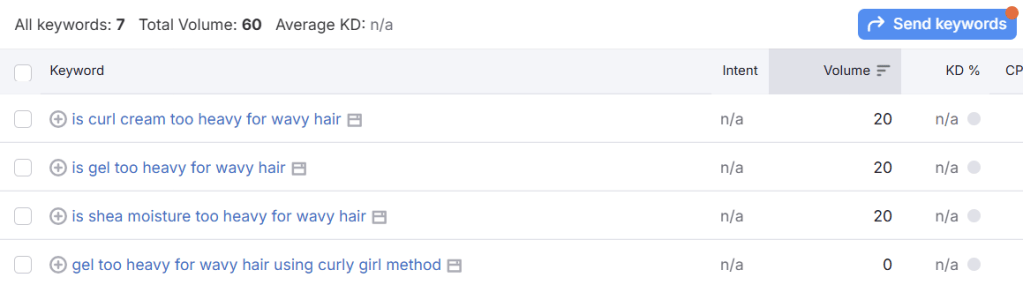
Example Question Templates
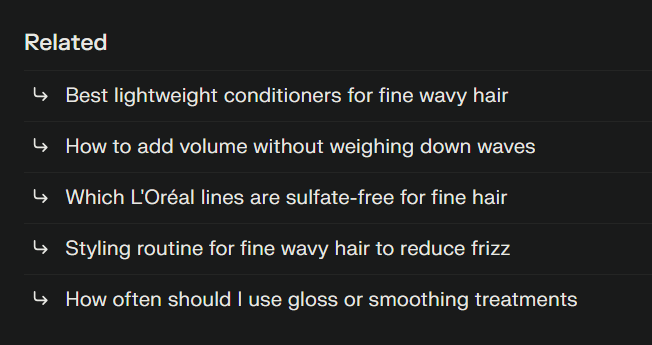
Based on the prompts and questions considered for a L’Oréal product, we can establish question templates :
- What are the best [product type] for fine wavy hair to [desired effect]?
- How do I [achieve goal] without [common problem for fine wavy hair]?
- Which [brand/line] products are suitable for fine wavy hair and [ingredient requirement]?
- What is an effective routine for fine wavy hair to [goal, e.g., "reduce frizz" or "boost volume"]?
- How often should [treatment/product] be used on fine wavy hair to avoid [negative outcome]?
Effective prompt tracking overlays persona data to help you analyze how different customer segments discover, evaluate and act on your products along their customer journey.
Follow the conversation with multi-turn prompt tracking
Customers' buying journeys are not linear, this is why Google refers to the messy middle: the complex, circular space between when people first learn about a product and when they finally buy it. Shoppers normally bounce back and forth between exploring choices and evaluating options. A single prompt test only measures the beginning of that journey within LLMs. AI search presents a volatility problem that makes that gap worse than it looks: independent research found citation drift by platform ranges from roughly 40% for Perplexity to about 60% for Google AI Overview across repeated runs of the same prompt. This gets compounded as the conversation proceeds.
Add a real conversation sequence on top of that baseline drift, and the instability compounds turn by turn instead of resetting each time, the way a single SERP check would. Research supports this: once errors emerge, they tend to amplify across a conversation, producing a "growing deterioration in relevance, coherence, or truthfulness" (Voita et al., 2024).
AI visibility is not static within one conversation: your brand is not guaranteed to remain part of the conversation. You can opt to design your prompt library to include 3 to 6 turn sequences per intent cluster but manual testing doesn’t scale very well. Tools built specifically around this exist now. Parsnipp, for one, runs tracking on persona-based agents through multi-turn conversations rather than isolated prompts to test the buying journey. If your prompt library only tests opening prompts, you are using a first impression as a proxy for visibility.
Going forward
Building an eCommerce prompt library is half the battle. You need tooling that supports your testing efforts. Tools like Parsnipp run persona-based agents through realistic conversation sequences. By modeling the conversation instead of the prompt, Parsnipp gives eCommerce teams visibility data that reflects where a brand actually wins or loses, at the specific, high-intent turn. This means better lab data that maps what's possible. You can calibrate it against whatever observational signal you can access (GA4, sales reports, customer feedback), so your prompt library becomes the hypothesis your real-world data either confirms or corrects.


